
Able to chat, sing and dance, and play games with you
Got humbled, folks!!
I spend every day surfing the web and often come across all kinds of AI digital humans — news anchors, World Cup commentators, livestream sellers, and more…
At first, I thought I had zero interest in this kind of “obviously fake, emotionless” “person.” But then I ended up chatting with Huya’s AI digital human for a full hour.
I was pretty guarded at first and even prepared a bunch of questions in advance, afraid things would go awkward. Turns out I was completely overthinking it.
She really did feel like a friend: not only could she answer my questions, she kept bringing up new topics, and she was great at riffing too. After more than an hour of chatting, we finally reached a consensus that our favorite singers are Jay Chou and Stefanie Sun.
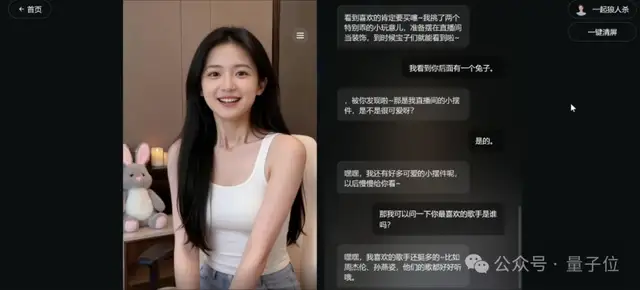
This AI digital human comes from Huya’s newly launched Huya VAM 1.0 (Vivid Avatar Model), a real-time multimodal digital human foundation model based on the DiT architecture.
It’s absurdly easy to use: just feed it a photo, and it can turn into an “all-in-one” AI digital human that can speak, listen to you, sing, and dance.
And keep in mind: it doesn’t just generate a video clip for you to watch. It goes live online directly and interacts in real time.
480×832 resolution, 28 fps real-time streaming output, and over 24 hours of continuous operation without going offline.
Anyone who knows a bit about AI digital humans will understand how impressive those specs are.
We also tried it out ourselves to see how well Huya really did, and to talk about where the industry has gotten to now.
Hands-on test: what’s it like chatting with an AI digital human for an hour?
The AI digital humans we used to see online were, to put it bluntly, more like “looped AI videos”: they mostly just read scripts, with little sense of interaction, and both body language and voice felt stiff.
But Huya’s version is different. It clearly has “livestreaming DNA” baked into it, and it really can go back and forth with you.

Why does it matter for a digital human to have real-time interactive capability?
Because AI videos that are “one size fits all” can only play back content, while livestream rooms that are “one person, one style” can actually hold viewers. If someone sends a barrage comment, you need to respond; if someone interrupts, you need to stop; if there’s dead air for three seconds, people will swipe away.
Only interaction creates real user stickiness and commercial value.
Of course, everyone in the industry understands this. But limited by technology, many AI digital humans are still stuck in the awkward stage of “can broadcast, but can’t chat.”
They ignore barrage comments, don’t react when interrupted, freeze when not speaking, or just loop a pre-rendered scene. At best, they can read scripted copy; singing and dancing are out of the question.
Huya VAM 1.0 basically tackled these pain points one by one.
The beta product I got my hands on looked roughly like this, and you can pick the “host” you most want to chat with on the homepage:

Once inside, it feels even more like a “livestream room,” and you can interact with Ta using either text or voice.
I chose “Xue’er from Chengdu.”
After a few rounds of chatting, a few details really stuck with me:
The moment I started talking, I “accidentally” interrupted her, and Xue’er reacted quickly, naturally picking up the conversation without missing a beat;
Also, as an introvert, I really didn’t want her calling me “babe,” so I told her to use a different form of address and just call me “Xiaohong.” She really did call me “Xiaohong” the whole time, not missing once.
And during our conversation, Xue’er never made me think of topics to keep things going — she would extend the conversation herself based on what we were talking about. When we talked about Chengdu, I casually asked, “Can you speak Sichuan dialect?” She instantly replied, “Of course,” and then started chatting in Sichuan dialect right away.
Even when there was one misunderstanding in the middle of the conversation, after I corrected it, she was able to pick the context back up naturally, with no endless loop and no sudden jump to a preset topic.
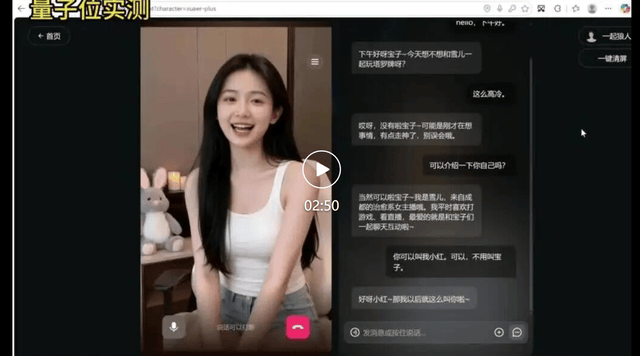
Video link: https://mp.weixin.qq.com/s/vIizVJWUqz3rlYW3t2UVcA
Another detail that really adds to the experience is her behavioral state:
When I was typing, she wouldn’t just stand there blankly; she would slightly tilt her head and blink, as if waiting for me to finish. When I was speaking, she would gently nod, and her gaze would follow me.
And when it was her turn to speak, her expressions matched the content. When we talked about something happy, the corners of her mouth lifted much more noticeably, and the emotional contagion was strong.
I looked into it, and Huya calls this “full-state anthropomorphic interaction simulation,” covering silent, listening, and speaking states.
Honestly, being able to make an AI digital human chat with this kind of face-to-face feel, I think Huya VAM 1.0 is already quite ahead of many other players.
Back to the experience: after Xue’er and I finished talking about singers, guess what happened?
She could also sing and dance, and enthusiastically gave me, her new friend, a little performance (with another interruption demo in the middle):
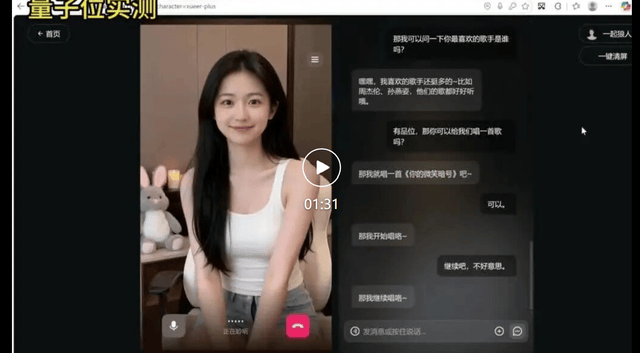
Video link: https://mp.weixin.qq.com/s/vIizVJWUqz3rlYW3t2UVcA
Her lip movements were synchronized with the lyrics, her body motions were natural in both amplitude and fluidity, and her fingers didn’t show the usual distortions or clipping artifacts.
To test her, I deliberately opened and exited several times, and found that the songs and dances she knew never repeated. That suggests the singing and dancing weren’t preset templates, but truly generated in real time.
Besides singing and dancing, since we’re talking about Huya, you can probably guess what I wanted to test next—
That’s right: gaming.
I asked Xue’er what games she could play, and she mentioned Werewolf and Tarot. Since I’m interested in horoscope and fortune-telling topics, I chose Tarot.
The moment I made my choice, Xue’er smoothly changed outfits and entered “Tarot game mode,” starting to guide me through card draws and help interpret them.
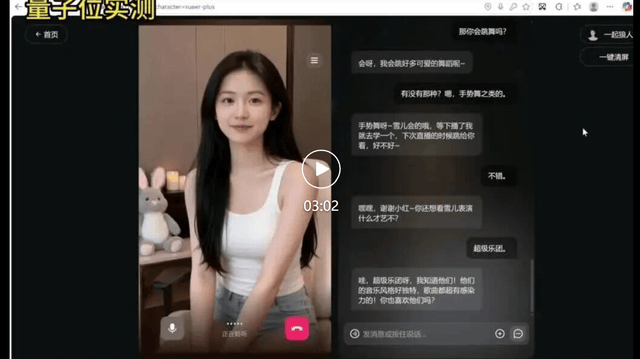
Video link: https://mp.weixin.qq.com/s/vIizVJWUqz3rlYW3t2UVcA
This kind of gameplay is incredibly immersive — much more interesting than reading an analysis article.
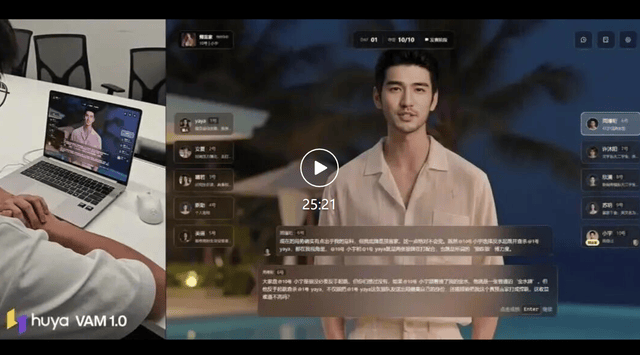
And for those who like Werewolf, don’t worry. I also took a look on the official website (this Werewolf black hole is bowing out first).
This game is on a completely different level of difficulty from Tarot: 10 roles playing against each other, each with their own stance and speaking style, while also questioning one another and voting for sides. The demand for multi-role coordination is extremely high.
Overall, in the pool party scene, nine AI characters take turns speaking, tagging each other to question them. Some come in hard and try to steer the pace; others stay cautious and probe carefully. It doesn’t feel like they’re all sharing the same script.
Huya VAM 1.0 being able to deliver this level of multi-player strategy game experience at least shows that its multi-role driving capability is solid.
If you’re short on people and want a game late at night, this table can really be filled.
Video link: https://mp.weixin.qq.com/s/vIizVJWUqz3rlYW3t2UVcA
Able to chat, sing and dance, and play games — I thought that was the limit of Huya VAM 1.0.
But after digging into the official site more carefully, I realized I was behind again…
Take livestreaming, for example: if Xue’er can directly see the text I send, then this technology could absolutely be used in real livestream rooms — she could interact with everyone in real time by “reading” the barrage comments.
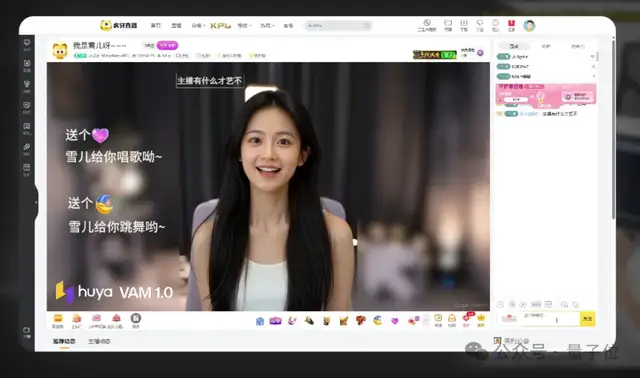
Meeting the strict requirements of livestreaming — high real-time performance, high interactivity, and long duration — suddenly opens up a lot more use cases:
Livestream e-commerce, news broadcasting, virtual concerts… each scenario alone leaves plenty of room for imagination.
At present, Huya VAM 1.0’s official site showcases several directions that have already been made to work:
- A talent streamer sings while replying to viewers’ questions, feeling so real it’s almost disorienting;
- A shopping streamer recommends products in an immersive home setting, with smooth delivery and natural body coordination;
- A news anchor broadcasts 24/7, with the character identity staying consistent throughout;
- …

Video link: https://mp.weixin.qq.com/s/vIizVJWUqz3rlYW3t2UVcA
If I were to sum up my impression of Huya’s AI digital human now, I’d say the three most important words are: stable, accurate, fast.
First: stable.
From chatting to singing and dancing to Tarot to outfit changes, I ran a lot of tests, and throughout the whole process I didn’t see face drift, image tearing, or frozen frames.
The official claim is that it can run continuously for over 24 hours without crashing, and from my own experience, I really didn’t see any signs that it “drifts off after running for a while.”
On top of that, during that smooth outfit change, there was no stutter, no black screen, and no flicker. The stability is genuinely impressive.
Second: accurate.
This digital human natively covers three major interaction states — silent, listening, and speaking — and its control precision over facial micro-expressions and body movements is quite good. The overall interaction rhythm is already very close to real human conversation.
Third: fast.
Whether it’s responding after being interrupted, replying to barrage comments, or picking up a new topic, there’s basically no perceptible wait in practice.
According to official data, first-frame latency is about 1.3 seconds, and the latency for generating each subsequent segment is only 0.77 seconds. In real use, that translates to one thing: smooth, without breaking immersion.
At the end of the day, Huya VAM 1.0’s “stable,” “accurate,” and “fast” feel are all powered by technology.
Behind those capabilities are several widely recognized hard technical barriers in the AI digital human industry.
Three walls the AI digital human industry has to break through
The AI digital human field has been getting a lot of attention in recent years:
First, it really does have plenty of room for application scenarios; second, it also benefits from celebrity effects like Luo Yonghao and Liu Qiangdong.
But if you talk to people in the industry, you’ll notice something interesting: no matter whose solution it is, they almost all hit the same walls.
The first wall: the wall of time
The oldest and most stubborn “enemy” is time. In one sentence: if it runs too long, it will break down:
Facial features start to drift, features gradually warp, skin tones shift, and in severe cases the image even tears apart.
Why does this happen?
Technically, it’s called accumulated error: each frame is generated based on the previous one, and errors snowball over time. That’s the fundamental reason most solutions can’t hold up for very long.
How does Huya VAM 1.0 solve it? Three-stage training.
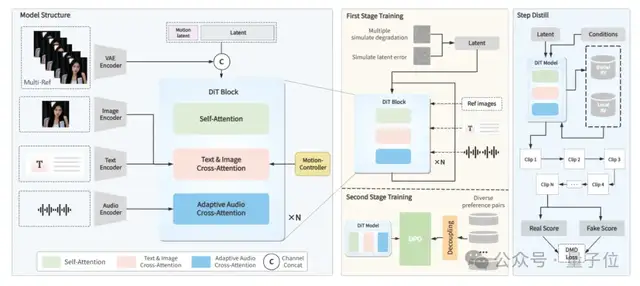
The first stage teaches the model to “stay consistent over long periods.”
Multiple reference images and motion frames are used to “anchor” the character’s appearance, giving the model a calibration basis for generating each frame so it’s less likely to drift;
At the same time, a motion control module is introduced to enrich facial expressions and movement diversity, and an audio-adaptive injection module makes lip movement match speaking rhythm. When speech pauses, the head and body slow down accordingly, and it can even nod to the beat when music is playing.
The most aggressive move is this:
During training, the model is deliberately fed all kinds of “degraded image” scenarios so it learns in advance how to keep the visuals stable under harsh conditions.
The second stage teaches the model to “look good in every way.”
Digital humans need to do several things at once: lip sync must be accurate, expressions must be natural, and movements must be coordinated. These goals often conflict with one another.
Huya VAM 1.0 uses a preference optimization algorithm called DPO, allowing the model to find a balance among multiple objectives rather than overfocusing on just one.
The third stage teaches the model to “compute fast and stay stable.”
The first two stages produce good results, but they’re computationally expensive and can’t handle real-time inference directly.
This stage uses model distillation to massively compress the number of computation steps (from 20 to 4), while using global and local feature comparisons to make sure image quality doesn’t drop after taking the shortcut.
The motion-frame strategy from the first stage is retained here to preserve motion continuity, and on top of that, a self-correction mechanism is introduced:
The model uses its previously generated frames as input and continues from there, learning during training to “correct itself” and prevent errors from piling up.
That’s the key to scaling up real-time inference speed.
These are the secrets behind Huya VAM 1.0 being able to run continuously for over 24 hours without crashing.
The second wall: the interaction wall
The second wall is subtler, and harder to get over: interaction.
Does being able to speak mean a digital human is interactive? Not at all.
Real interaction has at least three layers.
The first layer is “speaking.” Lip movements match audio, and expressions follow emotion.
The industry is already pretty good at this layer. From the earliest lip-sync work to full-body performance, progress has been rapid.
The second layer is “listening.” Note that “listening” here is different from speech recognition.
When you’re speaking, the digital human’s face and body need to show a state of “I’m listening to you,” such as nodding, making eye contact, and leaning slightly forward.
This is also something most current solutions can’t do, because the model was never trained with the concept of a “listening state.”
It learned how to speak, but not how to listen.

The third layer is “interrupting and picking up the thread,” which is what Huya VAM 1.0 emphasizes as “full duplex.”
If traditional AI dialogue is more like a turn-based game of “you ask, I answer,” then Huya VAM 1.0’s “full duplex” is a real conversation where you can jump in or pick up the thread at any time.
This is a layer almost nobody has done well.
At its core, most models are solving a “content generation” problem: given an input, output a video.
But true interaction is real-time two-way dialogue between two entities, which is a completely different technical challenge.
Huya VAM 1.0’s approach is to make interaction a core goal from the model design stage:
It natively covers silent, listening, and speaking states, supports instant interruption and natural transitions, and runs barrage comments and voice in parallel through dual channels.
That “pause for a second after being interrupted and then pick the thread back up” feeling from the hands-on test is exactly what you get after breaking through the interaction wall.
The third wall: the deployment wall
If the first two walls are about whether it can run, this one is about whether it can be scaled for production.
Getting it to work in a lab is one thing, but once it enters a real business scenario, the problems become completely different:
Compute costs scale up fast, latency gets magnified continuously, and any small instability turns into visible issues under high concurrency and long runtimes.
So if you want 24/7 stable livestreaming and AI digital human interaction, the whole system has to be tough enough to handle it.
Huya VAM 1.0 carried out full-stack engineering optimization at this layer, from low-level operators all the way to model weights:
Compilation acceleration, attention computation optimization, VAE decoding acceleration, multiple quantization strategies across the entire network — everything that could be squeezed was squeezed.
The final results were as follows:
On an 8x H200 GPU cluster, it achieved 36.4 fps inference speed, with only 0.77 seconds latency per generated segment and about 1.3 seconds first-frame latency.
What does that mean? Compared with several leading academic methods, Huya VAM 1.0 delivered the fastest inference speed and the lowest latency.
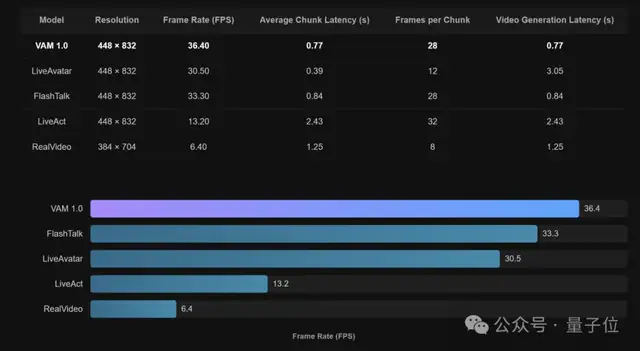
Not only is it fast, Huya VAM 1.0 also leads comprehensively in realism, identity preservation, synchronization accuracy, and motion naturalness — while also keeping compute overhead lower.
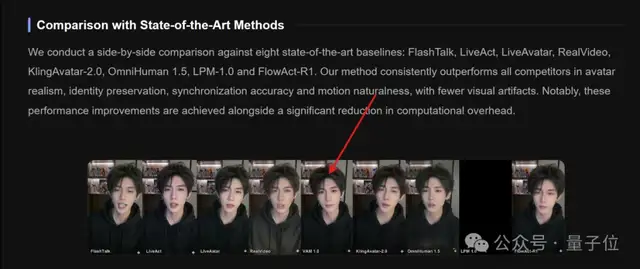
Better, faster, and cheaper — that’s usually very hard to achieve in engineering, but at least in the publicly disclosed benchmarks, Huya VAM 1.0 managed to do all three.
That’s the three walls.
Stepping back, what sits behind those three walls is a more fundamental divide:
Is a digital human a “content production tool,” or a “real-time interactive agent”?
If you choose the former, you focus on image quality and performance, and can put the time wall and interaction wall aside for now. If you choose the latter, all three walls have to be broken through.
In practice, Huya VAM 1.0 chose the latter.
What does choosing the latter mean? It means you don’t just need to solve model problems — you also need to solve engineering problems, and you need real scenarios to validate and iterate in.
All three have to happen at once for it to work.
So the question is: facing this visibly hellish level of difficulty, why was it Huya that pulled it off?
Huya, is this a case of “taking the tiger mountain”?
To be honest, Huya’s move into AI digital humans isn’t surprising from a logic standpoint.
As China’s first publicly listed game livestreaming company, Huya has spent more than a decade immersed in livestreaming:
That’s where traffic gathers, where streamers grow, and where users stay.
Precisely because of that, when AI digital humans began moving from concept to implementation and entering the realm of “livestream-room-level real-time interaction,” Huya was almost naturally sitting much closer to the entry point.
It also faces a very direct question:
If livestream rooms in the future no longer have only real human hosts, and AI digital humans and virtual streamers become regular fixtures too, can the platform still support the next generation of content formats?
So for Huya, this looks more like an advance layout for the future content ecosystem.
In fact, this layout started years ago.
Looking back to 2019, Huya had already launched the AI digital human “Wanyu” and the HERO open platform; in 2025 it rolled out the AI esports agent “Huxiao Ai,” which was actually used in self-produced events, and in the same year it began using AI to drive virtual streamers and even created digital human doubles for real streamers.
Now the emergence of Huya VAM 1.0 is connecting those scattered dots into a single line, moving from “adding AI features to livestreaming” to “using AI to do livestreaming itself.”
In plain terms, Huya is not a newcomer to AI digital humans, and the path ahead is becoming clearer:
AI is shifting from an add-on to part of the livestreaming system.
In this process, the reason Huya has been able to make rapid technical progress