
AI is entering biomanufacturing, and what’s really missing is not a smarter brain, but an interface that connects the digital and physical worlds.
Tian Yanlin, from Aofeisi
QbitAI | Official WeChat account QbitAI
AI today is indeed starting to look a lot like an “all-around researcher.”
Writing code, generating images, and making videos are just the basics.
It has even begun to take part in scientific research: reading papers, proposing hypotheses, analyzing experimental data, and even helping scientists design the next round of experiments.
But the problem is that if you actually put AI into a biology lab, things could look very different.

After all, in a biology lab, actions like pipetting, recording temperatures, and transferring petri dishes may seem simple, but they all demand extremely high precision.
A wrong unit, a slight parameter deviation, or an incorrect step order can make an experiment fail outright.
AI can help scientists design experiments, but it’s still very hard for it to actually carry them out. Where’s the bottleneck?
Too dumb? Not really.
Not long ago, after Claude Fable 5, described as Anthropic’s “strongest model ever,” was launched, it was abruptly halted over safety concerns.

Powerful reasoning comes with both scientific value and safety risks. That is the biggest awkward spot for AI in scientific research.
Sometimes it can indeed tell you “what you should do,” but most of the time, it may not truly know “what is actually happening in the experiment.”
It turns out that even a stronger brain is not enough without a unified biological experiment language that AI can understand.
Over the past two years, while AI4Science has been a hot topic, there have been few cases that have truly entered the core industrial workflow.
If biology wants to contribute more value to industry, lab work must be engineered and repeatable.
Recently, a study published on bioRxiv, the global biological preprint repository, offered the industry a new possibility.
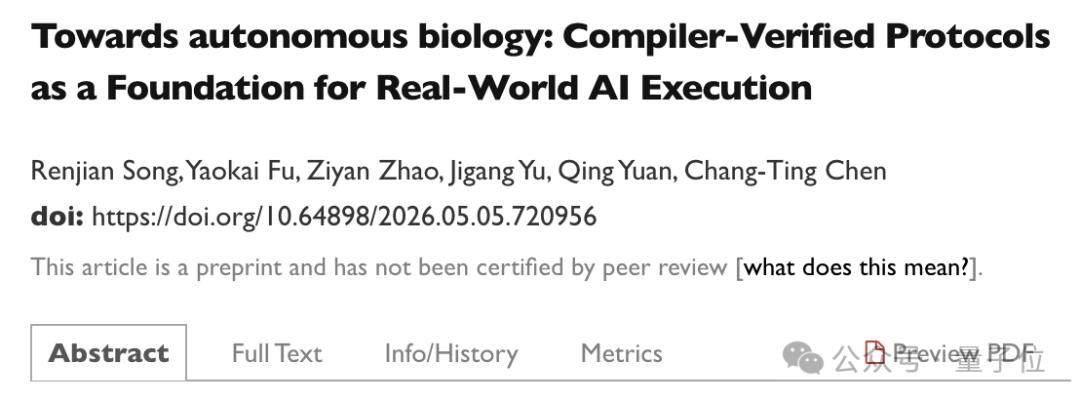
The paper mainly introduces two things:
- AI can’t understand biological experiments? Then let’s build a unified, easy-to-understand biological protocol language — Biology Protocol Language (BPL).
- Traditional biological experimental programming languages have a high barrier to entry, making it hard for researchers to independently write and operate related code? No problem, just hand everything over to the code generation tool BPL-COGEN.
I checked the authors’ affiliation: they all come from Bota Biosciences, a Chinese biomanufacturing company.
Well, let the professionals handle professional work. (doge)
Why Has AI Still Not Entered Biomanufacturing?
Believe it or not.
We’re already in the AI-for-everyone era, yet many top biologists are still stuck at the lab bench.
Between pipettes and petri dishes, they spend a huge amount of time every day doing manual work.
These tools form the core productivity of modern biomanufacturing, but they also create the biggest bottleneck.
The reason is simple: biological experiments are inherently hard to standardize.

△AI generated
For the same experiment, different lab personnel have different operating habits; for the same device, different vendors use different interface formats; for the same experimental record, different teams structure data completely differently.
As a result, the most valuable know-how in the lab is largely trapped in people’s heads.
An experiment that succeeds in Lab A may simply fail to reproduce somewhere else.
Data is hard to accumulate, workflows are hard to replicate, and automation is hard to close into a loop.
The entire industry has long depended on the DBTL (Design-Build-Test-Learn) cycle.
But this chain still relies heavily on human experience.
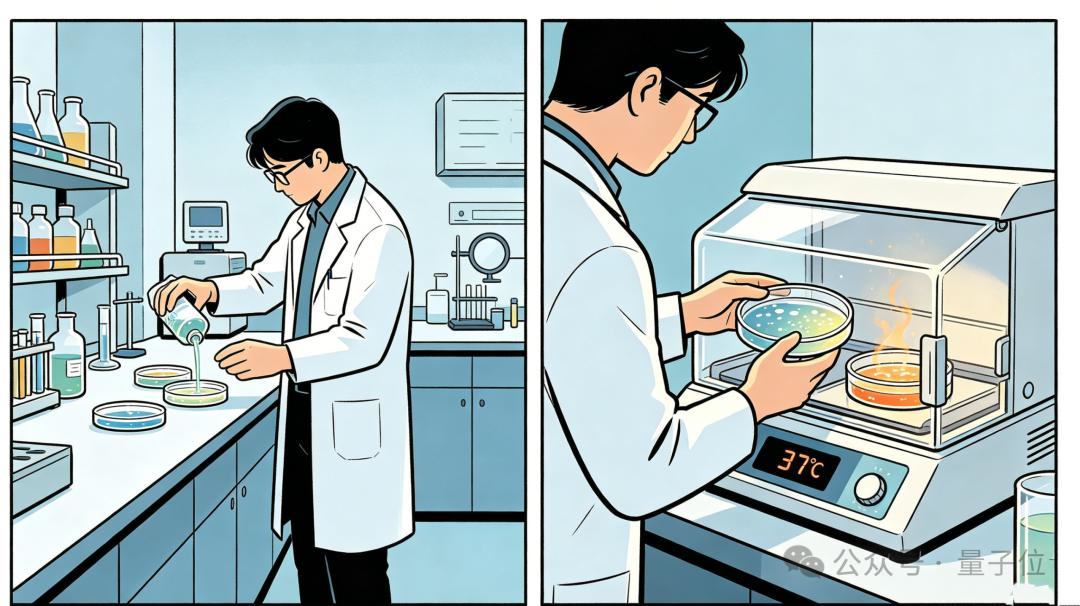
At this stage, biology still relies on natural-language text to write experimental protocols.
For example: add 5 mL of reagent, incubate at 37 degrees for a period of time, and mix gently.
△AI generated
For humans, this kind of description is fine. For machines, it practically says nothing.
Add 5 mL where? Incubate for how long? How gentle is “gently”?
Every ambiguous expression introduces execution uncertainty.
In software engineering, chip design, and similar industries, these problems were solved decades ago.
Programmers don’t write “run it roughly,” and chip engineers don’t write “connect it about like this.”
They use standardized, compilable, and verifiable description languages. Only then can systems run reliably.
What biomanufacturing has lacked for a long time is exactly that kind of language.
Over the past two decades, academia has not been idle.
Standardization efforts such as BioCoder, Autoprotocol, Antha, and LabOP have emerged one after another.
But they either had limited expressiveness, required binding to specific equipment, or were too difficult to use.

Most importantly, two major problems have never been solved:
First, automatic generation was insufficient and the solutions were poorly generalized, forcing researchers to manually write related scripts and configurations, which led to long development cycles.
Second, the systems could not guarantee sufficiently high execution precision.
For years, biomanufacturing has wanted to embrace AI but has also been constrained by AI, and AI4Science has kept getting stuck at the last mile.
BPL Is Here!
Alex Song, Director of AI and Computation at Bota Biosciences, raised a very real issue.
Even many top-tier papers, published in journals like Nature and Science, are still hard for others to reproduce.
It’s not that the scientific principles are undisclosed; it’s that the experimental process lacks a unified way to be expressed.
For Bota, this issue is even more urgent, because they are themselves doing AI-driven biomanufacturing.
In the past, when Bota built AI, the outputs of large models were also natural language. So how do they interact with automated equipment in the lab? There has to be a “translation” step in between.
You wouldn’t want a robot to run an experiment that can be done today but not tomorrow, right?
Against this backdrop, Bota developed the BPL language.
If we had to find an analogy, BPL is to biological experiments what Python is to programming.
What people see is the application; what the terminal sees is code.

The same idea applies here: researchers see an experimental protocol, while lab equipment sees standardized protocol code.
Only after this transformation can experiments be engineered and repeated.
More importantly, BPL is not just a descriptive language; it is also a compilable language.
Anyone who has written code knows that programs must be compiled before they run. The compiler checks for syntax errors, logic errors, and runtime risks.
BPL works the same way.
Before an experiment starts, it first undergoes a round of software-level experimental “simulation”: checking whether units are correct, whether reagents exist, whether container capacity is exceeded, and whether there are logical conflicts between steps.
If a problem is found, the system throws an error immediately instead of waiting for the whole experiment to fail and then starting over.
This means the high cost of trial and error in the lab is now resolved ahead of time in the digital world.

But language alone is not enough. What about writing the code? You can’t expect every biologist to become a programmer, right?
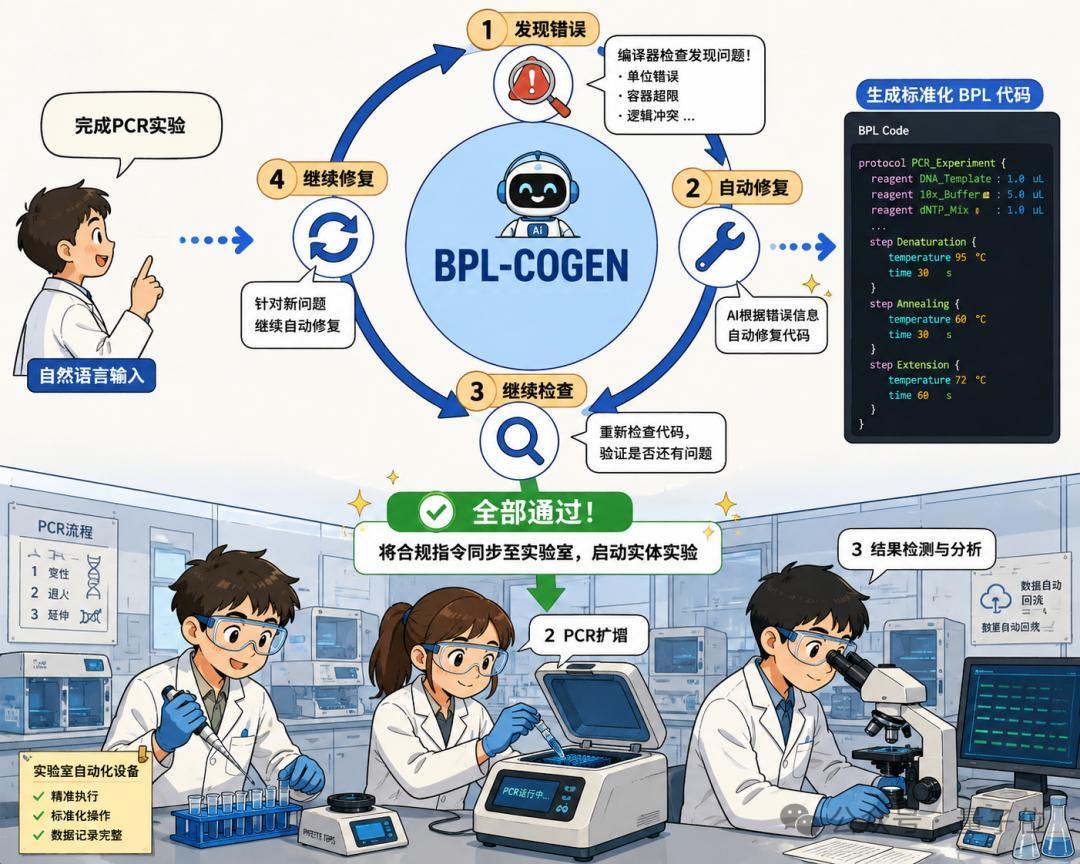
Based on BPL, Bota further developed BPL-COGEN.
For example, you tell it: complete a PCR experiment.
The system automatically translates the natural-language request into standardized BPL code, then enters the compiler verification stage:
find an error — auto-fix — keep checking — keep fixing, until the code passes compilation and simulation checks. Only then does the system sync the compliant instructions to the lab and launch the physical experiment.
△AI generated
The whole logic is very similar to Claude Code or Cursor. The only difference is that what’s being written is not software code, but experimental code.
That said, is BPL-COGEN actually reliable?
The paper says that to quantify the precision of the generated protocols, the team selected 30 classic experimental protocols from Nature Protocols, covering areas such as molecular biology, cell culture, and biochemical analysis.
And here comes the key step. Bota built a benchmark test set.
This is the innovative point that did not exist before.
The benchmark combines large-model evaluation + objective compiler verification, scoring protocols along three dimensions: content match, protocol validity, and experimental completeness.
The results are impressive: for the same experiment, generating code 10 times produced completely identical results in 98.3% of cases.
The overall score reached 95.1, with protocol validity as high as 98.7.
Bota’s team did not stop at “dry runs”; they also carried out two “wet experiments” for validation.

-
The same BPL code was converted both into a manual operation guide and into an execution script for an automated pipetting system.
Sequencing and fluorescence detection results showed no significant differences between the two systems.
-
In a liquid chromatography experiment, the original 32-minute analysis workflow was automatically converted into a 2.1-minute ultra-efficient method.
All five lipophilic compounds achieved baseline separation, and the separation order was exactly the same as in the original method.
It is worth noting that in the benchmark, the compiler detected a total of 343 issues, including unit mismatches, container overloads, and undefined reagents.
The model’s first-round code compilation pass rate was 82.3%. After up to three rounds of automatic fixes, the overall pass rate reached 98.6%, with only 1.4% of issues remaining unfixable.
The “AI Scientist” Is Here
Science drives industry, and industry feeds back into science.
Now that the underlying technology stack is in place, the next question is how to industrialize it efficiently.
Based on the BPL language, Bota Biosciences has launched the world’s first Physical AI platform for biomanufacturing: SAION AI.
Its positioning is very clear: an AI scientist.
When many people think of an AI scientist, they often picture nothing more than literature search or experimental suggestions. But SAION AI is much more capable, covering the entire research loop.
For example, existing researchers may want to develop a highly efficient enzyme-producing strain.
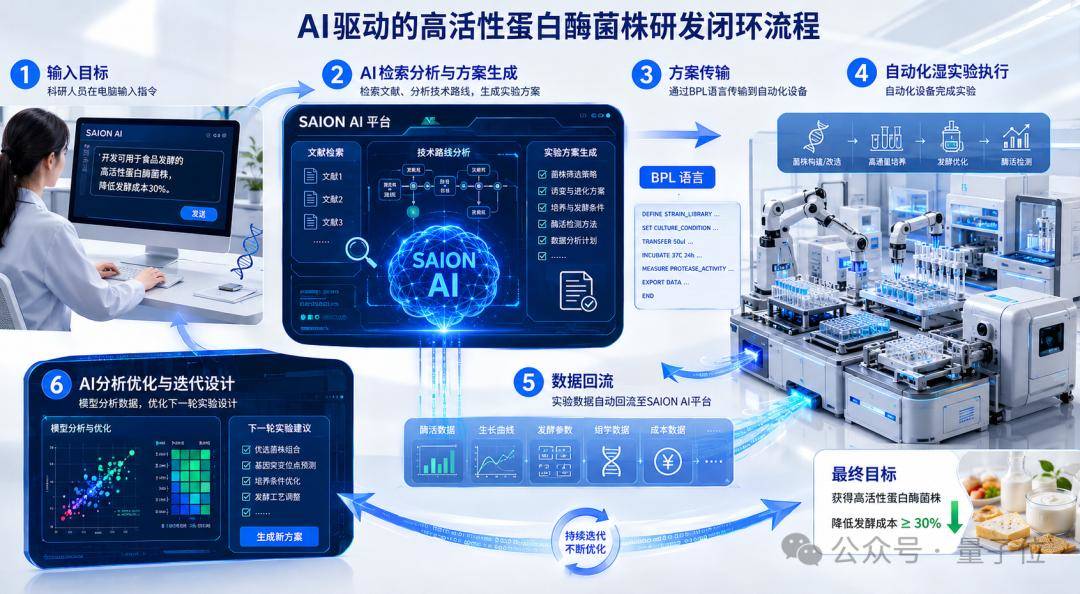
They only need to enter this into SAION AI: develop a high-activity protease strain for food fermentation, and reduce fermentation costs by 30%.
The system will automatically search the literature, analyze technical routes, identify key technical points, and generate a detailed experimental plan down to each operation step.
Then, this plan is transmitted through Bota’s self-developed BPL language directly to Bota’s “biomanufacturing foundry,” where automated equipment standardizes all wet-lab steps such as plasmid design, strain construction, cultivation, and testing, with no human intervention required throughout.
After the experiment is completed, all data automatically flows back into SAION AI. The model then analyzes the data and continues optimizing the next round of experimental design, forming a complete closed loop.
△AI generated
When experiments can be described in a standardized way, AI can truly understand biomanufacturing for the first time.
From an architectural perspective, SAION AI consists of three layers:
- Cognitive layer: responsible for understanding scientific problems and generating experimental plans.
- Control layer: responsible for BPL compilation, validation, and task orchestration.
- Execution layer: responsible for driving real lab equipment to carry out operations.
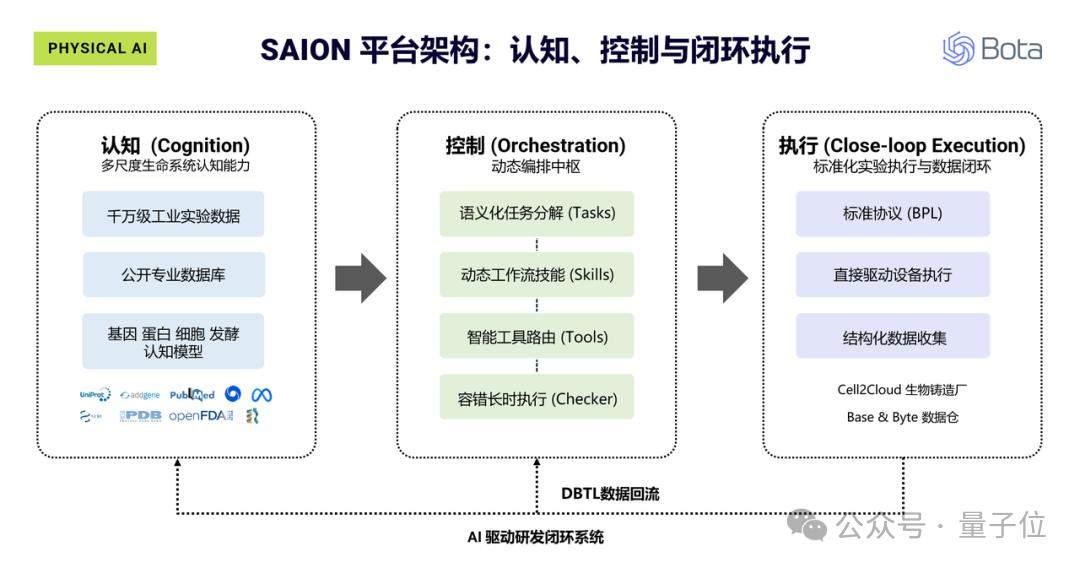
The whole process is like an ever-evolving scientific brain. That is exactly the core characteristic of Physical AI.
Why use strain engineering as the example? In biomanufacturing, it is one of the most core and fundamental areas.
Together with biological parts, it forms the core assets of biomanufacturing and is almost the starting point that all industrial production must pass through.
In the traditional model, a single R&D project might complete around 500 strain experiments in one year.
But with SAION AI, efficiency is instantly supercharged.
This round-the-clock “AI scientist” can carry out 300,000 sets of experiments during the same period for a single project, crushing an entire year’s workload in just one day.
The Team Behind It
In 2019, Bota Biosciences was founded in Hangzhou.
Unlike many AI startups, they did not put all their bets on models from the very beginning. Instead, they simultaneously built a “biomanufacturing foundry” called Cell2Cloud driven by Physical AI.
This system covers the full workflow from strain engineering and process development to large-scale production. At first glance, it may have looked like a way to solve lab automation issues, but now it feels more like an early bet on the Physical AI era.
Because what AI has always lacked is not parameters, but data. Especially in an industry like biomanufacturing, which is heavily constrained by physical reality, high-quality real experimental data is harder to obtain than the model itself.
Cell2Cloud continuously generates tens of millions of real experimental data points while also connecting to millions of papers and patent records, creating a data flywheel that is rare in the industry.
The later BPL language and the cognitive capabilities behind SAION AI are fundamentally built on this infrastructure.
In a sense, while many companies are training AI, Bota is building the training ground for an AI scientist.
The driving force behind this system is Bota Biosciences founder and CEO Hao Cui.

Cui graduated from the University of Toronto and later earned a PhD in Medical Engineering and Medical Physics through a joint program between Harvard Medical School and MIT. She was selected as a 2025 Young Global Leader by the World Economic Forum.
During her doctoral studies, she published multiple papers as first author or core author in top international journals such as Science, Nature Nanotechnology, and PNAS, and holds multiple invention patents related to synthetic biology and automated experimentation.
After founding the company, she led the team to build BPL, Cell2Cloud, and SAION AI — the three core capabilities.
At first glance, these seem like three separate technologies, but in essence they all point to the same goal: turning AI from “paper reasoning” into an AI scientist that can autonomously carry out wet-lab experiments 24/7.
This path was recognized by both industry and capital very early on.
In 2021, Bota Biosciences completed a $100 million Series B funding round, with investors including Sequoia China, Five Y Capital, Source Code Capital, Baidu, Meituan, BASF, Matrix Partners, and other leading institutions and industrial investors.

Today, Bota has turned its technological capabilities into scalable solutions for food, nutrition and health, and personal care, and has formed partnerships with companies such as New & Hualian, SYENSQO, Yili, BASF, PROYA, and Chando.
If BPL solves how AI understands experiments, then what Bota is trying to prove is something even bigger:
Physical AI is not just the future of the robotics industry; it is also reshaping how biomanufacturing is produced.
One more thing
Whenever an industry moves toward scale, one thing is unavoidable: turning experience into standards and knowledge into rules that machines can understand.
The semiconductor industry is the most典型 example.
Before EDA (Electronic Design Automation) emerged, chip design depended heavily on engineers’ experience, with high verification costs and long trial-and-error cycles.
The value of EDA is not just improving efficiency; it is that, for the first time, chip design was turned into a digital asset that can be described, verified, and simulated.
In a sense, without EDA, there would be no semiconductor industry as we know it today.
And biomanufacturing today is at a similar stage.
If Cell2Cloud is the body of Physical AI, and SAION AI is the brain of Physical AI, then BPL is the nervous system connecting the two.
From this perspective, the significance of BPL goes far beyond improving experimental efficiency.
It is more like the “EDA” of biomanufacturing: a foundational infrastructure layer for the industry of the future.