
Make AI truly “understand” the enterprise
Over the past three years, large model capabilities have advanced rapidly and computing power has continued to break through, yet enterprise AI adoption has not delivered the value release many expected. More and more industries are reaching a consensus: the focus of AI competition is shifting from models to data.
On June 29, OceanBase launched an AI database for the AI era built around a unified lakehouse architecture. It proposed centering the architecture on lakehouse integration, bringing together the openness and massive storage capabilities of data lakes, the transactional and analytical capabilities of databases, and multimodal data processing capabilities into a single, strongly consistent data foundation. This helps Agents obtain complete business context in one step, enabling AI to truly “understand” the enterprise.
Around this capability, OceanBase AI Database has also formed a product portfolio spanning the data engine, data governance, and business entry points, including Lakebase, DataStudio, and DataPilot. It has already been validated in AI scenarios such as Ant Afu and Lingguang.
The industry widely believes that as Agents become new database users, databases are shifting from “recording facts” to “participating in decisions.” As a result, AI databases are becoming a new form of infrastructure in the AI era.
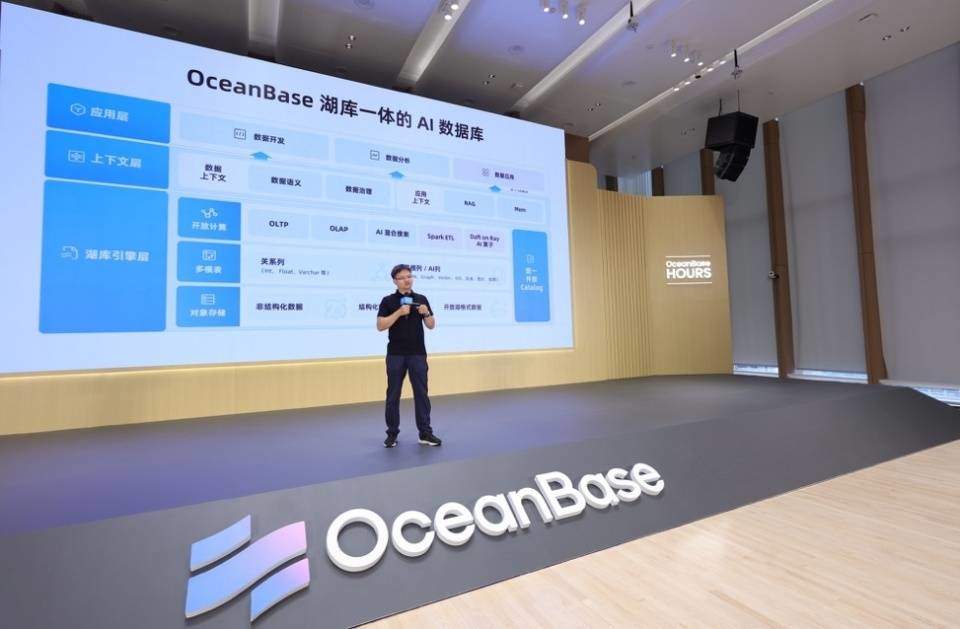
(Caption: OceanBase launches a lakehouse-integrated AI database)
The bottleneck for AI adoption lies in data; “lakehouse integration” is becoming the best path
In the past, large models solved the question of “whether they could think.” Today, the real bottleneck has become “whether they understand the business.” Model capabilities are rapidly converging, while business differentiation is shifting to the data layer.
As Agents move into the system execution layer and enterprise data becomes increasingly multimodal, traditional architectures that rely on coordination across multiple systems are finding it harder and harder to meet AI’s demand for a “unified context.” AI is reshaping the data management paradigm, and the three key challenges brought by Agents entering production—scale, context, and evolution—are becoming increasingly prominent. Breaking down AI’s impact on databases, data formats, data movement, and data interaction are all changing, but the four bottom lines of databases—consistency, scalability, reliability, and real-time performance—remain non-negotiable.
What really needs to be rewritten is the architecture; what must be preserved is the baseline. This points directly to lakehouse integration: managing, computing, and serving multimodal data within a unified engine, and eliminating architectural fragmentation across multiple systems.
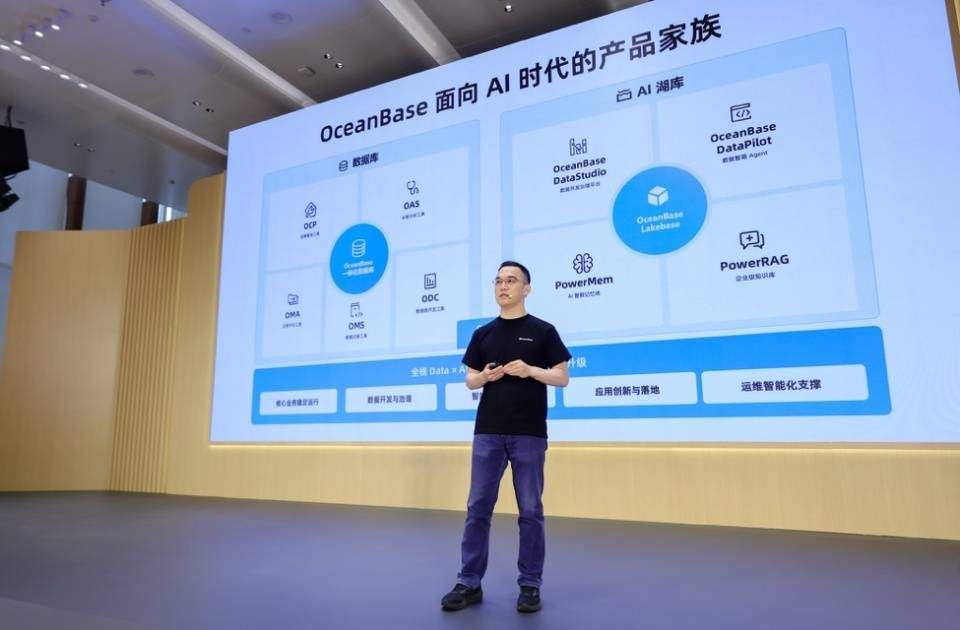
(Caption: OceanBase launches a new product portfolio for the AI era)
Centered on lakehouse integration, OceanBase has built a new product portfolio for the AI era:
OceanBase Lakebase serves as the underlying engine, enabling structured data, unstructured data, and vector data to be managed, processed, retrieved, and invoked within a unified architecture, addressing the data foundation problem in the AI era;
OceanBase DataStudio runs on top of Lakebase and covers the full workflow from data ingestion, processing, orchestration, and semantic modeling to Agent collaboration, turning fragmented data assets into callable data services and solving data governance and serviceification challenges;
OceanBase DataPilot serves as a unified intelligent entry point for enterprise operations, allowing business users to generate analytical reports, dashboards, and trustworthy answers through natural language, addressing how business users can directly work with data intelligence.
According to the introduction, compared with traditional multi-system solutions, OceanBase AI Database can reduce overall TCO (Total Cost of Ownership) by about 30%–50%. At present, this capability has been validated in scenarios such as Ant Afu and Lingguang, where Lingguang has cumulatively generated tens of millions of “flash apps,” proving the feasibility of the lakehouse-integrated architecture in million-Agent scenarios.
OceanBase CTO Yang Chuanhui said: “True integration must happen at the architectural layer. Lakehouse integration is not a simple combination of databases and data lakes, but the unification of multimodal data management within one engine, bridging online and offline processing.”
Redefining AI databases, with Chinese vendors entering a new window of opportunity
AI databases are becoming a new frontier in global foundational software, but the technical path has not yet converged: some are extending capabilities from the data lake side, some are strengthening search and semantic understanding, while others are starting from the database kernel and attempting to reconstruct the entire data system.
The essence of these differences is not in component selection, but in different understandings of how AI uses data. In this round of change, AI databases are no longer just an extension of traditional databases’ capabilities; they are redefining how data is organized, invoked, and used for decision-making by AI.
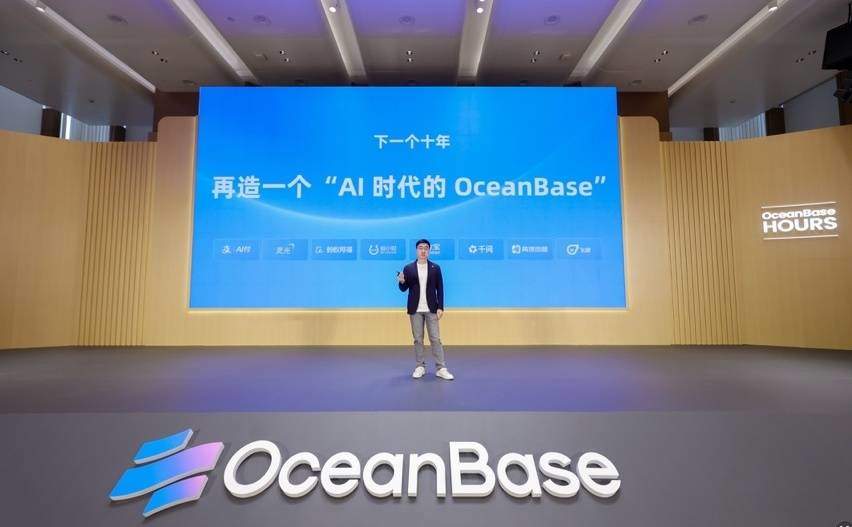
(Caption: OceanBase rebuilds the lakehouse-integrated database for the AI era)
OceanBase chose to start from the database kernel, extending the transactional consistency, high availability, and elasticity that have long been validated in core financial systems to lake and multimodal data systems, giving it the ability to uniformly support AI workloads. This is a reconstruction from the ground up, not a patchwork repair of an old architecture.
Public information shows that OceanBase is a domestically developed Chinese database that originated from the “Double 11” shopping festival scenario in 2010. Over the past 15 years, it has undergone the most rigorous testing in the financial industry, now serving more than 400 financial institutions. It has ranked first in China’s distributed database on-premises deployment market for two consecutive years, and it remains the only database to have topped both the TPC-C and TPC-H international benchmark tests. Its business spans multiple countries and regions worldwide.
The capabilities honed in financial-grade scenarios—no data errors, no system interruptions, millisecond-level fault recovery—are exactly what the AI era needs. Extending these capabilities from the “database” to the “lake” is a natural next step built on 15 years of groundwork, and it gives OceanBase the foundation to compete in reshaping the AI database paradigm.
For a long time, the standards for foundational software have largely been defined by international vendors, while AI databases are now entering a stage where the rules have not yet been set in stone. This means competition is no longer just about catching up with existing systems, but about participating in the formation of a new one.
OceanBase CEO Yang Bing said: “We have the opportunity to move from a follower to a co-definer and participate in shaping the AI database paradigm. This is both an opportunity for China and an opportunity for OceanBase.”