
Just Raised $200 Million, Shot to the Top of the Embodied Intelligence Rankings
Shi Miao, from Non-Temple
Quantum Bit | QbitAI Official Account
When you pick up a glass of water from the table, your brain takes less than a second to do three things at once:
Estimate the glass’s weight, predict how much the water will slosh, and avoid the glass next to it.
In that moment, your brain doesn’t care about the pattern on the glass or the complex reflections on its surface. Instead, it instantly gets to the core: how much force should your hand use so the water doesn’t spill?
This ability to ignore irrelevant environmental details and directly perceive the essence of things through “physical intuition” is what makes even delicate tasks feel effortless.
But for robots, learning this kind of causal intuition about the physical world is basically a hard-mode challenge in embodied intelligence.
Now, a rising embodied AI company founded just one year ago — Boundless Dynamics — has stepped up with a new solution.
It has officially launched the world’s first “long-horizon bidirectional physical causal chain” latent-space world model, MWA™, expanding embodied intelligence’s ability to generalize across diverse scenarios and directly tackling one of the industry’s toughest problems: long-cycle, high-precision robot execution.
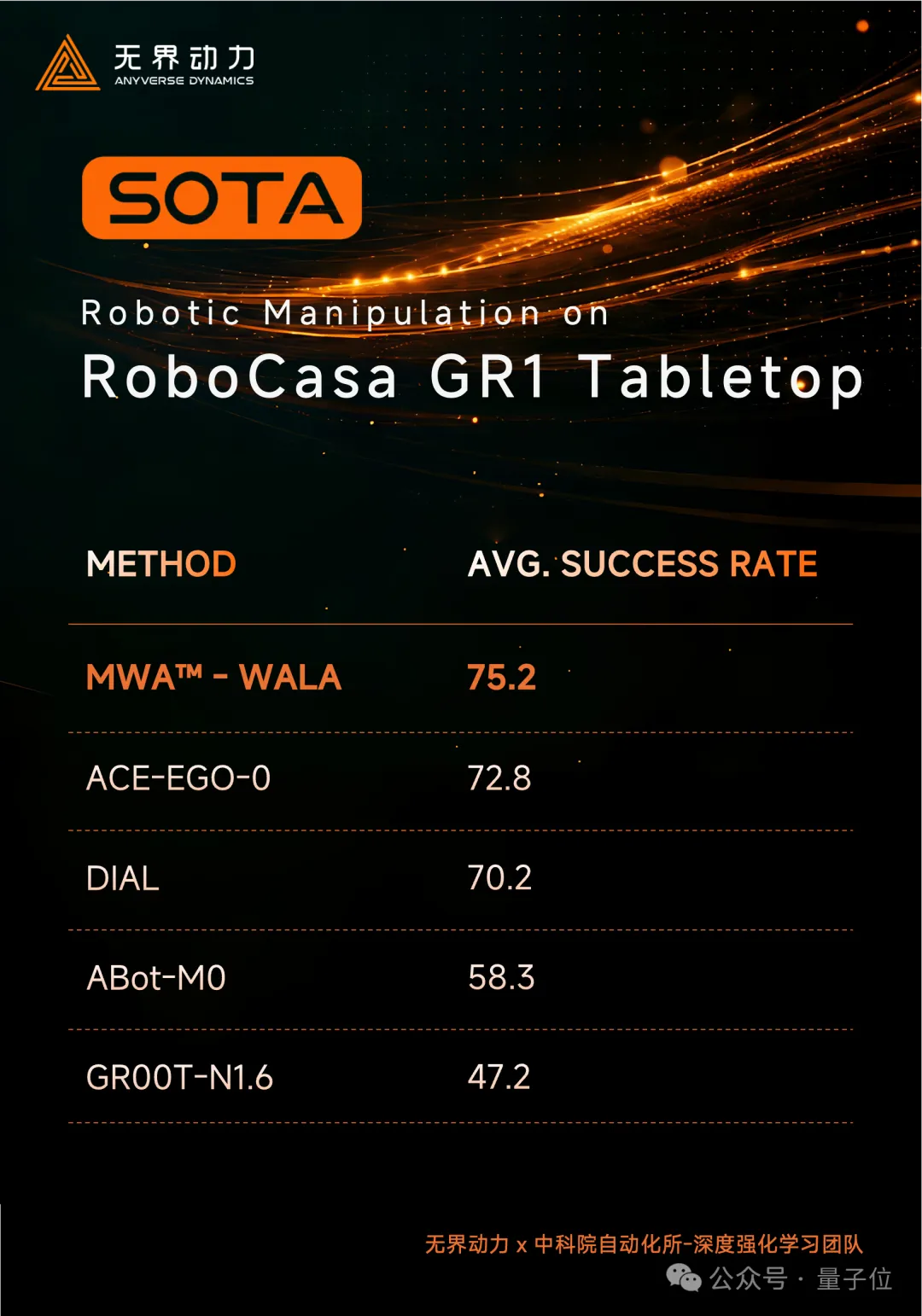
In the RoboCasa GR1 TableTop leaderboard co-initiated by Stanford University and other top institutions, Boundless Dynamics’ MWA™ achieved a global No. 1 ranking with an average task success rate of 75.2%, outperforming mainstream models in the field such as NVIDIA GR00T-N1.6.
As a newcomer in the field, Boundless Dynamics is one of the few companies in the industry that has stuck to the technical path of “latent-space world model + reinforcement learning.”
This somewhat unconventional hardcore route has not only proven itself in technical testing, but has also shown extraordinary fundraising power:
The company had previously announced an angel round of more than $200 million, and its subsequent Pre-A round of nearly $200 million is also nearing completion, with heavyweight backers including Sequoia China, Linear Capital, and JD-affiliated funds.
How exactly did this dark horse — both technically capable and highly fundable — help robots understand physical causality and break through the bottleneck of multi-scenario generalization?
Let’s break it down.
The Road to the Endgame: Latent-Space World Models + Reinforcement Learning
If a robot understands language and logic, can it then understand human instructions and get work done in the real world?
The answer is: not quite.
Over the past few years, the VLA (vision-language-action) embodied intelligence approach has enabled robots to understand human text instructions.
But once deployed in the real world, even a slight change in lighting or moving a cup a few centimeters can make the robot instantly “freeze up,” or even produce distorted motions.
The root problem is that traditional VLA models are more like a rigid open-book exam for robots.
They rely heavily on imitation learning from human demonstrations, merely memorizing demonstrated action trajectories. They do not truly understand the causal relationships in the physical world, so their generalization performance naturally drops off a cliff.
Humans can handle all kinds of non-standard tasks because the brain is naturally equipped with “intuitive reasoning” about the physical world. If a robot has a blank slate when it comes to real-world commonsense understanding, its policy ceiling will be locked inside the old paradigm.
Boundless Dynamics chose a different route: latent-space world model + reinforcement learning.
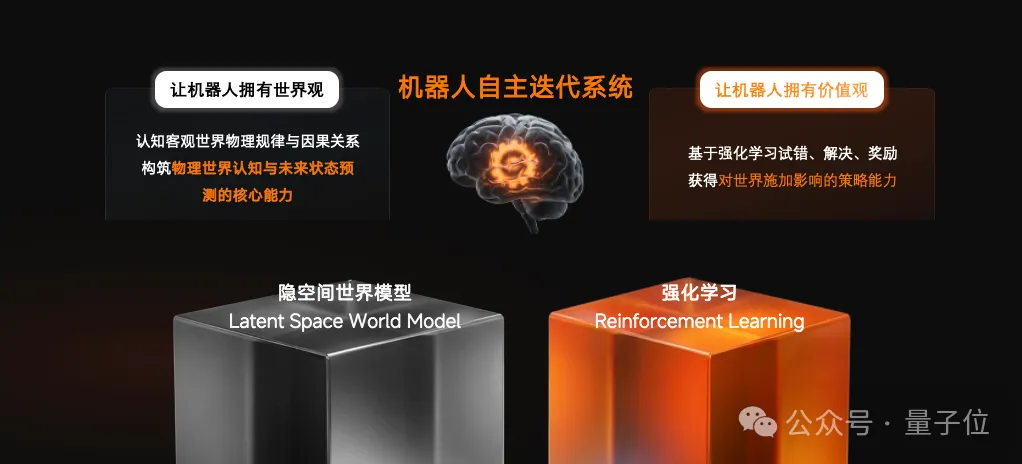
Here, the latent-space world model builds the “worldview,” giving the robot an understanding of physical laws and causal relationships, and forming the core capability to perceive the physical world and predict future states.
Reinforcement learning, on the other hand, shapes the “value system.” Through frequent trial and error and reward feedback, it turns that understanding of the physical world into precise execution strategies.
First understand causality, then learn how to act. Only by letting robots see the causal boundaries of the physical world can they truly move beyond lab demos and into real-world scenarios.
How Do Robots Understand Physics? Don’t Stare at Pixels — Capture the Environment’s “Latent Actions”
But building such a world model raises the first question: what exactly should the model look at?
Traditional approaches often predict the future in pixel space.
When a robot watches a video, it doesn’t just need to learn how a hand grabs a cup; it also has to compute subtle changes in lighting, meaningless pixel noise, and even the texture of the floor.
A huge amount of compute is wasted on redundant information unrelated to the task.
MWA™ carries out its reasoning entirely in a unified shared latent space, skipping redundant pixel-level computation.
More importantly, it distills “latent actions” as the underlying representation of interaction-induced changes in a scene.
What are “latent actions”?
Traditional embodied AI depends on explicit action spaces, where humans must first label where the end effector of a robotic arm should move and what trajectory its joints should follow, which is extremely costly.
“Latent actions” bypass that step. Instead, they abstract the position and state changes of objects caused by interaction in a video into a set of high-dimensional representations in feature space.
Without relying on any human action annotations, the model can infer the essence of an action directly from changes in the visuals.
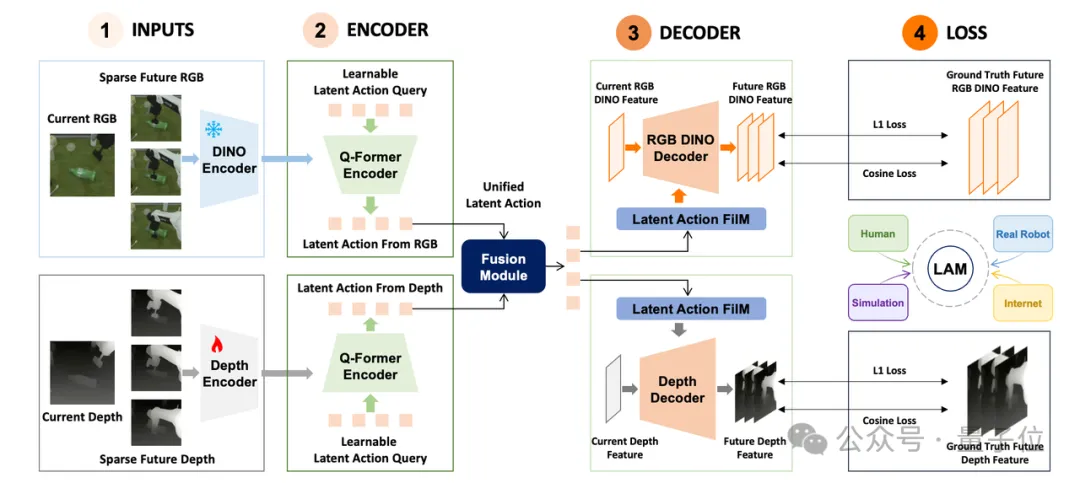
With latent actions, MWA™ is no longer dependent on traditional action labels.
That means it can train directly on the massive amount of raw video on the internet — videos that have no human action annotations at all.
It can automatically cut through irrelevant background noise and use latent actions to reason backward from effects to causes, understanding the essential physics behind how objects are affected by forces and evolve over time.
This is essentially unlocking the internet’s gold mine of unlabeled data, taking the utilization efficiency of multi-source data to the next level.
Moving Beyond “One-Step Grinders”: The “Long-Horizon Bidirectional Physical Causal Chain” Redefines the Core World-Model Paradigm
To address the problem of “stuttering actions and lack of continuity,” MWA™ adopts a latent-space bidirectional dynamics architecture at the foundation.
This architecture builds a bidirectional logical synergy within latent space.
In simple terms, the model runs two reasoning streams at the same time:
One is inverse dynamics, responsible for extracting features by reasoning from effect to cause — seeing the result and inferring which action caused it;
The other is forward dynamics, responsible for reasoning from cause to effect — given an action, predicting how the environment will change next.
These two streams do not operate independently. The architecture introduces a forward-reverse cross-check mechanism.
The action inferred by the inverse model must be handed to the forward model for mental simulation and virtual verification; the environmental changes predicted by the forward model must also be fed back in real time, to be causally aligned with the physical understanding accumulated during inverse-model pretraining.
Forward and reverse cross-checking, repeated over and over, gives the model extremely high causal reasoning accuracy.
However, when traditional bidirectional dynamics architectures are brought into complex real-world settings, they still have a fatal blind spot: even in latent space, they are generally constrained by the temporal limitation of “single-step instantaneous latent-action reasoning.”
Under this single-step reasoning mechanism, the model lacks a macro-level ability to summarize long-horizon causality, forcing the robot to “take one step, look one step, guess one step.”
As a result, when it faces long-cycle continuous tasks, even a tiny prediction error at one step will snowball rapidly across the sequence, eventually causing action discontinuity or even a full system breakdown.
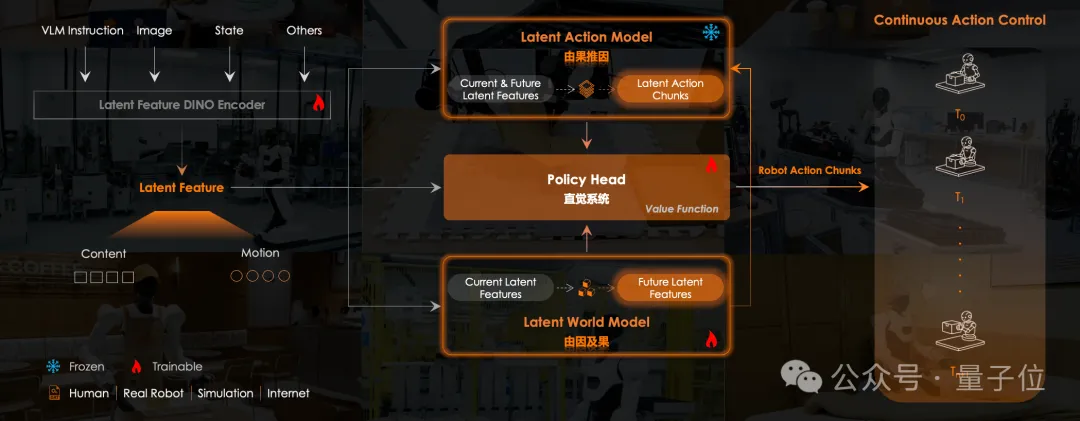
Recognizing this limitation, Boundless Dynamics introduced a core paradigm innovation on top of bidirectional dynamics: the world’s first latent-space world model with a “long-horizon bidirectional physical causal chain.”
MWA™ pioneered a temporal chunk-level inverse dynamics modeling mechanism, restructuring the output paradigm of the inverse dynamics model and breaking through the limitations of traditional single-step reasoning.
This directly moves robotics away from the old “take one step, inspect one step” instant-response approach and into continuous long-horizon action simulation.
When dealing with complex continuous tasks, MWA™ performs long-cycle game-theoretic simulation between action execution and environmental change throughout the entire action-sequence generation process, directly inferring and outputting multi-step continuous Latent Action Chunk action groups in batches from visual sequences longer than 10 seconds.
This substantially weakens the snowball effect of error accumulation at the foundation, giving robots the ability to truly complete complex long-horizon tasks.
Let’s use a concrete scenario to understand how this works.
Three components work together in this mechanism:
- The Policy Head is intuition, responsible for producing an action plan immediately;
- The Forward Dynamics Model (FDM) is the simulator, responsible for mentally testing “what happens if we do this”;
- The Inverse Dynamics Model (IDM) is the reviewer, responsible for working backward from the result to figure out “which action caused this?”
A robot is wiping a table. There is a water stain on the table, and next to it sits a fragile glass.
Based on intuition, the Policy Head quickly outputs an initial action: wiping from right to left with a cloth.
At this point, the FDM takes over. Based on the latent features of the current image and this action, it performs a preemptive mental rollout of the next latent-space frame, and the result is that the glass will be accidentally knocked over.
This unacceptable outcome is then fed back together with the current features into the IDM, which precisely identifies the part of the action responsible for knocking over the glass.
The Policy Head then makes a value judgment and, during gradient-backpropagation updates, forces the strategy away from that dangerous action region, using the physical causal chain to preempt collision and slipping in the real world.
Conversely, if the action output by the Policy Head is rolled out by the FDM and the next-frame features indicate that the water stain is successfully removed, the IDM further infers from the structural changes across the before-and-after sequence that, to perfectly clean the stain, the optimal action features should be latent-action representations with a more suitable amplitude and higher energy efficiency.
The policy system then aligns accordingly, actively narrowing the gap and forcing the control sequence toward this better amplitude and trajectory.
Within latent space, the FDM rolls out consequences and the IDM traces them back to causes. Before the robot even touches the physical world, MWA™ has already defined highly certain forbidden zones and recommended ranges of action, thereby making generalized action output more coherent and more precise, and closing the loop from data to deterministic execution.
Robots Also Need an Error Notebook
If the latent-space world model gives robots a worldview that lets them see causality clearly, then how do we turn that knowledge in their heads into real-world value and execution ability that is robust and won’t fall apart under interference?
Boundless Dynamics’ approach is to make the latent-space world model natively compatible with reinforcement learning (RL) from the ground up.
Through a closed loop of “physical causal modeling + reinforcement-learning trial and error + evolving boundary awareness,” robots can continuously improve themselves in a virtual training ground.
But to build truly tough, resilient capabilities, the entire industry is currently stuck on the same bottleneck — datasets are generally “heavy on positives, light on negatives.”
Look through current industry datasets, and they are almost entirely made up of “perfect positive samples,” with very few finely grained examples of failure.
It’s like a student who only practices reading comprehension with perfect model essays and never sees where points are deducted.
When the exam comes, they know what a good essay looks like, but they don’t know where their own writing loses points, or even how to improve it.
Reinforcement learning works the same way: if the dataset only contains “did it right” and never “did it wrong” or “almost did it right,” then the model has nothing to compare against to judge how far off its action is or in which direction it drifted. The reward signal becomes vague, and policy optimization stalls.
This dataset structure is also why reinforcement learning, lacking multi-dimensional sample comparisons, cannot get frequent, dense reward feedback for policy tuning.
To address this industry pain point, Boundless Dynamics pioneered the AnyPhys negative-sample core data system.
Instead of only feeding robots the standard answer, they interweave deep negative samples, fine-grained boundary-instability samples, and even “almost successful” suboptimal samples with baseline positive samples.
At present, AnyPhys has accumulated tens of thousands of proprietary failure, instability, and boundary-critical samples, essentially covering every kind of “botched scene” robots might encounter in industry, commerce, and daily life, creating an exceptionally rare failure knowledge base.
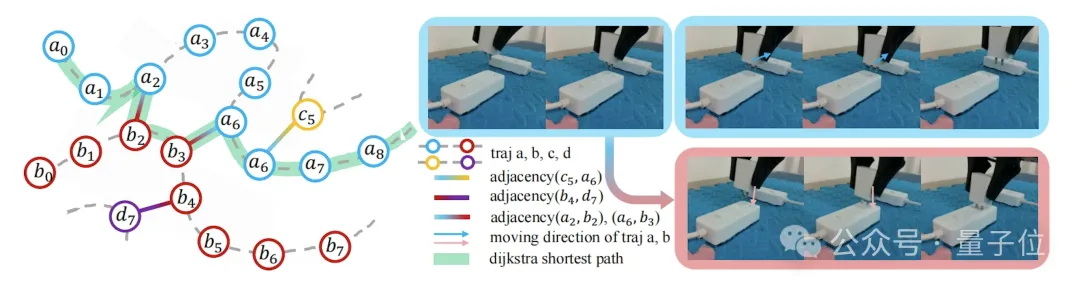
The team abandoned the traditional single-objective approach of maximizing success reward alone and instead built a methodology that automatically distinguishes positive, negative, suboptimal, and boundary samples, enabling complex dense-reward design for reinforcement learning.
This methodology requires no extra manual labeling and can fully reuse imperfect demonstration data, significantly improving robot execution accuracy and generalization.
For example, in precision insertion tasks, a global spatial graph is built based on the robot’s pose, with the 3D distance of the end effector used as the motion cost to solve for the shortest path to the target. Remaining path distance is used to quantify action progress, clearly distinguishing forward, backward, and stalled states, and automatically scoring and classifying samples.
The algorithm supports both offline imitation-weighted training and online dense-reward training. In high-precision insertion tests, task success rates under noisy data improved by as much as 5x.
An Unconventional Path Took First Place, Beating NVIDIA
Back to the leaderboard mentioned at the beginning.
Recently, on RoboCasa, a leading benchmark in embodied intelligence, the latent-space world model MWA™ – WALA jointly released by Boundless Dynamics and the Institute of Automation, Chinese Academy of Sciences, set a new industry record and took global No. 1 with an average task success rate of 75.2%, surpassing mainstream models such as NVIDIA GR00T-N1.6.
This ranking deserves a closer look. RoboCasa, co-initiated by Stanford University and other top institutions, is widely regarded as one of the industry’s core evaluation arenas for embodied manipulation.
It does not simply let robots do a few standard actions in a clean ideal environment and call it a pass.
The test scenarios cover a variety of non-standard kitchen environments and interactive objects, including long-horizon composite workflows and object retrieval in constrained spaces, across 24 highly challenging tasks. They are paired with strict testing conditions such as global randomization of lighting and shadows, clutter interference, and changes in object specifications, specifically to test a model’s generalization ability in uncertain environments.
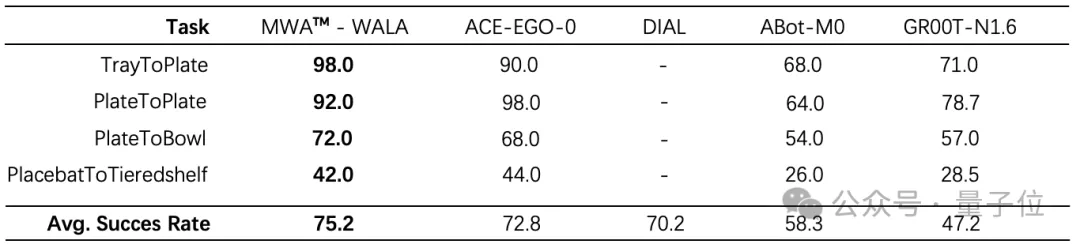
Test data show that MWA™ – WALA improved task success rate by 2.4% over the second-place model, and it performed particularly well on high-frequency difficult tasks such as multi-step coherent operations, object retrieval in constrained spaces, and precise picking of scattered objects.
There is a noteworthy detail behind this result.
MWA™ – WALA’s stable performance under high uncertainty is mainly due to its deep activation of unlabeled raw data from the internet.
Comparative tests show that the all-scenario generalization gains brought by large-scale unlabeled-data training are significant, and this is the core reason MWA™ – WALA can maintain stable performance in highly uncertain environments.
Betting on Technology, but Valuing People Even More
Funding in embodied AI is nothing new, but Boundless Dynamics’ pace is a bit unusual.
One year after founding, it closed an angel round of over $200 million, its Pre-A round of nearly $200 million is close to completion, and cumulative funding in the first half of 2026 reached hundreds of millions of dollars.
Sequoia China, Linear Capital, and JD-affiliated funds are all on the investor list.
For investors to back this kind of amount at the angel stage, what they are betting on is not only the technical route, but more importantly the fact that this team has already fully gone through the complete cycle from “algorithm to mass production.”
CEO Zhang Yufeng of Boundless Dynamics previously served as the No. 1 leader for intelligent driving at Horizon Robotics.
He led a team of over a thousand people, pushing Horizon’s intelligent-driving software algorithms from R&D into large-scale delivery, and ultimately grew Horizon’s intelligent-driving business from zero to No. 1 market share in China.
Even more memorable in the industry was the €2.4 billion business partnership with the Volkswagen Group that he led — the first technology export of a Chinese intelligent-driving solution to a world-class global automaker, and one of the largest overseas orders in China’s intelligent-driving industry at that stage.
Co-founder and CTO Xia Zhongpu brings a deeper technical profile.
He is one of the key figures in China’s intelligent-driving industry for developing and mass-producing end-to-end models. He once led a team of fewer than 40 people to deliver the first demo in just a month and a half.
At Boundless Dynamics, he leads the core technical stack: R&D for the latent-space world model + reinforcement learning, as well as the construction of the underlying technical infrastructure.
One investor commented that the Zhang Yufeng and Xia Zhongpu pairing is the most proven among founders who came out of the Li Auto and Horizon Robotics ecosystems.
One knows how to push technology into production; the other knows how to push algorithms to their limit.
This DNA, which combines both technical depth and commercialization capability, is also directly reflected in Boundless Dynamics’ business rollout.
In just one year since founding, Boundless Dynamics has secured nearly $100 million in global orders.
The customer list spans several very different industries:
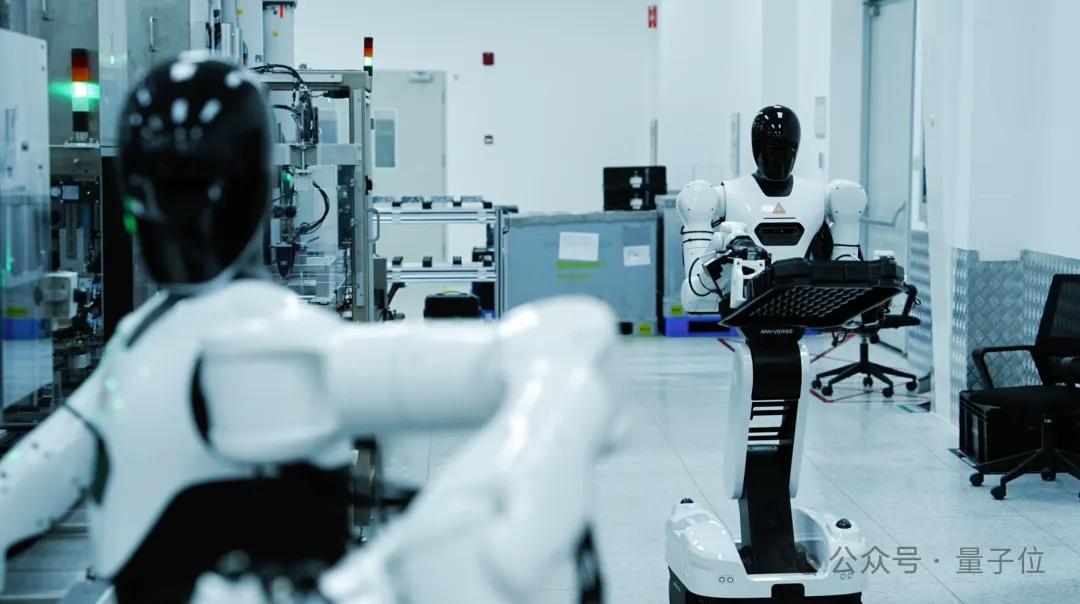
In automotive, it has formed strategic partnerships with top global suppliers such as ZF LIFETEC and Forvia Group;
In energy, it signed an order worth over RMB 500 million with Envision Technology, covering large-scale overseas deployment and joint R&D. This is also the first overseas order worth over 100 million yuan in the domestic embodied manipulation intelligence sector.
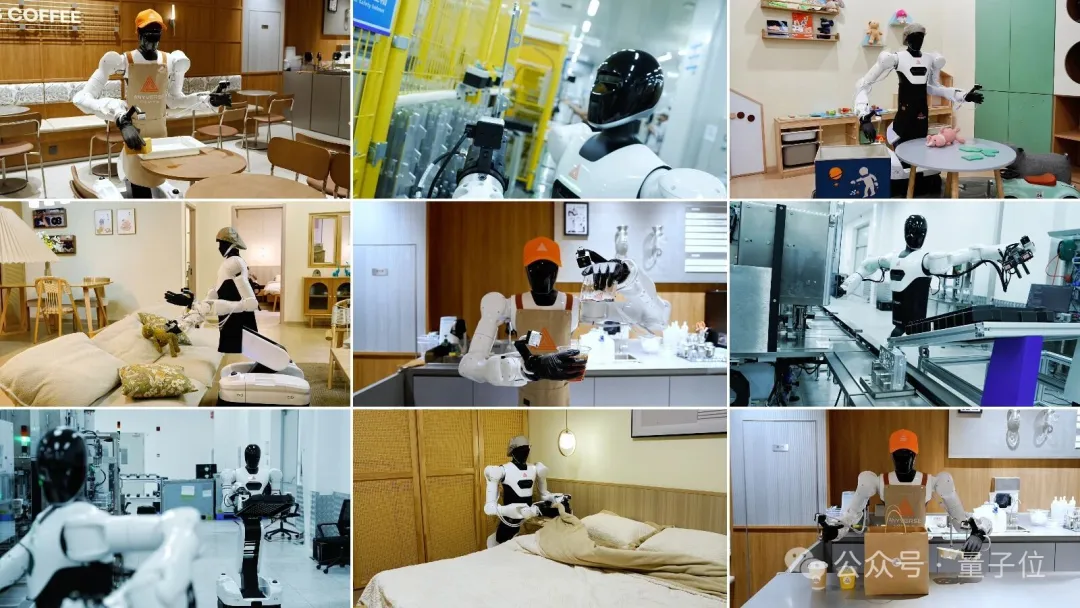
On the consumer side, Boundless Dynamics has partnered with well-known coffee chain brands at home and abroad, bringing robots into open, dynamic commercial service scenarios.
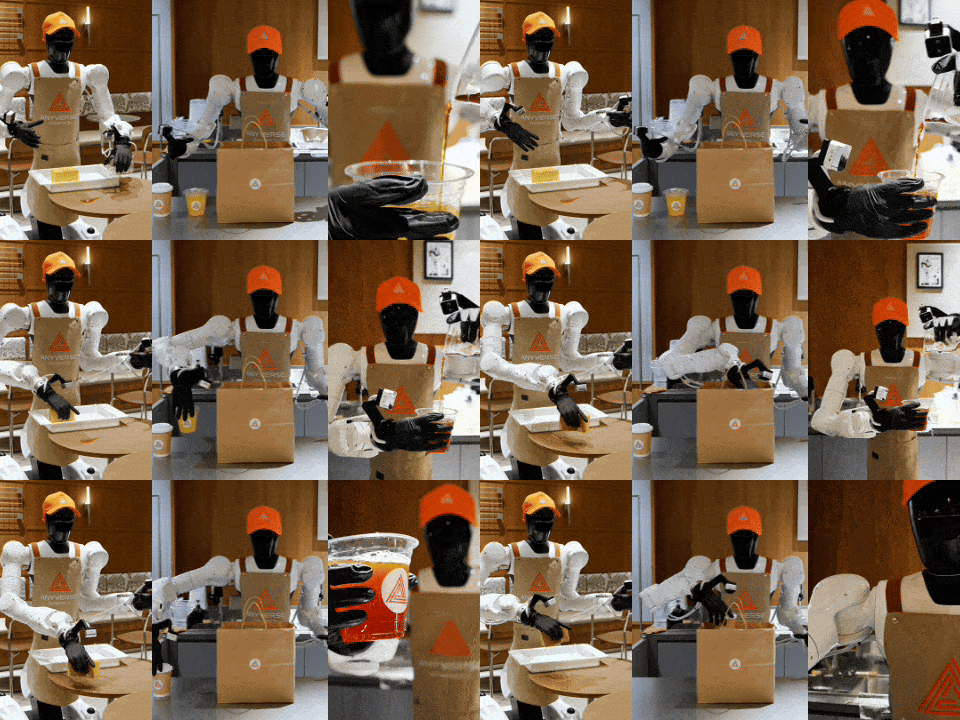
From automotive production lines to coffee shops, the scenario gap is huge, and the technical requirements are completely different. Boundless Dynamics’ answer is to independently develop a general-purpose hardware foundation to connect them all.
And in the more complex home environment, the robot also demonstrates nuanced physical commonsense. Faced with various dynamic multi-task situations, it relies on autonomous decision-making and long-horizon rollouts to achieve extremely strong adaptive generalization.
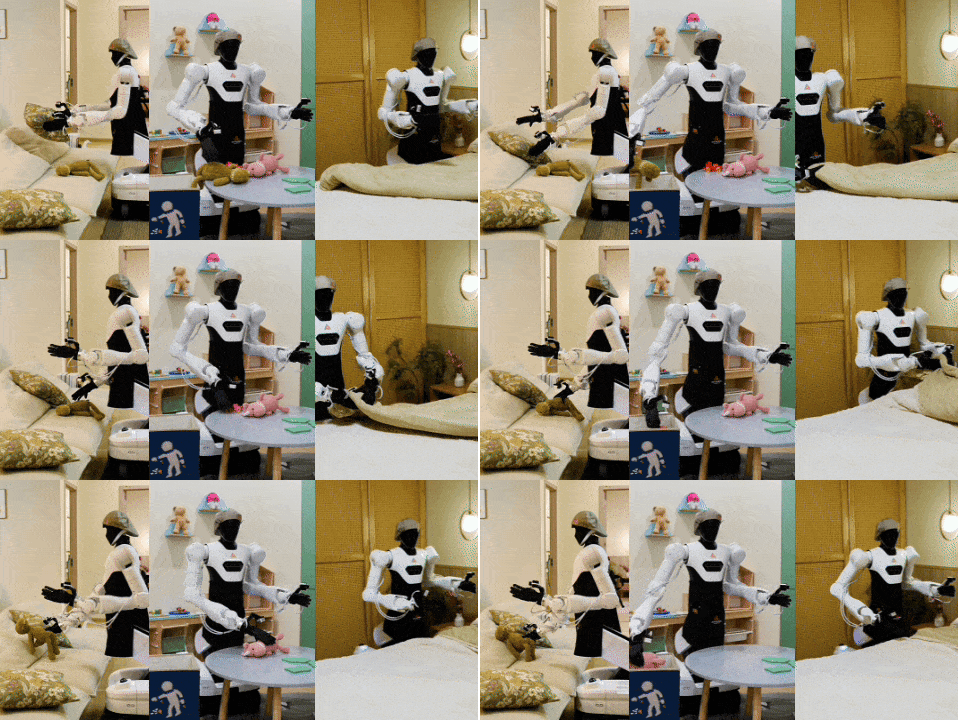
The company has now fully in-house developed a 1200 TOPS (INT8) large-and-small-brain integrated high-compute platform and has deployed it as standard on its robots.
Operational data from different scenarios continuously flow back into the training pipeline of the core model, forming a positive cycle in which data feeds technology.
The elimination round in embodied intelligence has already begun. The demo phase is over, and the industry is now looking at a much harder metric — can your robot really do the work and actually deliver?
Boundless Dynamics’ answer points to a deeper question.
Rather than teaching robots more tasks, what is becoming increasingly important is helping them understand the physical world