
Google CEO Admits It’s Lagging in Coding
A major search overhaul after 25 years, but Google still isn’t ready to go all-in on AI
Mengyao, from Nanfafei Temple
QbitAI | WeChat public account QbitAI
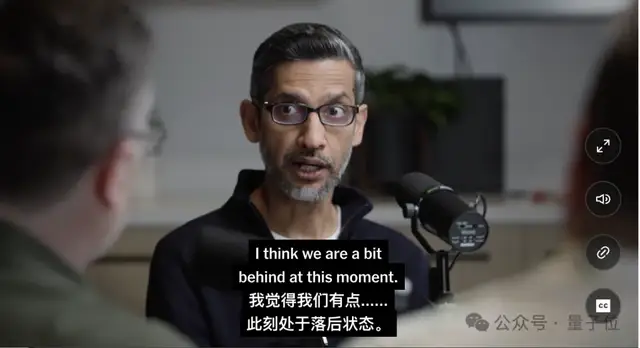
Google CEO Pichai didn’t hold back this time and went straight into a candid, no-filter confession:
On coding, our Gemini is indeed a bit behind…
(Gemini: Why am I hearing this from my own boss?!)
Just as Google I/O wrapped up—
A whole lineup of new AI products landed, including Gemini 3.5 Flash, Gemini Omini, and Gemini Spark.
And in a recent interview on The New York Times’ tech podcast, Pichai responded in detail to several of the most pointed questions.

He talked openly about Gemini’s capabilities, AI anxiety, and more—laying bare Google’s strengths and his own thoughts in a refreshingly honest way:
- On coding agents, Google really isn’t at the front of the pack.
- Honestly, the pace of progress over the past year or two makes me feel like AGI may be closer than we previously thought.
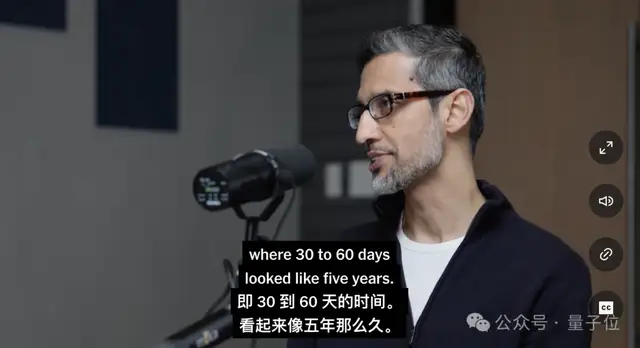
- The AI world is changing at an absurd speed now. Changes that happen in just 30 to 60 days today might have taken 5 years to show up in the past.
- People’s fears about AI aren’t just overblown worry, because jobs, income, and future lifestyles really will be rewritten.
…
Below is a curated transcript of the podcast’s key points, organized around the core takeaways, with some light edits made for clarity without changing the original meaning.
Pichai Admits It: Gemini Is Behind in Coding
Q: The last time we had you on the show was in 2023, when Bard had just come out and people thought Google was still playing catch-up in AI. How do you see Google’s position in this AI race now?
Pichai: That question really takes me back. Looking at it now, three years feels like a long time ago.
To be honest, the pace of technological progress over the past few years has been staggering.
Google has obviously kept moving forward too, but the industry is changing so fast. In some areas, we’re already at the frontier, but in others, we definitely haven’t fully caught up yet.
If you look at overall capabilities across text, multimodality, speech, audio, and reasoning, I think we’re pretty strong.
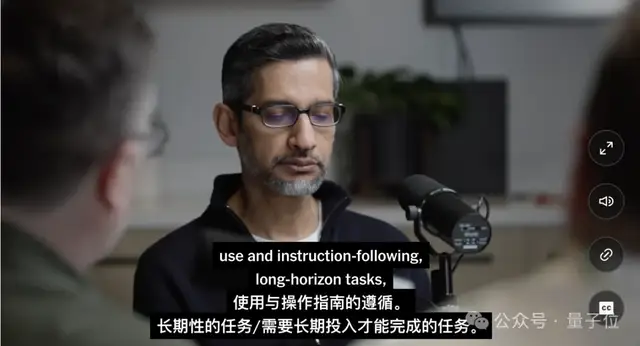
But when it comes to agentic coding with tool use, instruction following, and those long-horizon tasks that require many steps over a long period of time, I think we are indeed somewhat behind. (doge)
Of course we’re catching up, but this field moves incredibly fast.
Every top lab has its own training cycle, and the timelines don’t always line up. Three months ago, people might have thought they were in the lead and impossible to catch—then the winds can shift before you know it.
That’s what it’s like to be on the frontier.
I think Google is the only major company that is truly still on that frontier. Of course, a few startups are moving very quickly, but Google has been investing in this for many years.
For us, Gemini 3.5 Flash is genuinely a big step forward. It fills in some of the gaps we had before. A model only gets better if you put it into the real world, then keep iterating based on user feedback.
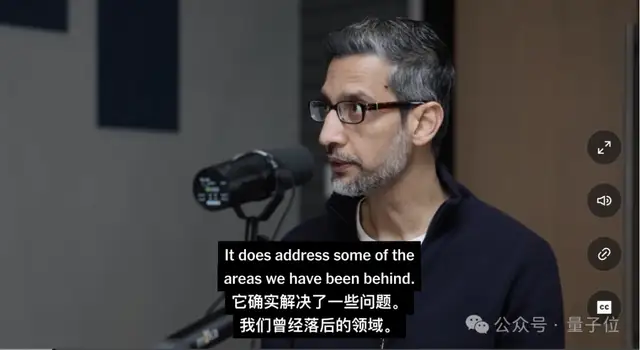
Real-world usage data is especially important for coding.
In the past, we may not have had a product surface like Claude Code that directly reached developers, nor the kind of high-frequency usage scenarios Anthropic gets through Cursor.
That’s why Antigravity 2.0 is so important for us. We’ve already been using it internally at Google for quite some time. I also mentioned at Google I/O that—
internal token usage has been growing extremely fast. I’ve never seen anything like this at Google before: it’s doubling every week. People are really using the model to get work done.
Q: So it sounds like if there’s one area where you feel Google hasn’t fully reached the frontier yet, it’s coding, right?
Pichai: Coding is actually crucial to everything we do.
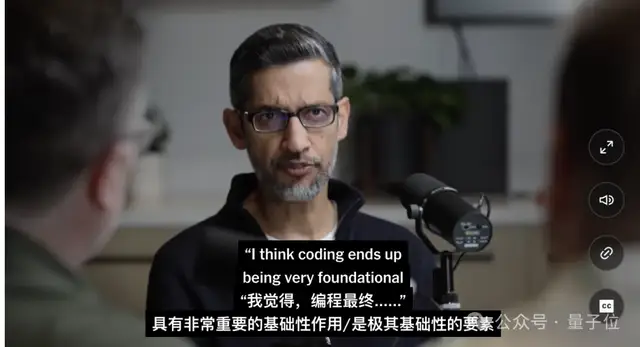
I think it’s an area worth exploring deeply. In some aspects of coding, we’ve already done quite well.
But for long-horizon tasks involving complex codebases that require senior developers, we still have a lot of room to improve. We know that very clearly, and we’re working hard to make progress.
Gemini 3.5 Flash Has Just Launched, and Google Is Still Catching Up on Coding
Q: Gemini 3.5 Flash has only been out for a day. Normally, people need a few days to really evaluate a new model properly.
That said, we’ve also received some feedback on pricing and product quality. I’m curious—what’s your initial assessment of the product?
Pichai: We definitely need a day or two for things to settle.
It’s a new model, and it’s also a step forward in a new direction. It does bring some progress, but there may also be some regressions. Still, those are things we can address quickly through post-training.
Some of the flaws and behaviors we’re seeing right now, I think, are fairly easy to fix.
Also, at this year’s Google I/O, we launched a lot of things in a single day.
So to avoid service interruptions, we’ve temporarily tightened some usage limits, but you’ll soon see improvements there.
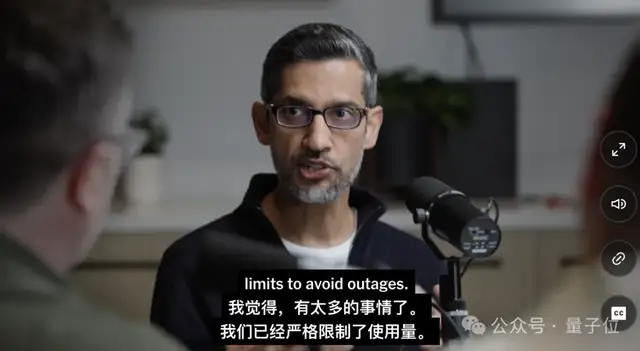
I understand people get frustrated when they hit limits—I would feel the same way—but we’ll fix these issues quickly.
Q: Some AI companies have been successful because they stay very focused.
Everyone knows Anthropic and OpenAI have invested heavily in coding. OpenAI was criticized last year for spreading itself too thin, but now it has narrowed its focus too.
So do you think Google is focused enough on coding? Or are you betting on too many directions at once, splitting up resources, time, and attention?
Pichai: I think everyone can see that coding has reached a turning point, so everyone is responding to that shift.
We’re certainly investing heavily in this area, and I don’t think the issue is focus. Google is a very large company with enough scale, so we can focus on multiple important directions at the same time.
For me, this isn’t a fundamental problem. The key is that we’re making progress, and we will keep making progress.
In this field, changes over 30 to 60 days look like what used to take 5 years. It’s moving that fast.
A Search Redesign 25 Years in the Making, but Google Still Won’t Go Full AI
Q: Another big change that drew a lot of attention this week was the redesign of the Google search bar and entry point. You could call it the biggest change in 25 years.
A lot of people are guessing that the classic web search interface will one day disappear, and that AI Mode will become the default entry point. Do you think that day will come? Will Google one day just rip off the bandage and fully switch to AI Mode?
Pichai: I think one important thing is to bring users along as the product evolves, while making sure the product matches their expectations.
I don’t want to get too far ahead of user demand.
Looking at the changes we’ve made so far, user feedback has been positive, and you can see that clearly in the product’s long-term metrics.
But users want search to be fast. People use search to connect to information and content that already exists on the internet, and that matters hugely to us. So you’ll see us continue evolving the product, but doing it in a paced, measured way.
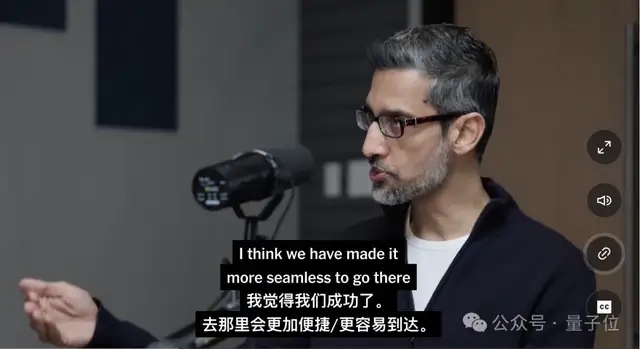
A year ago, we didn’t even have AI Mode. Now many people are using it, and we’ve made the path into AI Mode much smoother than before.
This is a continuous evolution, but information sources and links will always remain part of it.
Q: Kevin told me on the way here that over the past year he basically hasn’t used traditional Google Search much at all—he’s almost entirely using AI search.
When you hear that, do you think, “Great, that’s exactly the kind of user I want,” or do you get a little uneasy? After all, traditional search ads are very lucrative for Google.
Pichai: In AI Mode and in Agentic Mode, these technologies can do far more for users than they could ten years ago.
The ultimate business value depends on how much total value you create for users. Over time, the value we provide to users will increase, competition will increase, and choices will increase too.
So I believe there will still be a viable business model that combines subscriptions and ads.
Adam Smith’s rules still apply in this new world.
Public Anxiety About AI: Pichai Admits It Makes Sense
Q: Let’s talk about how the public sees AI.
A survey by The New York Times and Siena this week found that about 16% of respondents think AI is overall a good thing, while 35% think it’s overall a bad thing. What do you make of the current AI backlash? How much can Google do to change public opinion?
Pichai: AI is now seen by many people as one of the most important technologies humanity will face next.
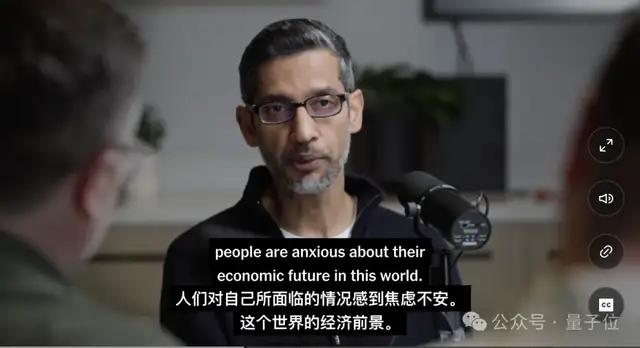
It’s moving so fast that it’s not easy for people to fully absorb such a massive change all at once… So it makes sense that people feel anxious.
When faced with such a huge technological shift, it’s natural for people to feel uneasy. Even less complex technological changes in the past have caused anxiety before—let alone this one, which really is unprecedented in its scope and scale.
From the perspective of the industry as a whole, what we can do is keep improving the technology and keep showing people what practical benefits AI can actually bring. That’s something we can work on.
At the same time, infrastructure investment is getting bigger and bigger, so we also need to keep thinking about how to use those investments more effectively and turn them into real value.
But at the end of the day, what people worry about isn’t just the technology itself.
One very real concern is whether their jobs, income, and future lives will be affected. There’s also a lot of discussion out there about whether work will be fundamentally transformed, whether certain roles will disappear, and so on.
Personally, I don’t think the future will be as bad as some of the especially pessimistic predictions suggest.
I think it’s healthy that people are debating AI right now. Given the current pace of AI development, people have every reason to be concerned, and we should take those concerns seriously.
AI Will Rewrite Work, but Pichai Thinks Young People Still Have a Chance
Q: You’re giving the commencement speech at Stanford next month. You’ve probably heard that a lot of commencement speakers have been talking about AI lately. How are you planning to talk to graduates about it?
Pichai: Every technological advance pushes the world forward.
In a sense, these graduates will be part of that progress, and also part of responding to its impact.
I’ve always been optimistic about the next generation. People always worry about the next generation, but the next generation always rises to the challenge and builds a better world. I think that’s true now too, and my goal is to share my experience with them.
Q: If you were speaking to a young person who just graduated, how would you explain that their economic future is still something to feel optimistic about?
Pichai: The most basic point is that in the future, each of us will have a new capability, and many things that used to be impossible may suddenly become possible.
Think about when spreadsheets first came out. I didn’t live through that era, but before spreadsheets, it’s honestly hard for me to imagine how people did financial analysis.
Once spreadsheets arrived, the threshold for many tasks changed. AI is similar—it will suddenly move a lot of people’s starting point forward.
Coding is the same. If we keep moving forward at this pace, more people in the future will be able to write code on their own.
And many positive changes may ultimately show up in ways that are more surprising than we can imagine right now. For example, people may become more productive, and there may also be more leisure time. Those things can happen at the same time.
Also, I feel that a lot of jobs are actually pretty exhausting.
Doctors are a very typical example. What doctors most want to do is care for patients. But many doctors will tell you that the amount of time they actually spend with patients is not that much.
AI can help free up some of that time so they can put their energy back where it belongs—on patients. Radiologists are another interesting example, and this topic has actually been discussed for a decade now.
Take me, for example: I’ve had many more scans in my life than my father’s generation ever did, and each scan now contains far more information than before. In the past, there were film constraints; now everything is digital, and the amount of information may already be 10 times what it used to be.
Looking 10 years ahead, that number may grow another 10 times.
So what do we do? Humans definitely can’t keep up on our own—you really need AI to help. That means the impact of this won’t be linear.
Every major technological shift brings disruption, and this one is no different.
As a society, we of course need to engage with it seriously, discuss it carefully, and respond thoughtfully. But I also think AI has many positive sides that haven’t been fully communicated yet.
I don’t really buy the extremely pessimistic view that the future is already destined to be terrible.
Agents, AGI, and the Singularity: Google Wants to Speed Up, but Fears Losing Control
Q: One more safety-related question. All the major labs are moving toward what you called “recursive self-improvement,” meaning AI systems that can improve themselves rapidly.
Do you think that can be done safely? Can you see the path to it now?
Pichai: I think any responsible lab, if it really gets close to that moment, shouldn’t just be discussing it internally—that has to become a broader conversation.
At these stages of AGI, we have to avoid falling into a race mindset.
Q: What do you think of the term AGI? What do you make of the idea that all progress is converging toward a single, world-changing thing?
Pichai: Technology is inevitably moving toward AGI, and that is absolutely happening.
I understood that very early on. Otherwise I wouldn’t have pushed the company, 10 years ago, to shift course and put AI at the very center of the company.
What I was trying to say was that even if AGI is still 10 years away, technology three years from now will already be much more powerful than it is today. So I didn’t want people to think that because AGI might be 10 years away, there’s no need to act now or prepare now.
Q: Are you basically AGI-pilled now?
Pichai: I’m very sure this technology is making foundational progress toward AGI.
I can’t predict whether it will happen in 3 to 5 years or 5 to 10 years. But the pace of progress over the past year or two makes me think it may be closer than people expect.
I’m running one of the largest companies in the world, and I also have a responsibility to society, so when I talk about this issue, the language I use may be different from others.
But 10 years ago, on the I/O stage, I announced TPU and an AI-first data center. So we know very clearly where this technology is headed.
Q: In this year’s keynote, Hassabis had a quote that went viral: “We’re at the foot of the mountain of the singularity.” From Google’s perspective, what does that mean exactly? Should people be excited, scared, or both?
Pichai: I’ve talked with Hassabis about this many times.
Here, he defines the singularity as the arrival of AGI. If you believe that, then that statement is his way of expressing it—that’s his definition of the singularity.
I think if you truly believe that, you should say it clearly, because we’re all on the frontier building this technology, and we want people to really listen.
As a society, we need to absorb this and prepare for it.
Reference: