
The Fastest Among Top-Tier Models! Zhipu, Are You “Spitting” Out Code?
400 tokens/s
Jin Lei, reporting from Aofeisi
QbitAI | Official WeChat Account
AI, your speed is basically blasting out code!
Take a close look. Don’t blink:
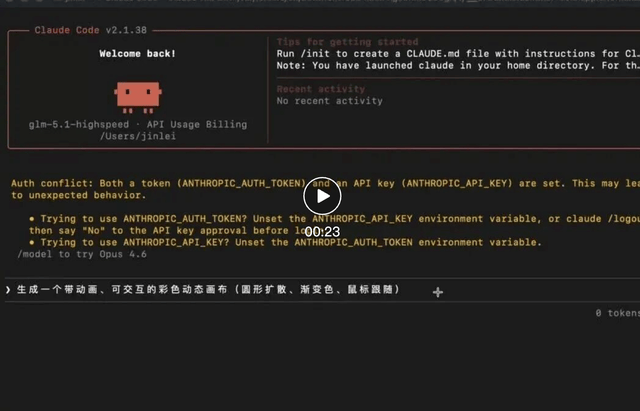
Video link:
https://mp.weixin.qq.com/s/Wn1-SzjpEkQLTyZnJKDRwg
So much code, just “whoosh” — it’s practically being fired out.
In the past, AI coding felt like a CPU rendering frames, typed out bit by bit. But this AI coding feels more like a GPU:

Can code generated this fast actually be useful?
The answer is yes:

This is Zhipu’s newly released high-speed API — GLM-5.1-highspeed.
According to the official description, this flagship model API is currently the fastest among top-tier models, reaching 400 tokens/s!
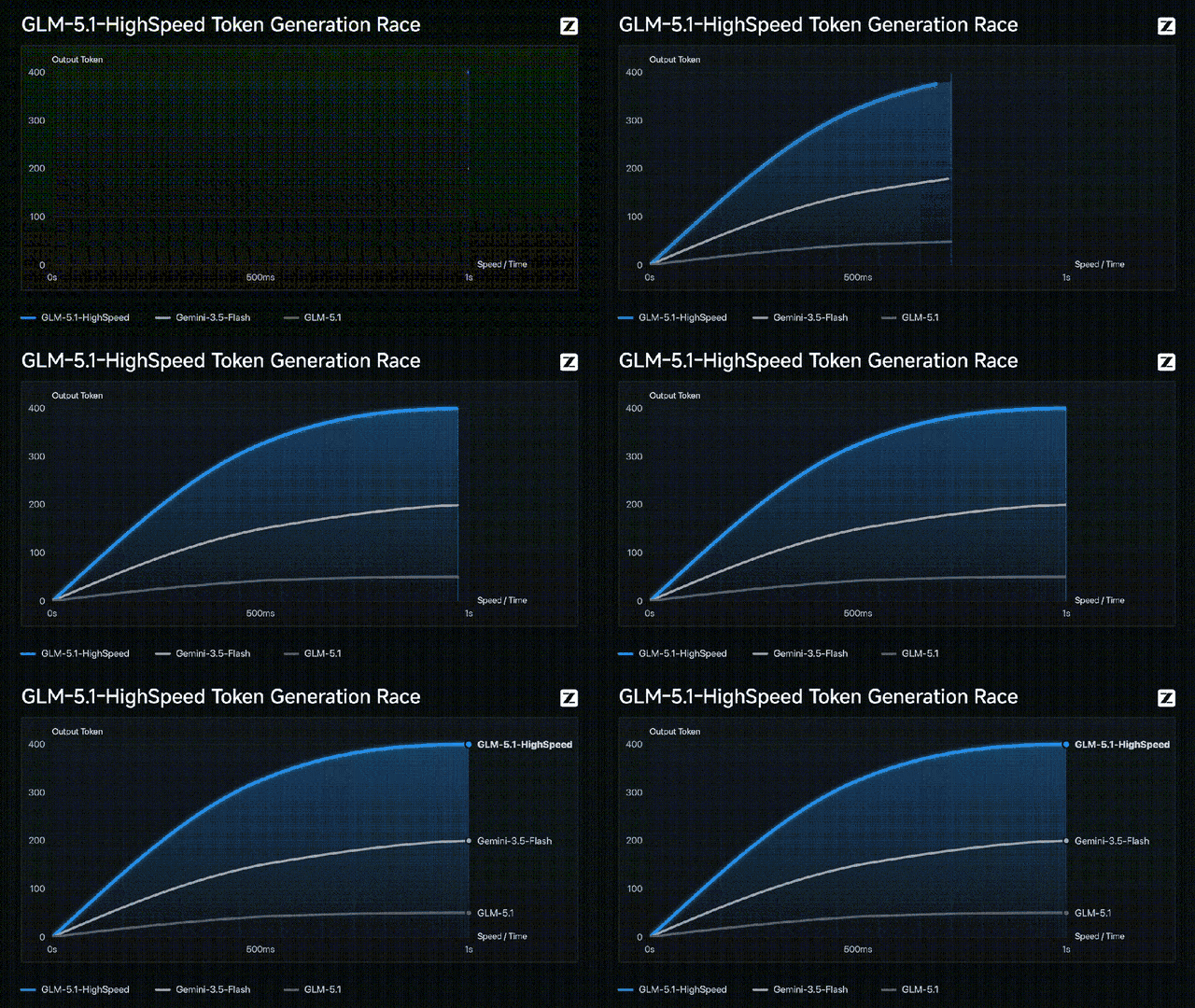
And although GLM-5.1 has been out for over a month, it’s still the strongest open-source model for coding:
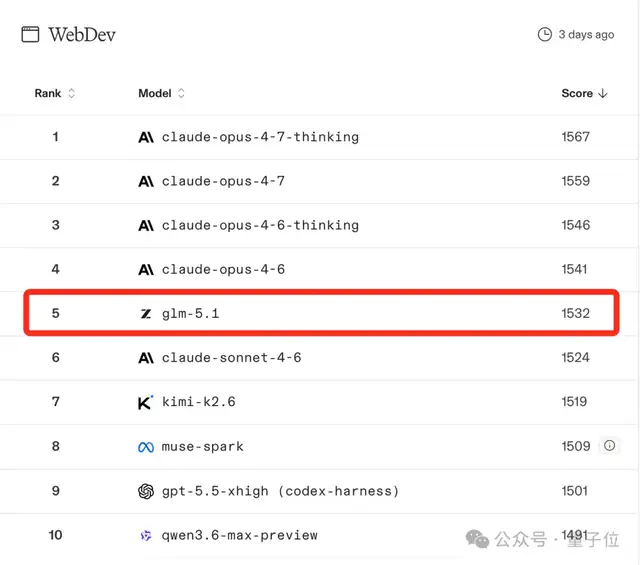
So next, let’s do the usual: a round of hands-on testing~
Hands-On Test of GLM-5.1-highspeed
AI coding feels like it’s on fast-forward
Let’s start with an example even more complex than the one at the beginning. The prompt is:
Create a web page where the center of the screen is a breathing nebula; after the user clicks play, particles should expand, converge, and change color in response to a simulated audio rhythm; also include several adjustable parameters such as speed, density, trail, and glow intensity.
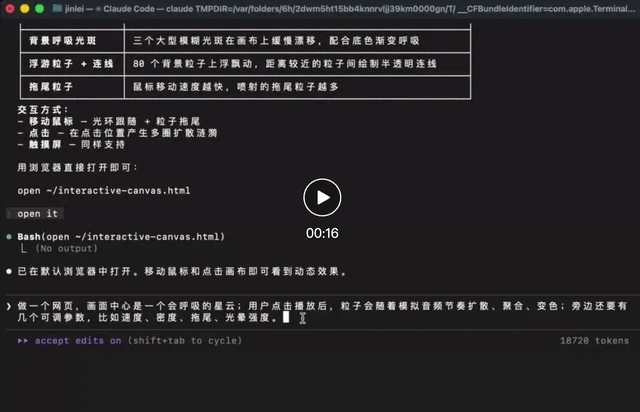
Video link:
https://mp.weixin.qq.com/s/Wn1-SzjpEkQLTyZnJKDRwg
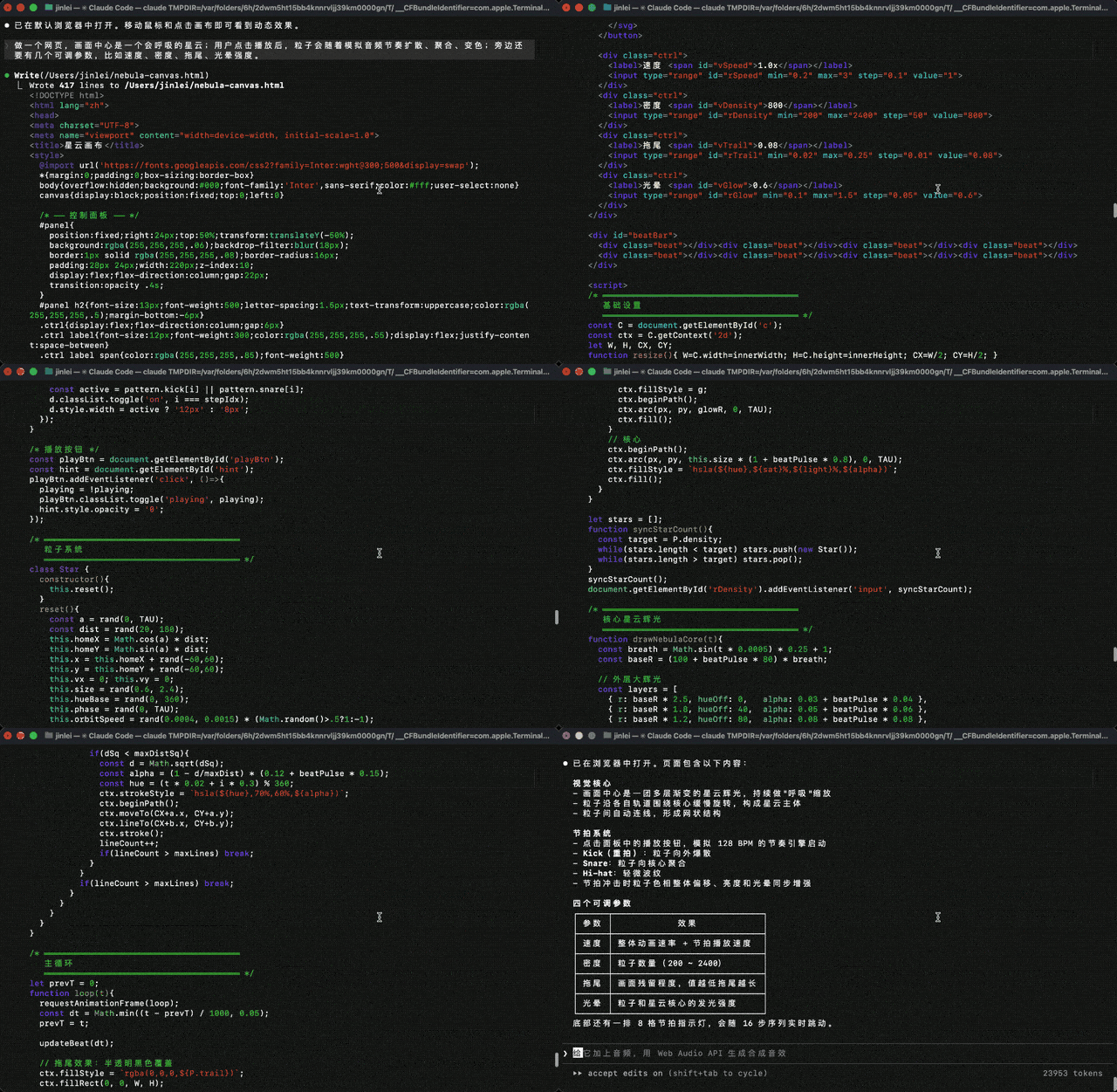
As before, even with so many lines of code, after thinking for more than ten seconds, the AI still spits it out in one go.
The challenge here is that it has to handle front-end structure, Canvas animation, state management, visual parameters, interaction logic, and also make the result look good rather than cheap.
Judging from the outcome, it did indeed meet the prompt’s requirements:

Like sitting at the same canvas with a designer
The second test is even more interesting.
Building on the previous code, we kept adding requirements:
“Make the ripple a bit faster.”
“Make the glow color warmer.”
“Make the particles spread out more softly, not so abruptly.”
“Don’t make the background pure black; add a little deep-blue layering.”
Video link:
https://mp.weixin.qq.com/s/Wn1-SzjpEkQLTyZnJKDRwg
First, these instructions are fairly vague, not as precise as “change the speed from 0.6 to 1.2 on line 42,” so the model has to accurately infer our intent first.
Second, because GLM-5.1-highspeed is fast enough, the felt experience of building projects changes too—
It feels much more like sitting next to AI and tweaking parameters together while watching the canvas.
This is also where high-speed APIs are easy to underestimate: collaborating with AI on projects now feels much closer to real time.
Letting the model act as a game director
For the third test, we pushed the scene one step further.
If the model is fast enough, can it change the world in a game in real time?
For example, build a small 2D game:
The player controls a character moving around in a 3D map. The scene includes obstacles, enemies, items, weather, lighting, and random events. There is also a dialog box for entering text, and the scene changes in real time based on the text input.
Then, instead of giving the model a fixed script, we keep issuing director-style commands like:
“Snow.”
“Rain.”
“Explosion”…

Video link:
https://mp.weixin.qq.com/s/Wn1-SzjpEkQLTyZnJKDRwg
This kind of test is trickier than building a webpage.
That’s because the model has to understand the game state, code structure, and interaction logic, while also judging what changes will affect the experience.
And a high-speed API makes previously impractical product forms possible, such as having the model change the game world state in real time.
Of course, there are still many engineering issues to solve here, such as stability, safety boundaries, state consistency, cost, and concurrency. But at least from a speed perspective, an API at the 400 tokens/s level has already made this kind of imagination more than just a PowerPoint idea.
Processing a 10,000-word article in 10 seconds
For the fourth test, we returned to the content industry.
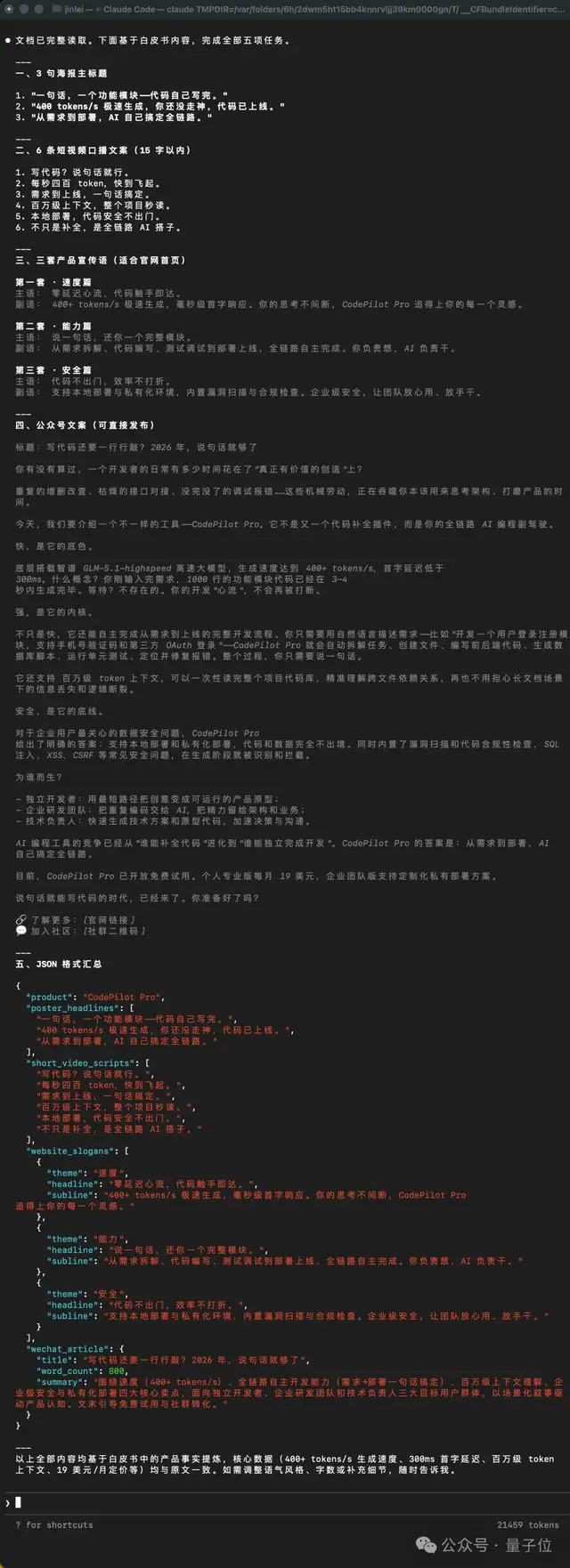
We used AI to read the material from a 10,000-word article and had it execute all of the following at once:
- Extract 3 of the most eye-catching poster headlines;
- Generate 6 short video voiceover scripts within 15 Chinese characters each;
- Produce three sets of promotional copy for a product (suitable for the homepage);
- Generate copy that can be posted directly to a WeChat official account (800 Chinese characters);
- Finally, generate a JSON summary of all the content.
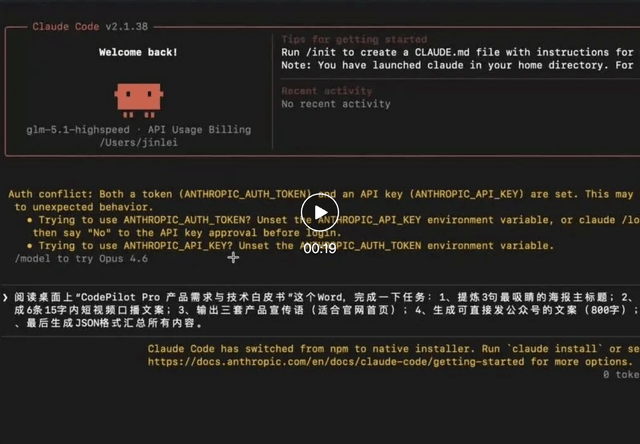
Video link:
https://mp.weixin.qq.com/s/Wn1-SzjpEkQLTyZnJKDRwg
It only took 10 seconds!
And the result was still impressively solid:
Once AI speeds up, humans move more quickly into the judgment stage; as a result, the collaboration between humans and AI becomes more like iterative refinement than one-off outsourcing.
Agents Enter the Fast Era
If we only look at the number 400 tokens/s, it’s easy to assume the model is faster simply because it’s smaller.
But in fact, what makes GLM-5.1-highspeed more noteworthy is that it positions itself as a high-speed version of a flagship model, not just a small model optimized purely for low latency.
What’s behind this is systems engineering.
The GLM team at Zhipu and the TileRT team jointly built GLM-5.1-highspeed, optimizing three layers: the inference engine, the scheduling system, and the underlying infrastructure.
The inference engine rewrites the core inference path around the characteristics of the GLM-5.1 architecture. The scheduling system reduces tail latency under high-concurrency scenarios through dynamic batching, request merging, KV cache scheduling, and similar methods. At the infrastructure layer, the team carried out coordinated optimization around inference cluster deployment, network links, and load balancing.
Put simply, large-model inference is not just a matter of “let the GPU compute and you’re done.”
In a real online system, how requests are queued and merged, how KV cache is scheduled, how multiple GPUs communicate, and how the network load is balanced — all of these affect the final latency.
TileRT takes the idea a step further.
It pushes the inference scheduling unit down from the traditional operator/kernel level to the tile level, using compile-time static orchestration, a persistent Engine Kernel resident on the GPU, and reduced host-side scheduling and cross-operator synchronization to compress the overhead of scheduling, data movement, and synchronization in the inference process.
In plain English, you could think of it like this:
In the past, it was like a group of workers having to wait for the foreman to give instructions every time they moved a single brick. Now, the route, division of labor, and pace are all planned in advance, so the workers can keep collaborating on the job site in a smooth assembly line.
Improvements in large-model inference speed often come not only from stronger chips, but also from squeezing every idle step out of the system.
Competition among high-speed APIs is, at its core, a combined battle of model capability, inference engine, scheduling system, and infrastructure.
Of course, speed should not be overhyped.
If an API is truly going into production, you still need to look at model quality, stability, cost, context capabilities, tool-calling reliability, concurrency, and error rates in complex tasks.
In particular, a speed figure like 400 tokens/s still needs to be continuously validated across more tasks, more time periods, and more concurrency conditions.
But at least from this test, one clear trend is visible:
The competition among domestic large-model APIs is moving beyond simply answering well, and toward being able to work fast and reliably.
That is exactly where the significance of GLM-5.1-highspeed lies.
It shows us that when flagship model capability is paired with a high-speed inference system, the AI Agent experience changes in a very intuitive way: less waiting, denser feedback, and more continuous task progression.
In the coding era, speed is what feels exciting.