
80-Episode Short Drama Shot in 3 Days: When Filmmakers Build Agents, the Film Industry Finally Gets a Truly “In-the-Know” Solution
Dozens of times more efficient, with token consumption cut by 70%
Yunzhong, from Aofeisi
Quantum Bit | WeChat Official Account QbitAI
Many people think the end goal of AI video is “generating a stunning clip.”
But anyone who has actually worked in film and television knows that’s not the end — it’s not even the beginning.
A real production needs a character in Episode 8 to look exactly like they do in Episode 1, needs 20 people working simultaneously without stepping on each other’s toes, and needs the budget to still add up after it’s spent.
From script breakdown to character modeling, from multi-person collaboration to version control to budget accounting — in every link of that chain, existing AI generation tools are almost entirely absent.
So a group of filmmakers who had spent twenty years in the industry decided to step in and fill the gap themselves.
MovieFlow Studio was born.
Based on what is publicly available and feedback from beta testing, MovieFlow Studio’s impact is mainly concentrated in three areas:
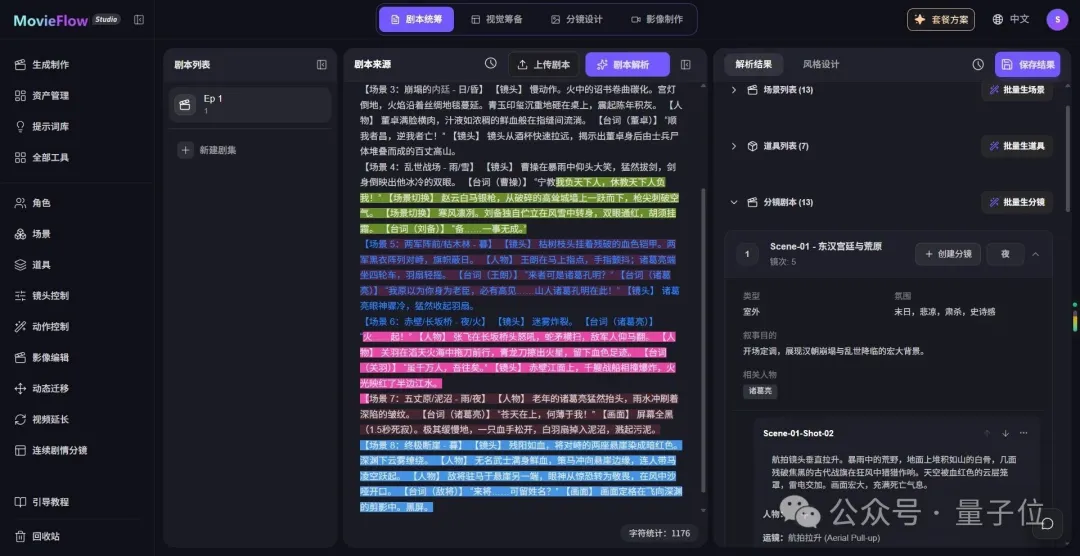
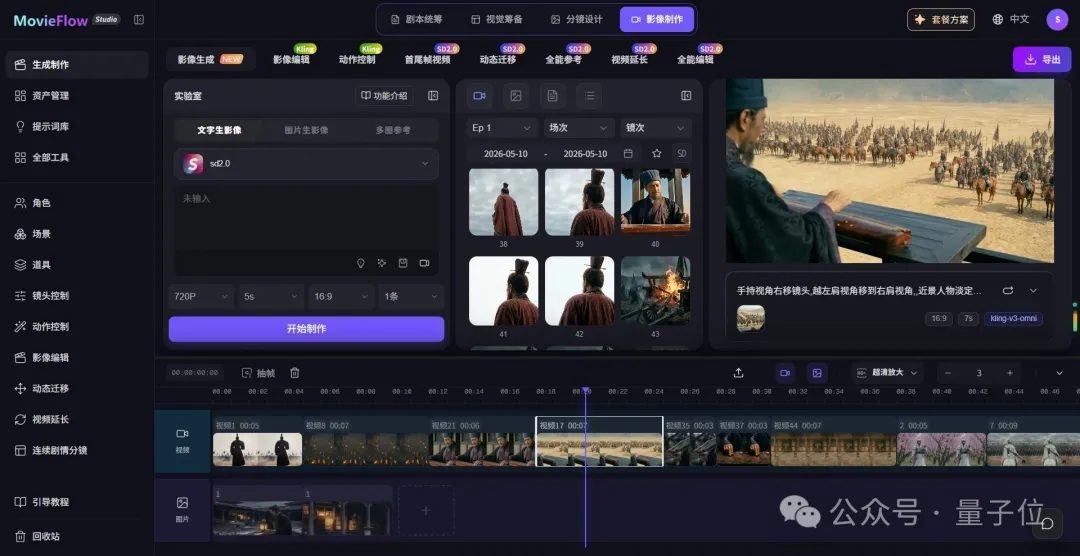
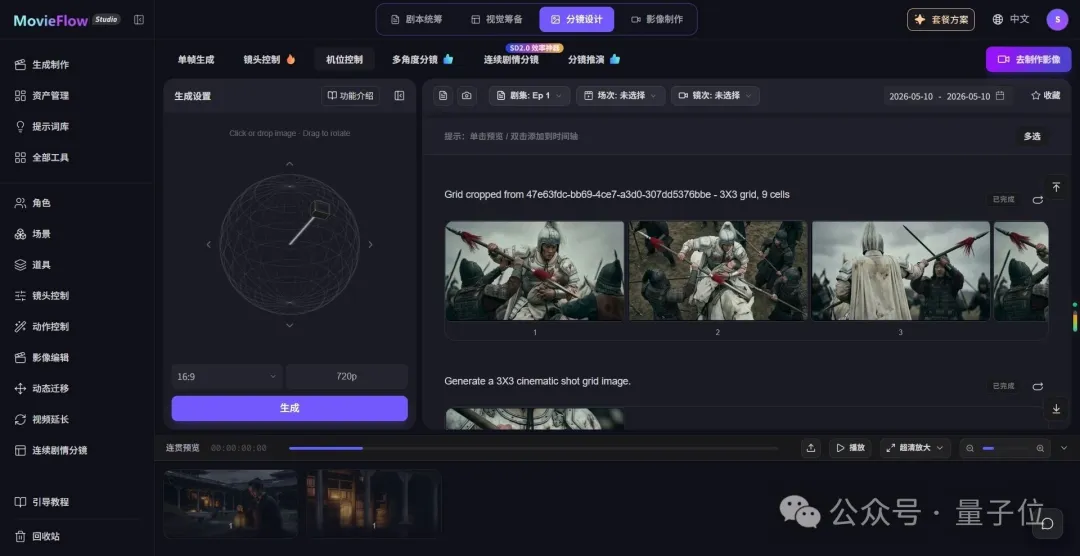
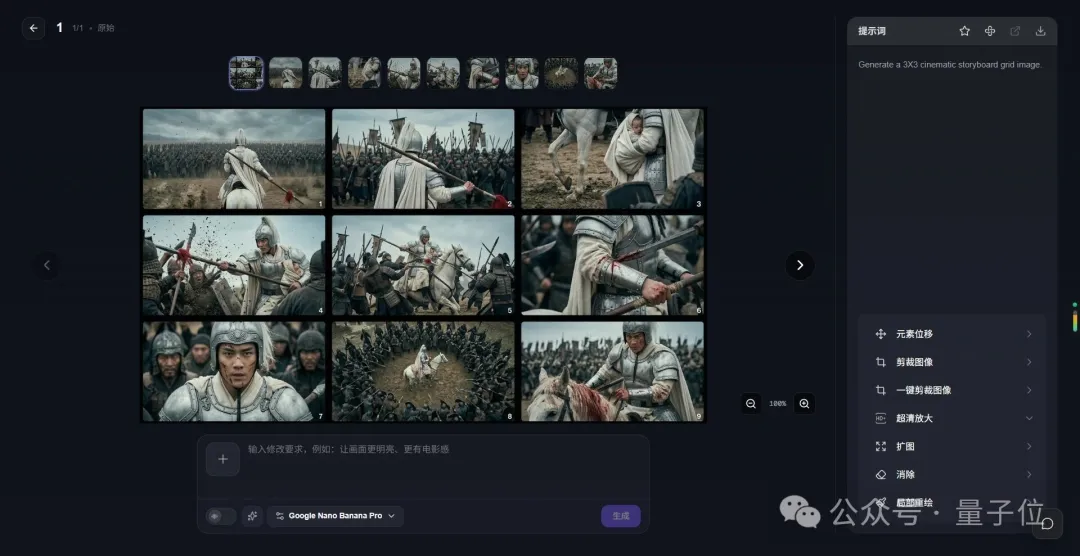
- End-to-end closed loop in a single system: It brings together workflows that were previously scattered across a dozen tools — script parsing, storyboarding, video generation, timeline editing, and more — into one workspace;
- Enterprise-grade asset library: By building libraries for characters, scenes, and props, it tries to put an end to the nightmare of visual elements constantly “changing faces/drifting” in serialized content;
- Collaborative management at the thousand-user scale: It brings member permissions, project progress, point allocation, cost tracking, and canvas collaboration into the backend, turning uncontrollable artistic creation into measurable “data flows.”
On closer inspection, this is a full-fledged AI video agent that has grown directly out of the logic of film production.
How did it break open the industry’s “false proposition” and push AI filmmaking toward industrialized production?
The Industry’s False Proposition: The Flashiest “Pen,” but No “Production Line”
To understand MovieFlow Studio’s impact, we first need to look clearly at the awkward reality of current AI film and TV creation.
Right now, AI video generation often follows a kind of “show-off creation” model: input a precise prompt, generate a few dozen seconds of stunning visuals, then post it to social media.
In essence, these tools have become toys for social flexing, while whether they can truly be used in a real production pipeline is still an open question.
In fact, real filmmakers have spent the past few years trapped in a swamp of “tool stacking.”
During MovieFlow Studio’s research, the team learned that a typical short-drama production team using AI to make content often ends up with a workflow like this:
Use one large model to write script prompts, switch to Tool A for character concept art, jump to Tool B for environments, use Tool C to generate video materials, then edit in Tool D, and finally go to AE for effects — all while using cloud drives for transfers and WeChat, Feishu, and other group chats for coordination.
Each individual tool is powerful, but stitching them together makes the workflow painfully cumbersome.
The pain caused by this fragmentation is, frankly, “fatal.”
And this fragmentation directly leads to three outcomes:
First, time costs rise.
Materials have to be exported, imported, transferred, and renamed over and over; teams spend huge amounts of time moving files and aligning versions instead of focusing on creation itself.
Second, visual continuity becomes uncontrollable.
Switching back and forth between different tools, models, and parameters easily causes drift in character appearance, costumes, props, scene atmosphere, and lighting style.
Third, management costs increase.
Once a project involves multiple people, material versions, permission divisions, point consumption, budget tracking, and asset archiving all become new hidden costs.
What we really lack is not a more powerful model, but a system that can connect tools, workflows, and assets.
This is the common conclusion reached by many creators who have tested current AI video production tools.
Among them, Zhu Shengda, CEO of Santo Shuo and a beta tester of MovieFlow Studio, pointed out that in serialized short dramas, the easiest place for problems to occur is not that a single shot is unattractive, but that characters and worldbuilding are hard to keep consistently stable.
In the past, when making serialized short dramas, a character’s clothes or props might change after just one or two episodes. Every time a creator made a new film, the visual assets from previous characters, scenes, and props almost all had to be reorganized from scratch. A lot of time wasn’t spent on storytelling, but on aligning characters and visual styles.
This kind of problem is highly related to the tool fragmentation mentioned above.
When character images are generated on one platform, scene images on another, and video footage comes from a third, the production team has a hard time ensuring that every generation call is based on the same asset standards.
For viewers, character drift breaks immersion; for the production team, it means rework, redrawing, regeneration, and additional costs.
Zhangen from Ruyi Film, Chief Content Officer Zhang Qiang, saw a deeper issue from a project management perspective. In his view:
Many AI tools are very strong at a single point, but once placed into a complete project, they reveal shortcomings in asset management, production continuity, and cost control. For a company, whether a tool is easy to use is not just about output quality — it’s also about whether it can reduce trial-and-error costs, shorten the production cycle, and make the project controllable.
This also explains why MovieFlow Studio did not build product features around “generation” alone, but instead put scripts, assets, storyboards, video, collaboration, and management into one unified system.
When Film Industry Logic Begins to “Backward-Compatibly” Land
MovieFlow Studio’s breakthrough point is very sharp.
Other teams come from a technical background and focus on making the visuals more dazzling; this team, by contrast, is made up of filmmakers who have spent a decade or two grinding away in the film and TV industry.
They have suffered from cross-department collaboration and lost materials, so what they built feels more like a system for AI visual creation and asset management grounded in real film production logic, rather than a generic AI video tool.
And when evaluating a product’s differentiated value, the key is whether it solves the industry’s “dirtiest, hardest” work.
MovieFlow Studio’s first major move is its end-to-end closed loop.
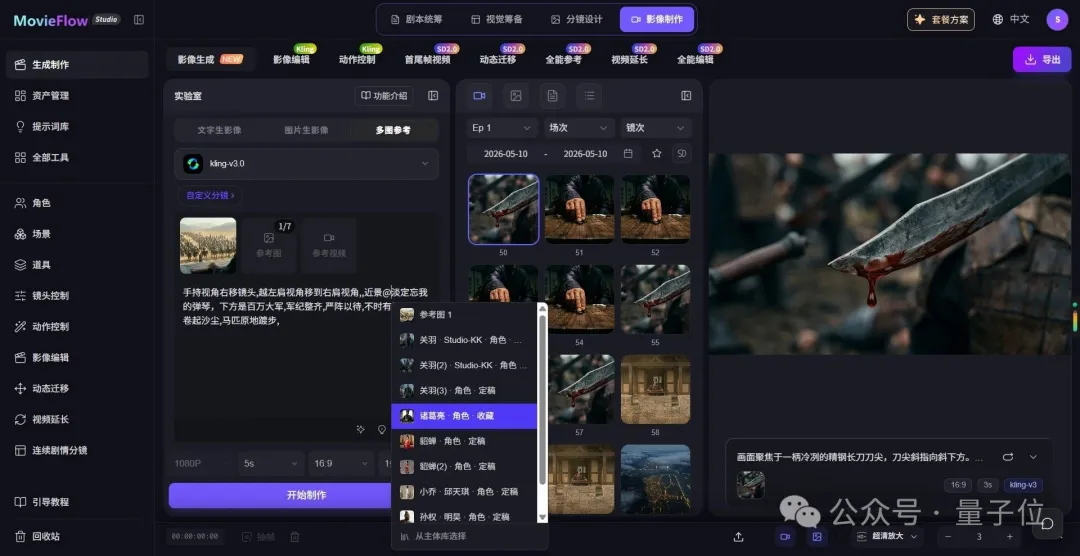
It integrates script parsing, character/scene/prop generation, storyboard design, video generation, timeline editing, team collaboration, and project management into a single workspace.
That means creators no longer have to bounce endlessly between different software tools.
Let’s look at some of the latest test results:
- Script parsing: Supports importing million-word scripts in PDF/DOCX/TXT format, and can complete structured breakdowns of characters, scenes, props, scenes, and shot information within 3 minutes, with accuracy maintained at 100%. This directly improves early-stage coordination efficiency by more than 10x;
- Workflow optimization: Built-in timeline editing reduces operating steps by 70%. Text prompts stay with the project throughout, so whether you want to revise or review, you can find them in time.
As fast as within 1 hour, professional creators can complete a full short film with strong visual impact.
In AI live-action short-drama beta testing, creators could produce up to 20 episodes per day, and an entire 80-episode series required only 3 days from start to finish (assets can be reused, and much of the later-stage work speeds up, so production gets faster and faster).
In specific cases, the team has used MovieFlow Studio to achieve highly efficient production of multiple episodes in a single day.
Compared with simply emphasizing output speed, what is more noteworthy is that under such high-frequency production, MovieFlow Studio can still maintain higher stability and consistency in the final work through script information following, asset reuse, and project management.
A Reusable Asset Library Is the Real “Efficiency Killer App”
If the end-to-end workspace solves the problem of “broken workflows,” then the asset library solves the problem of “starting over every time.”
Many AI generation tools on the market are stateless, meaning that each generation is like starting a brand-new game.
But film and TV, short dramas, comic-style dramas, brand IP, and virtual character projects are not suited to this mode of creation.
They need characters, scenes, props, styles, and worldbuilding to remain continuously stable across multiple episodes, multiple shots, and multiple projects.
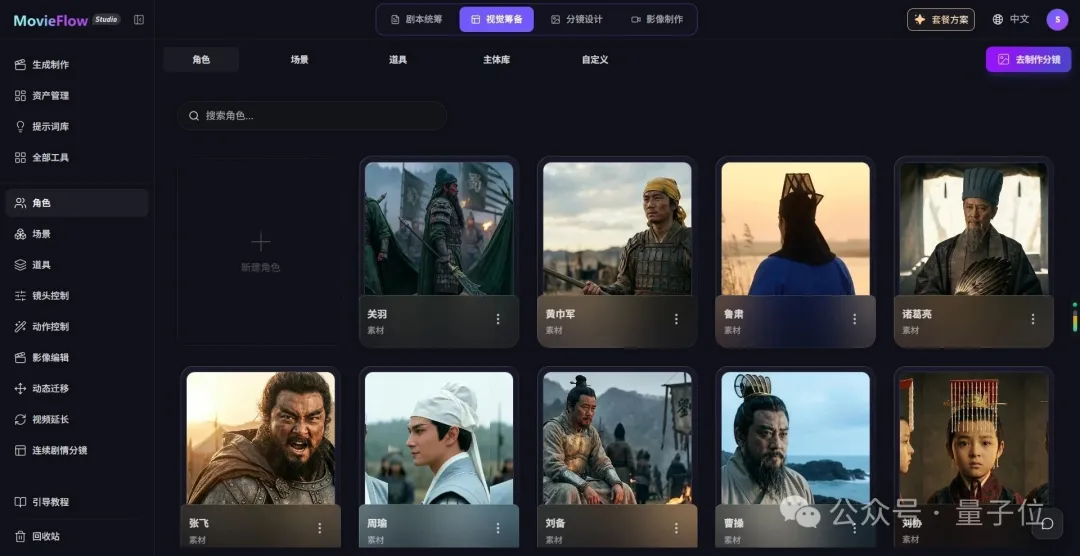
To address these issues, MovieFlow Studio includes a full set of character libraries, scene libraries, prop libraries, subject libraries, and custom asset libraries.
Characters designers have created, scenes they have built, and props they have refined can all be saved, categorized, and managed by the system, then called again and again in future creations.
This directly hits the core pain point of all serialized content creators, because serialized creation fears one thing most: visual discontinuity.
One user did the math:
In the past, when producing IP short dramas, the proportion of token consumption spent on “retouching to align visual style” was outrageously high. Now that assets are accumulated, there’s no need to regenerate the base character image for later use. Token consumption drops by more than 70%, and character consistency reaches 95%.
On this point, staff from Yuanhuan Studio under Youku also said:
This isn’t just about saving money. More importantly, it has improved the team’s creative efficiency by 353% month over month. Every time they make a new film, the team is accumulating digital assets rather than resetting to zero. This mindset of “content compounding” is what AI-driven film industrialization should look like.
From “Small Workshop” to “Thousand-Person Studio,” Redefining Collaboration
If the features above give individual creators a powerful boost, then MovieFlow Studio’s enterprise-grade management capabilities are the key that lets the whole film industry see the promise of scaling up.
What many people don’t realize is that when creation moves from an individual to a team, the real enemy is often not technical barriers, but management loss of control.
For example: Who changed the protagonist’s model? Which folder is the storyboard for Episode 3 in? How much budget is left?
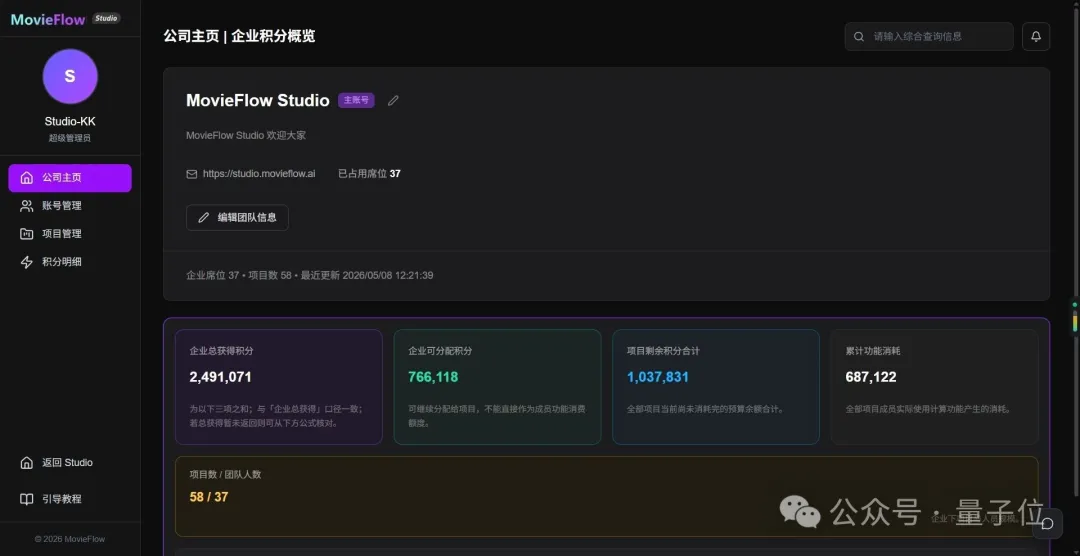
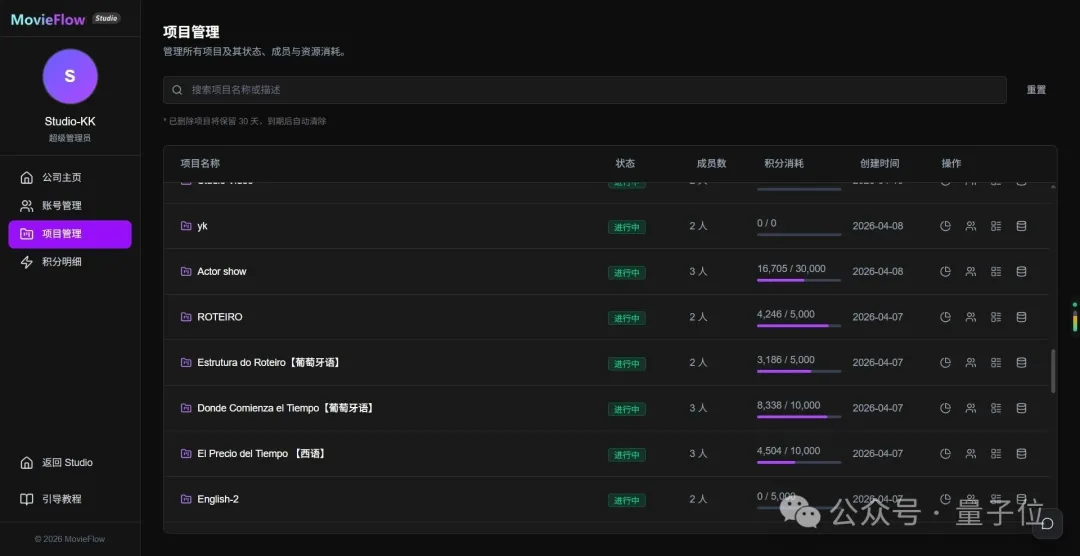
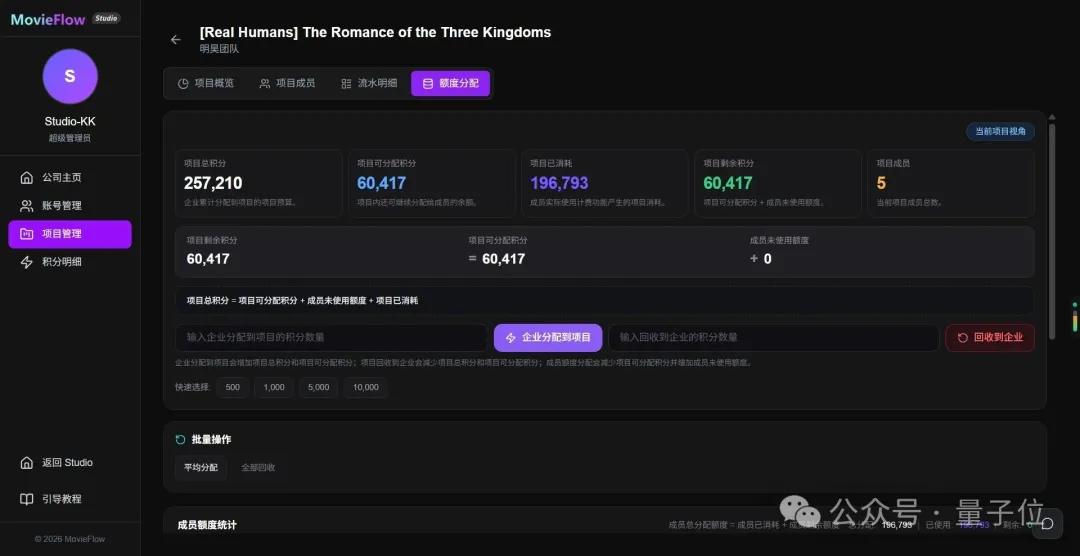
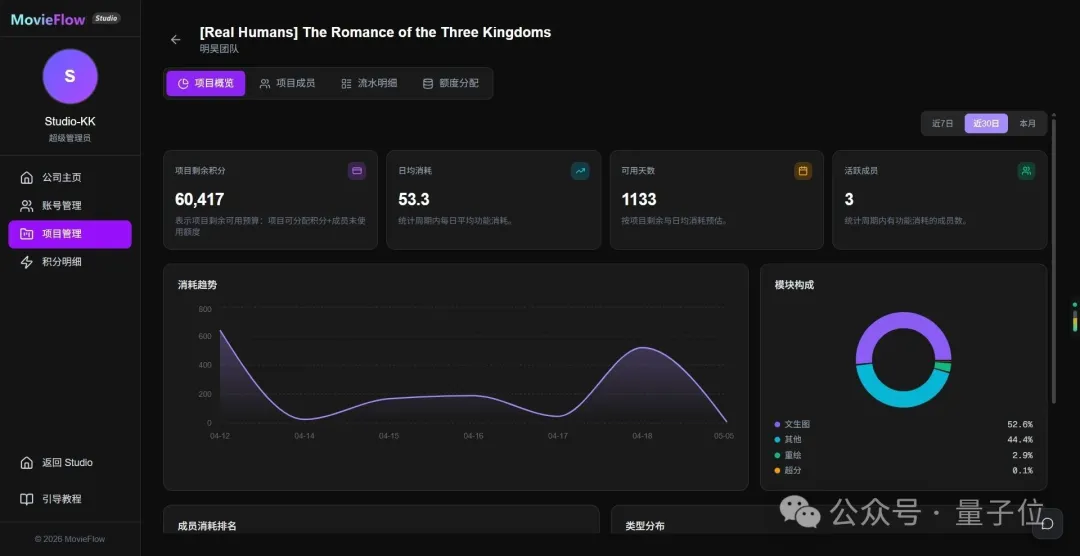
In MovieFlow Studio’s backend, all of these resources are highly visualized.
It supports tiered collaboration for up to 1,000 people within a single organization, and can manage more than 200 feature-length and short-form projects in parallel.
In addition, the team has developed a “canvas collaboration” feature.
Unlike the canvas generation approach of other products, MovieFlow Studio directly brought the concept of “Feishu shared documents” into the product.
Within the canvas, members can annotate, edit, and communicate at any time, organizing generated content and sorting it into different projects, which effectively doubles efficiency.
Member permissions, communication handoffs, point allocation, project progress, asset flow, and cost statistics are all clear at a glance.
In this way, the uncontrollable “artistic creation risk” is directly reduced into a measurable “industrial data flow.”
In addition, MovieFlow Studio natively supports 36 languages, and the backend interface, prompt input, and team collaboration all connect seamlessly across regions.
This lays the foundation for multilingual creation and collaboration for international teams that need to allocate CG talent globally and co-create with overseas directors, thereby reducing communication costs in tool usage and project management for cross-regional projects.
In the industry’s view, this “deploy once, produce globally” capability truly fills the final missing piece in the AI film and TV chain — organizational capability.
Not Just a Tool, but a Plan for the “Digital Actor” Frontier
If it were only about reducing cost and improving efficiency, MovieFlow Studio would already have scored very highly.
But the founders’ and team’s ambitions go far beyond that.
At present, MovieFlow is actively advancing the construction of an actor digital asset library and a global digital asset management center.
According to reliable sources, MovieFlow is continuously building connections with domestic and international actor resources, film and TV resources, rights holders, and overseas partners.
At the same time, they are also promoting a highly forward-looking ecosystem initiative:
Under compliant authorization, convert real actors’ images into digital assets that can be called across projects.
This is a concept with the power to transform the industry.
In the future, classic IP characters and original virtual人物 will all form traceable, licensable digital assets on-chain.
Actors gain new career space and revenue models, creators gain stable and unified visual identities, and the industry gains an asset foundation that can be operated long term.
This is no longer a one-off “copyright business,” but a living ecosystem that can continue to generate value.
 △ Founder Liang Wei with senior industry figures from China and abroad
 △ Founder Liang Wei with senior industry figures from China and abroad
MovieFlow Studio’s biggest breakthrough may be that it has redefined the relationship between “people” and “tools” in AI filmmaking.
It systematizes the repetitive labor that drains artists’ inspiration — such as moving materials across platforms, aligning character images, and manually calculating costs.
It turns every asset from past creations into future capital, making “continuity” the norm rather than the pain point.
On this workspace, workflows are straightened out, boundaries are disappearing, and a “leap in creative efficiency” led by filmmakers who truly know the industry is reshaping the way content is generated from the ground up.
Creator Collaboration: Finding the World’s Best Storytellers
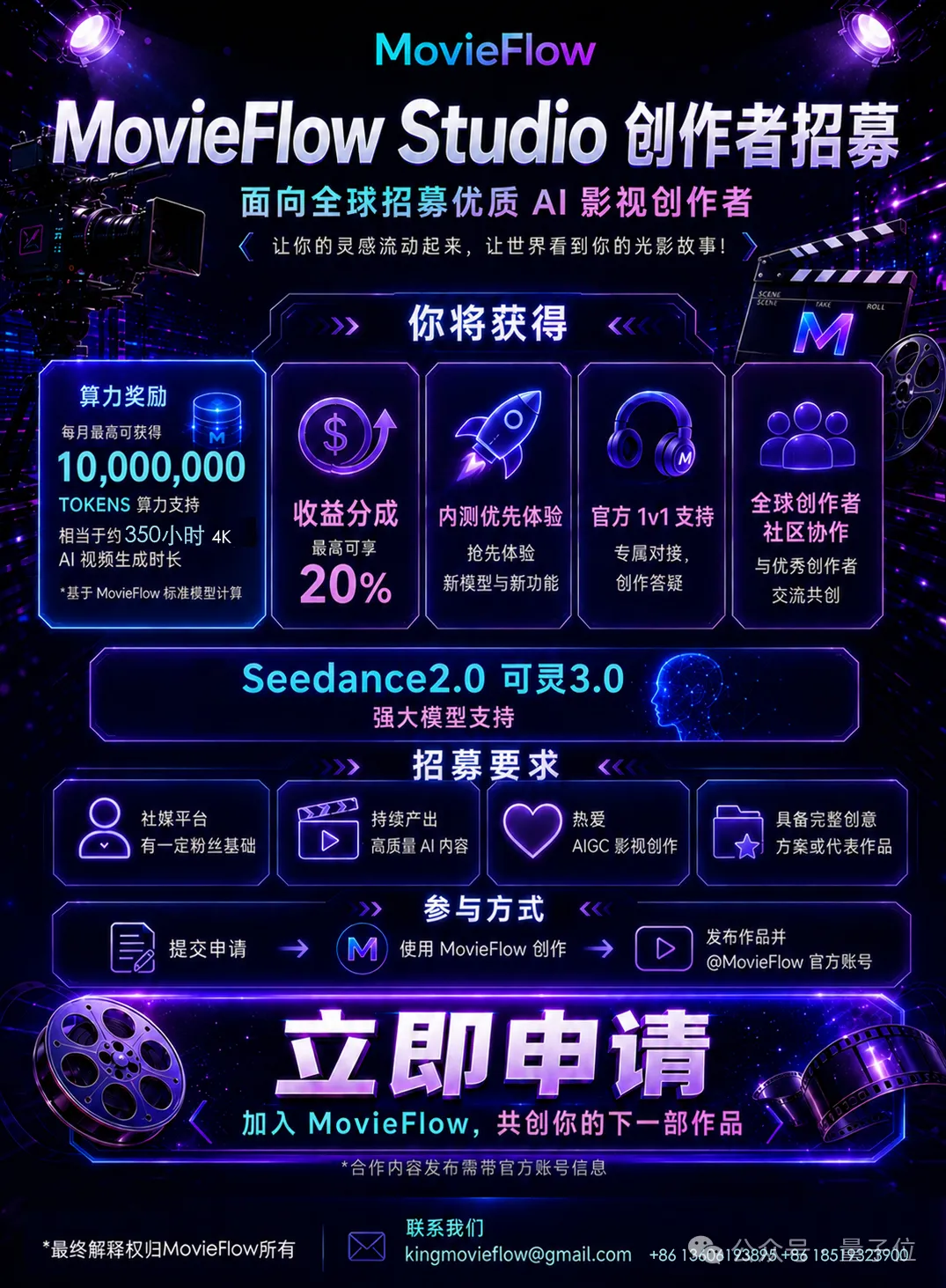
The launch of MovieFlow Studio is not the end; its official creator collaboration program has also gone live.
According to reports, the official team is now recruiting high-quality AI film and TV creators from around the world. Selected creators will gain deep beta access to the technology, unlimited compute support, exclusive traffic exposure, and even the chance to directly participate in building the overseas digital actor ecosystem and matching with commercial projects.
For many young directors who have strong scripts but lack industrialized production capabilities, this is an ultra-low-barrier channel to quickly turn inspiration into visuals and reach the global market directly.
Is the Film Industry’s “iPhone Moment” Here?
Most of the AI video tools on the market are still focused on polishing the “visuals” themselves.
But history has shown that what changes an industry is never the sharpest brush — it’s the production line that lets that brush move.
MovieFlow Studio did not try to outdo everyone on technology alone; instead, it turned to sorting out the most painful, most labor-intensive “dirty work” in the film and TV industry.
- Complete the entire process in one workspace;
- Use an asset-library system to turn generated elements into stable digital assets that can be reused long term;
- Manage production, people, budgets, and schedules. Thousand-person collaboration, 200+ projects running in parallel, with every asset flow and cost trend visualized in real time.
From full-process integration to asset reuse, from thousand-person collaboration to global deployment, these veteran filmmakers have used one system to restore “creation” to what it should be: give complexity to the system, and give creative control back to people.
This is completely and unmistakably the first true AI video agent that has grown out of the logic of film production.
The AI agent the film industry has been waiting for for so long is right here.