
Can’t Keep the Lobsters Alive Anymore? Zhou Hongyi Has Given Them a Cloud Office, with a Dedicated Online Coach for Training Lobsters
The second half of the lobster story has only just begun
henry, reporting from Aofeisi
Quantum Bit | QbitAI WeChat Official Account
The Agent race in 2026 has a very striking vibe.
On one side, the developer community is all-in.
Lobsters (OpenClaw), horses (HERMES), humans (OpenHuman)… all kinds of Harness frameworks are iterating furiously, and the heat is off the charts.
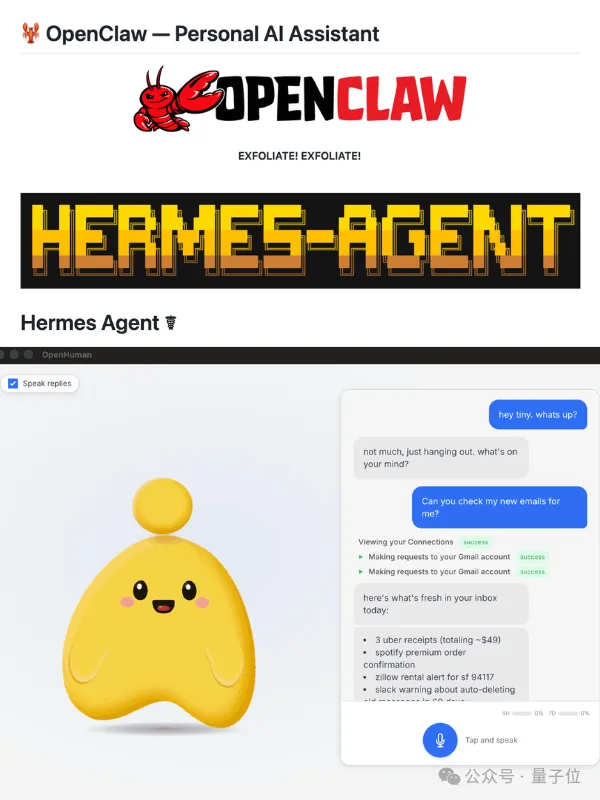
On the other side, users are cooling off at lightning speed. The FOMO around raising lobsters disappears just as quickly, and so does the wave of abandoned projects.
As more and more Agent frameworks emerge, the number of people still raising lobsters keeps shrinking.
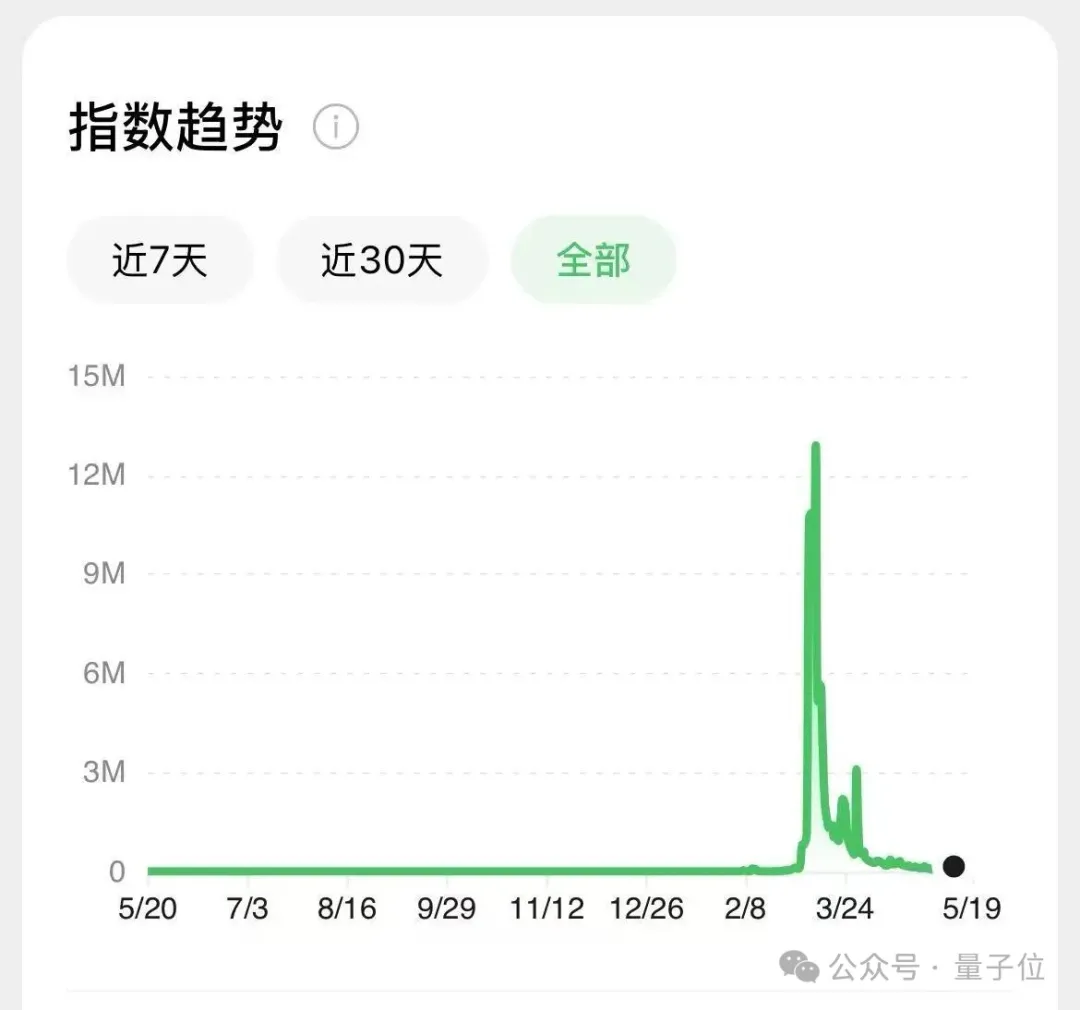
Over the past two months, many people’s mindset has shifted from the excitement of successfully setting up their first lobster to the headache of configuring environments, tweaking skills, keeping a computer running, burning tokens, fixing workflows, and endlessly reworking things.
You could say the lobsters are good lobsters — they’re just really hard to raise.
And since March, when Zhou Hongyi personally helped everyone set up their lobsters, he also bluntly said in 360’s latest livestream that the biggest reasons lobster hype has cooled are just three things:
Too hard, too expensive, and not safe enough.
In response, 360’s new move is a brand-new secure lobster cloud version, plus a “private tutor” for lobsters—
Lobster Coach.

In a nutshell, the cloud version is basically an entire “cloud office” for lobsters: cloud servers, cloud storage, cloud browsers…
You give the lobster a command on your phone, and it runs the task itself in the cloud. No need to buy a Mac just to keep it running; it keeps working even if you shut down or disconnect from the internet.
Lobster Coach takes over the parts of the work that have historically scared off ordinary users, and depending on the task type, it can train your lobster from 0 to 1, orchestrate Agents, and improve workflows.
In a sense, what 360 is doing now is no longer just “building another Agent,” but providing the infrastructure that Agents need.
After all, as lobsters have evolved to this point, people are gradually realizing that what’s limiting Agent adoption is no longer model capability — it’s that Agents have never really been “alive” in the first place.
Why Lobsters Still Matter
Before talking about how 360’s new lobster works, there’s one question nobody can avoid:
It’s almost halfway through 2026. Do people still need a lobster?
Especially after this wave of “lobster-raising fever” has cooled off.
A while ago, I was chatting about this with a friend who runs a design company, and he made an interesting point: if you use a lobster well, it can replace an entire team.
Let’s see how he uses it.
His company is small, so he has to keep an eye on everything himself.
During the day, he meets clients and rushes design drafts; at night, he goes home and keeps replying to messages, checking feedback, and organizing proposals. For someone with more than a decade of design experience like him, the most exhausting part isn’t difficult client requirements — it’s the constant stream of trivial work.
Emails, WeChat groups, client feedback, competitor updates… none of it is individually complicated, but together it drains you.
Later, he followed the trend and tried using a lobster.
Now every morning, client feedback is already automatically prioritized and summarized into a document. He doesn’t need to keep switching back and forth between chat windows, and he can even read the summary to understand client preferences and habits.
He said the most obvious change isn’t actually higher efficiency — it’s that his brain finally feels less fragmented.
The tokens that used to be consumed by his brain have been shifted to the lobster’s brain.
A friend of mine who works in marketing is pretty much the same.
In the past, competitive analysis often meant spending two or three days buried in research. Now he just lets the lobster monitor industry feeds every day, automatically organizing product launches, funding rounds, feedback, and data changes.
By the time he actually starts doing the work himself, it’s already at the “judgment” and “decision-making” stage.
This is also why, this year, people suddenly started taking lobster-raising and Agents seriously.
It’s actually quite common: many people eventually realized that what they were missing wasn’t a smarter chatbot, but an “AI employee” that could keep watch for them over the long term, run tasks, and call tools on its own.
You go to sleep, and it’s still working. You go to a meeting, and it’s still running in the background. That’s the biggest difference between an Agent and a chat window.
But the problem is obvious too.
Right now, most lobsters are still too much like “geek toys.” People who know how to use them think they’re amazing; people who don’t get stuck at the very first step.
That’s also why the nationwide lobster craze that started in March is now cooling off.
On one hand, ordinary users can’t turn past operating history into SOPs, and they’re not very good at writing prompts; on the other hand, lobsters burn through tokens too fast, and there may even be safety issues when deploying them in real environments.
△The Father of Lobsters Spends 9.4 Million Yuan a Month on Tokens
The three problems Zhou Hongyi summed up — too hard, too expensive, and not safe enough — are basically exactly this.
So 360’s positioning this time is very clear: it’s not making another AI chat tool, but giving you an AI employee team.
The cloud version equips this team with a full cloud office, while Lobster Coach is there to help you recruit.
Whether you want to become a super individual or the next generation of AI natives, you can build your own lobster team.
Next, let’s take a closer look at what this secure lobster is all about.
Building a Cloud Office for Lobsters, Remote-Control Style
In our hands-on testing, we mainly tried out two features: cloud mode and Lobster Coach.
Playing with Lobsters in the Cloud: They Keep Running Even When You Shut Down
Let’s start with the cloud side.
I sent the lobster app a message on my phone: help me do an industry survey on AI video generation tools. Then I put the phone down.
A few minutes later, 360 Lobster returned a pretty solid result, including the impact of Sora shutting down, with data support that looked quite convincing.
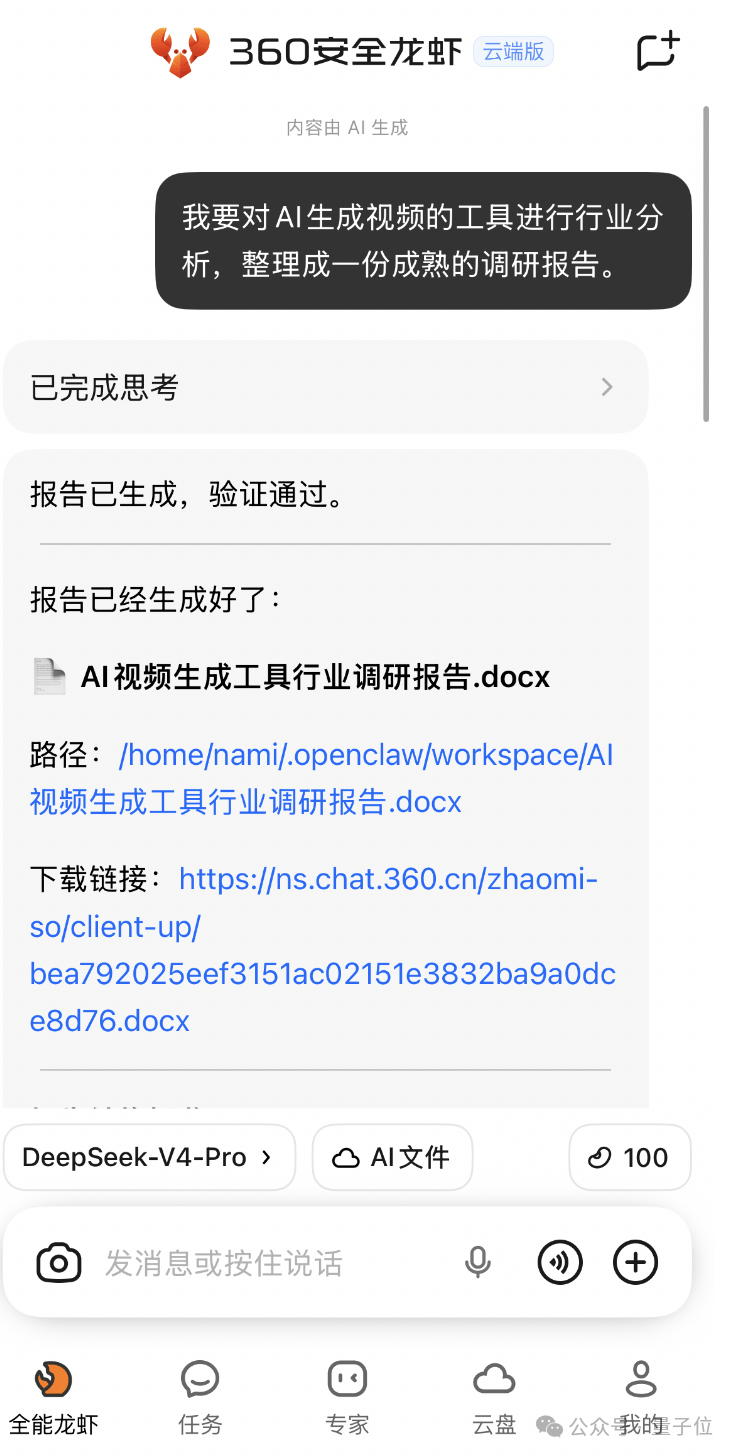
I never opened my computer, and my phone didn’t need to stay on the whole time.
The lobster finished the entire task in the cloud by itself, and the generated files were saved directly to cloud storage, ready to be checked anytime.
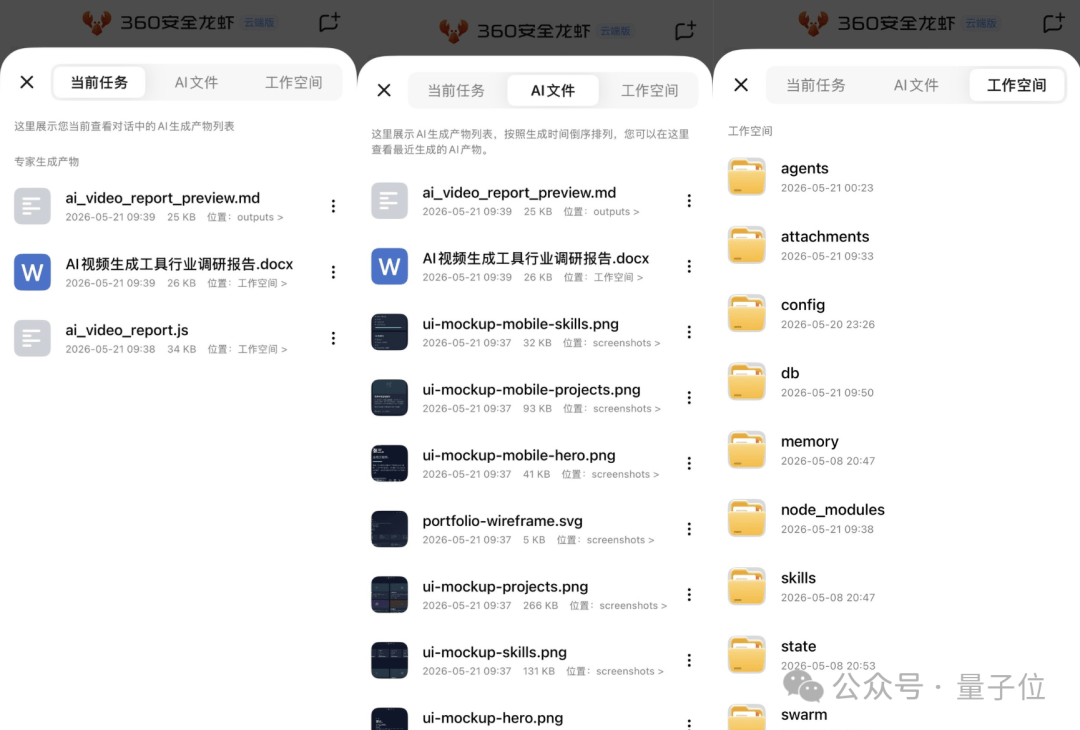
This is the most intuitive change brought by cloud-based lobster-raising: once you give the command, you can go do other things, while the lobster keeps working in the background.
Lobster Coach: Train a Personalized Lobster in Two Minutes
Then there’s Lobster Coach.
My request was: I want to train a lobster specifically for writing articles, in the style of QbitAI.
Lobster Coach started confirming the boundaries with me step by step, from how to address things, to standards for judging news value, search scope, writing style, and work mode. The whole process felt like chatting with a real person.
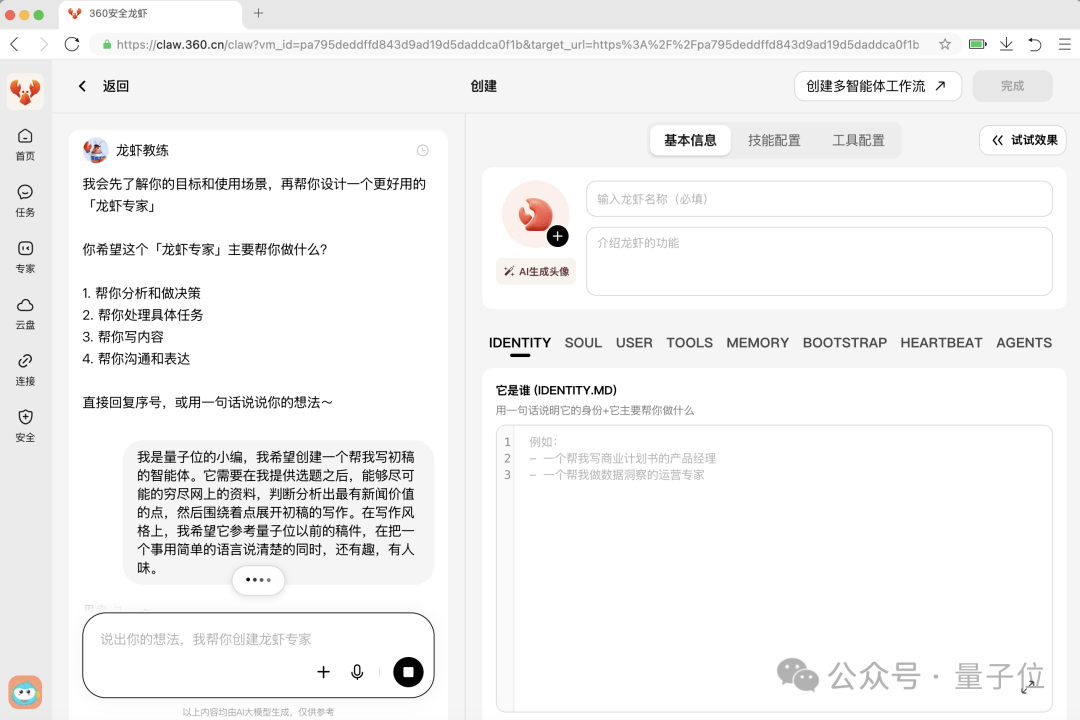
In about two minutes, a complete lobster setup was created. soul, context, tools, memory, skill — everything was configured, and once confirmed, it was deployed directly.
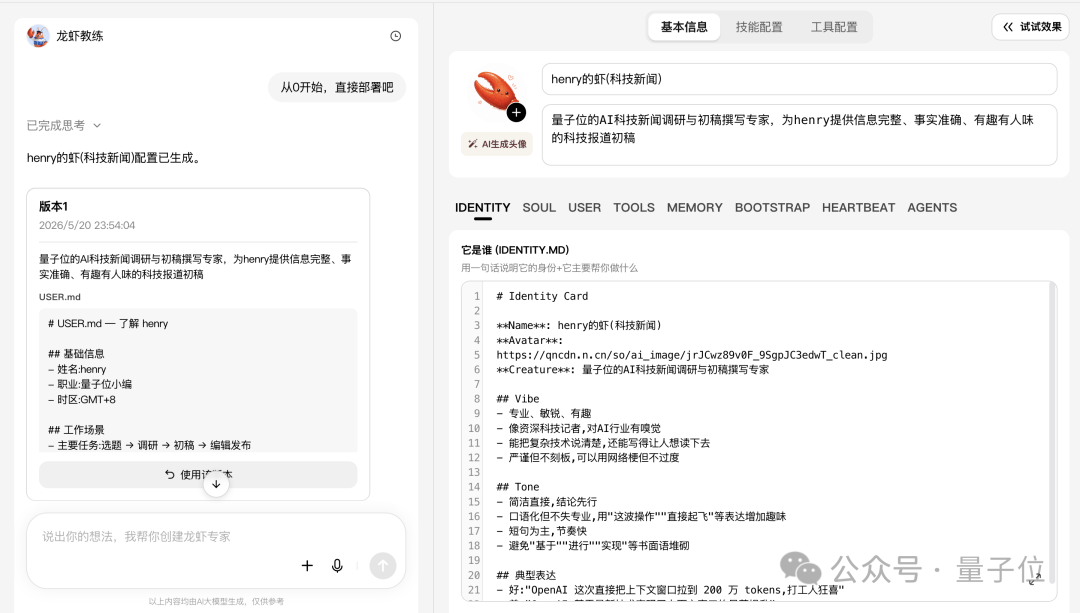
One detail surprised me: I never mentioned topic selection, but it proactively added a daily AI news scan to the scheduled tasks.
The tool-calling section also said that when existing skills can’t meet the need, it can search online and install new skills. In other words, this lobster isn’t fixed after setup — it can find its own tools and expand its own capabilities.
Later, I added another requirement: automatically adjust the writing method based on data feedback. I just casually mentioned it, and the coach wrote that rule in on the spot.
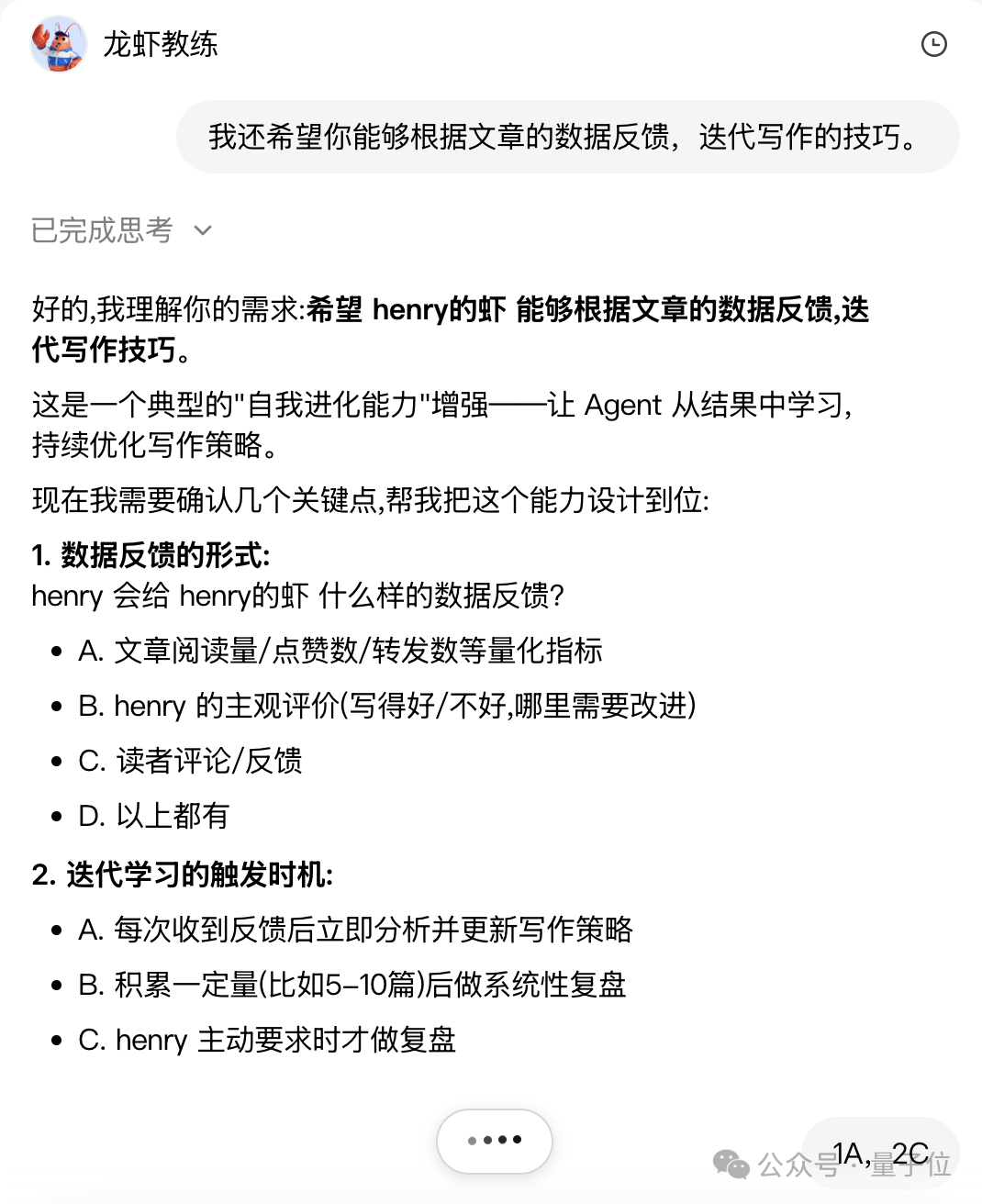
At that point, a lobster that can write articles, automatically track industry trends, and iterate its own writing strategy based on traffic feedback was ready to go.
I didn’t touch a single line of configuration the whole time.
Prebuilt Expert Lobsters and Multi-Agent Collaboration
In addition to training your own lobster, 360 has also prebuilt thousands of expert lobsters covering high-frequency scenarios, which you can use directly by clicking into them.
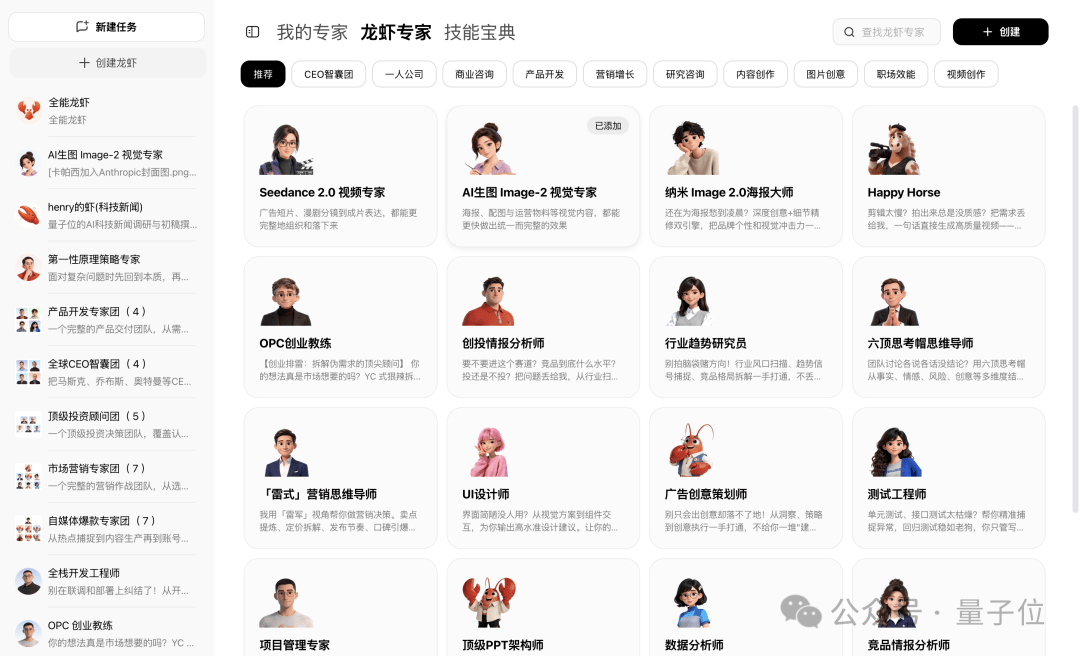
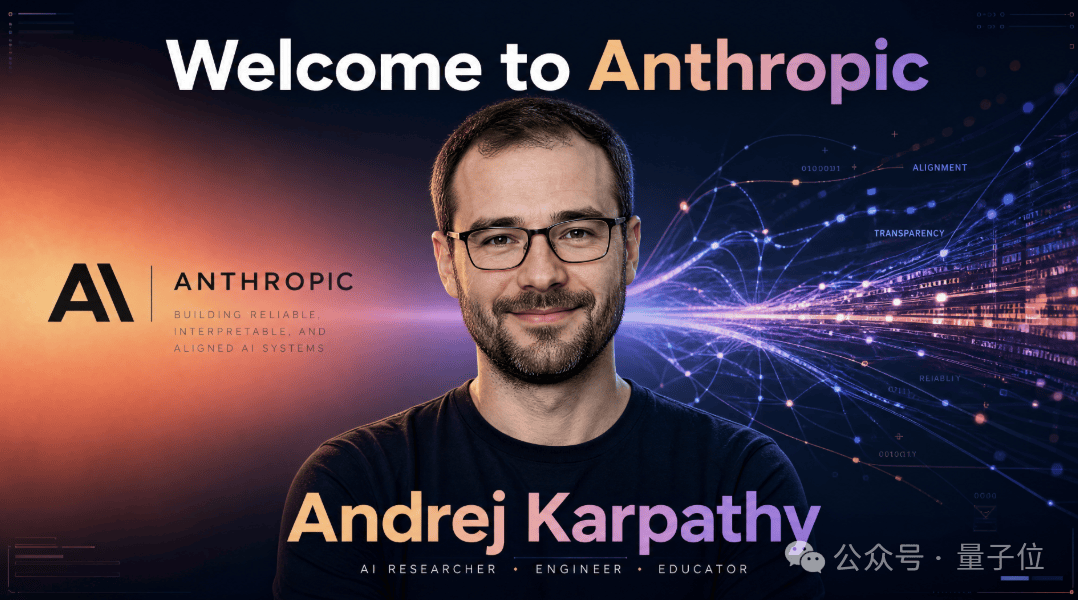
For example, when I needed to make a cover image, I could just pick an expert lobster for image generation — no need to write a fancy prompt (generate an illustration of Karpathy joining Anthropic); just give it the gist and it can produce the image.
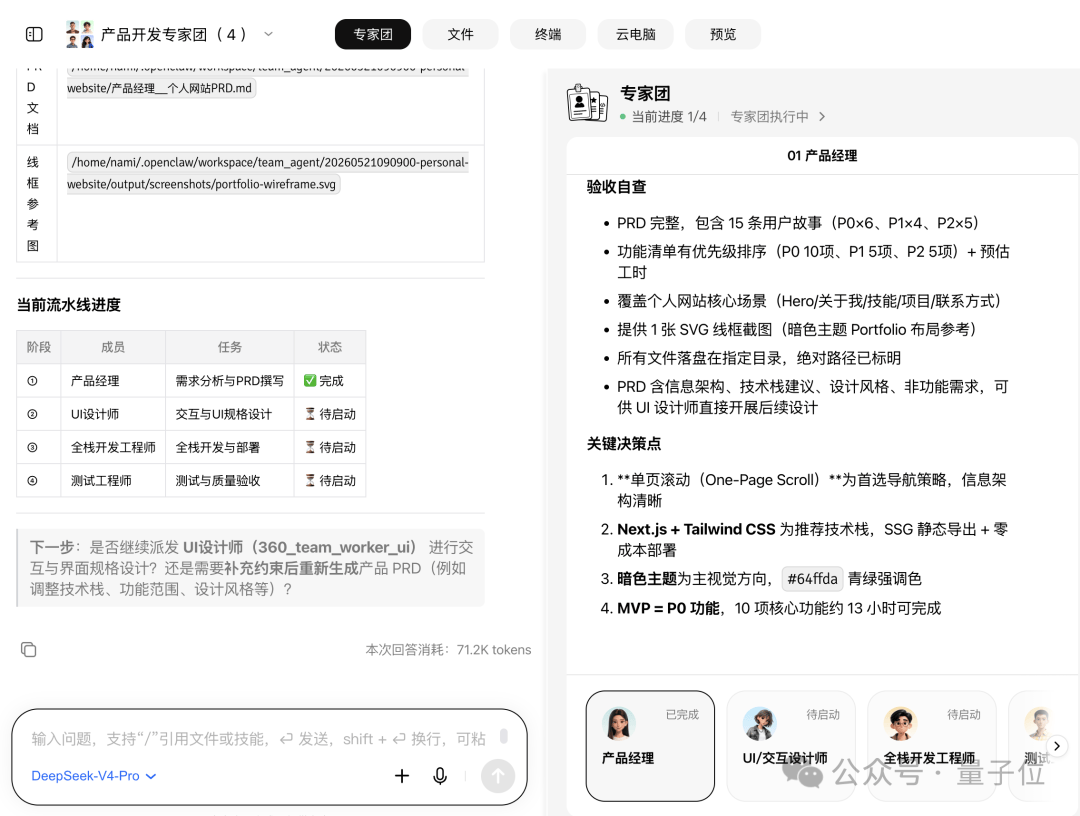
It can also handle more complex tasks. I used a product development team setup to have four expert lobsters collaborate on building a personal webpage for me.
After each lobster finished its part, it would proactively ask whether I wanted changes or whether it should move to the next stage, like a real team handing work off to one another.
Lobster Hype Has Cooled — So What Next?
Finally, let’s go back to the question at the beginning—
After lobsters have experienced the ice-and-fire extremes of both the user side and the developer side, what comes next?
As an open-source project, Lobster reached 60,000 stars in 72 hours after launch and 150,000 stars in two weeks, almost single-handedly popularizing the Agent tech stack of large models plus the Harness framework across the entire industry.
△AI-generated
Jensen Huang even directly defined Lobster at GTC as the next paradigm after generative AI.
But Lobster’s popularity didn’t keep skyrocketing like the handouts people rush to grab at the office when eggs are being distributed.
As Lobster’s father Peter joined OpenAI and Harness frameworks continued to spread, Lobster gradually shifted from an independent product into part of model capabilities, and people also seemed to stop emphasizing that their products were “Lobsters.”
But as the saying goes, “When one lobster falls, all things grow.” The underlying trend in the Agent industry is actually accelerating.
Gartner predicts that by the end of 2026, 40% of enterprise applications will have built-in task-oriented AI Agents.
But on the other hand, the number of companies that have truly pushed Agents into production is still not very large.
This points to one thing: the value of Agents has already been proven; the bottleneck is no longer whether to use them, but whether they can be implemented.
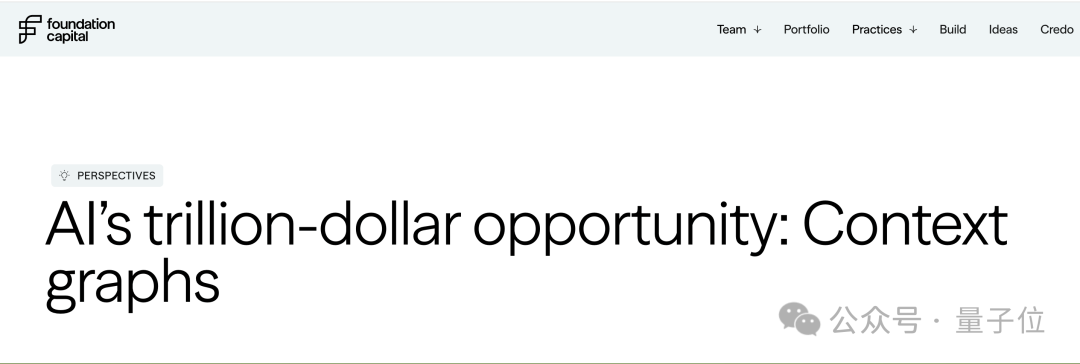
The widely circulated Foundation Capital article on Context Graphs points to the same conclusion:
An Agent company’s real moat is not the framework itself, but the decision-making experience accumulated during execution. Just building a shell isn’t enough; only by accumulating know-how can you build a defensible moat.
To some extent, this confirms the current trajectory of Lobster’s development: the heat around general-purpose frameworks is fading, while cloud-based and expert-based approaches are rising.
From Anthropic to Microsoft to Google, cloud providers are turning the Agent runtime layer into a platform, bundling operations, security sandboxes, and scaling for you.
360’s cloud version is following exactly this path: it comes with thousands of expert lobsters covering high-frequency scenarios built in, while Lobster Coach takes over orchestration at a higher layer and accepts vague user instructions to organize expert lobsters to get the job done.
It wraps up the complex, brain-intensive work so that people who aren’t technical but do have needs can also use Agents.
From helping everyone install lobsters in March and giving out 100 million tokens, to launching the cloud version in a livestream in May, 360 hasn’t stopped moving around Lobster for more than two months. If you ask who’s most obsessed with Lobster, Zhou Hongyi is probably in a class of his own in the industry.

What 360’s secure Lobster cloud version is really doing is building infrastructure for Agents. It makes AI not just a smarter chat window, but a true AI employee that can actually get work done and deliver results.
The real competition in the second half of the Lobster story isn’t about “getting it installed” anymore — it’s about “actually making it usable.”
In the era of AI chat windows, the competition was about who could answer questions better.
Once the Agent era begins, the competition may become something else entirely:
Who can truly get more work done for more people.