
Taught by an AI Professor from Shanghai Jiao Tong University: Spend Half a Day Unpacking the Core Logic Behind Agents
Come to Beijing this Sunday for an in-person reveal
Yanzhong, reporting from Aofeisi
QbitAI | WeChat public account QbitAI
In the era of large models, is your company still treating AI as just a “chatbot” and “writing assistant”?
Don’t rush. The real technological inflection point has already arrived.
When your peers have already started deploying 24/7 “digital employee teams,” if you’re still trying to break through the fog and find the point where AI can intersect with your business, then this half-day high-value public course, led in person by a professor from the School of Artificial Intelligence at Shanghai Jiao Tong University, may be the breakthrough opportunity you’ve been waiting for.
This AI Talk Beijing event is not about fluff — only hard-core logic.
Focusing on the cutting edge of generative AI, it distills the essence of six core modules and, through accessible explanations combined with industry insights, helps you fully understand the underlying logic of AI Agent (intelligent agents).
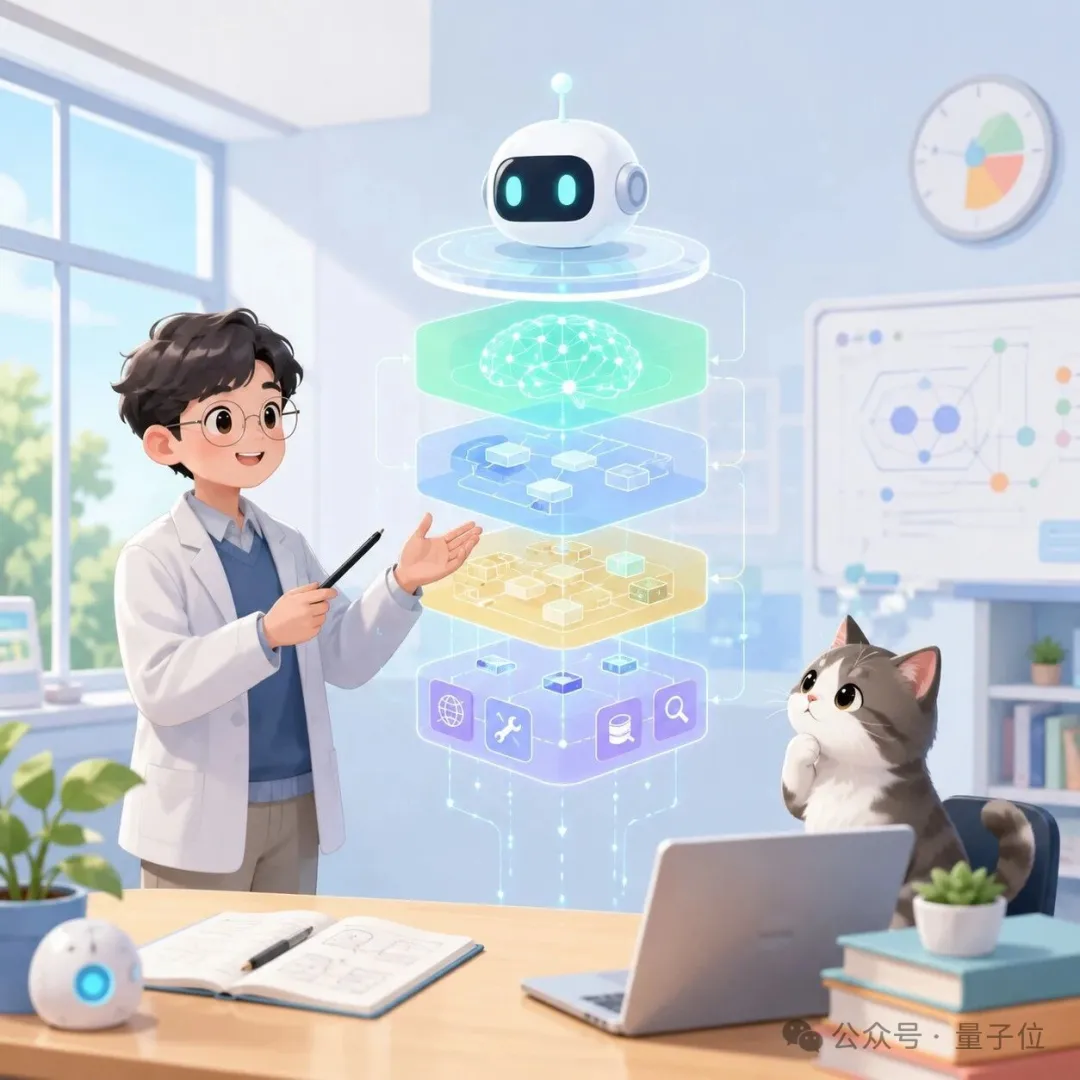
△Image generated by AI
Why now? Because the second half of AI belongs to Agent
If large models are the “brain” of AI, then Agent is the intelligent agent that has grown “hands and feet,” can think, and can remember.
It is no longer a passive question-answering tool, but a “digital employee” that can proactively break down tasks, call tools, and work in coordination.
From vector databases to RAG, from CoT chain-of-thought to multi-agent collaboration, these once intimidating technical terms are now exactly what makes enterprise implementation possible.
Led by an AI professor from Shanghai Jiao Tong University, a half-day deep dive into 6 core modules
This public course is jointly designed and delivered by a professor from the School of Artificial Intelligence at Shanghai Jiao Tong University, directly addressing the core pain points of enterprise AI adoption and helping you build a systematic framework for understanding AI:
- Foundational understanding of large models: Step beyond the “chat” misconception and understand the capabilities and limitations of LLMs.
- Core Agent architecture: Break down the agent’s “brain,” “memory,” and “action” systems.
- Vector databases and RAG: How to give AI “long-term memory” and address hallucinations.
- CoT chain-of-thought analysis: Teach AI to think step by step like a human expert.
- Tool calling and multi-agent collaboration: Build a 24/7 “digital employee team.”
- Security bottom line and future outlook: The guardrails enterprises must maintain when adopting AI, and the trends ahead.
Who should attend?
- Entrepreneurs deeply rooted in their industries: Looking for a second growth curve that combines AI with their business.
- Digital transformation managers: Need an AI implementation roadmap that can actually be put into practice.
- Frontier technology practitioners: Want to quickly grasp industry trends and build a systematic understanding.
Clear away the fog around AI and seize the first-mover advantage.
Location: Shanghai Jiao Tong University Antai Global Beihang Campus (5th Floor, West Tower, Global Financial Center, No. 1 East 3rd Ring Middle Road, Chaoyang District, Beijing)
Duration: Sunday, May 24, 2026, 9:00–12:00

Professor Profile:

Xia Renqiu
Assistant Professor, School of Artificial Intelligence, Shanghai Jiao Tong University
He earned his PhD from the Department of Computer Science at Shanghai Jiao Tong University and focuses on large language models, multi-agent systems, and AI for Science.
In recent years, as a core member, he has taken part in major national and ministerial-level strategic projects, including the Ministry of Science and Technology and the National Development and Reform Commission’s large model technology breakthroughs, the Ministry of Industry and Information Technology’s robot foundation pretraining, and Shanghai’s “Hundred Teams, Hundred Projects” controllable fusion intelligent agent initiative.
He has published more than 20 papers in leading international conferences and journals such as TPAMI, TIP, ICLR, NeurIPS, and CVPR, and has led the development and open-sourcing of high-performance foundation models and ultra-large-scale datasets for formal mathematical reasoning and multimodal document understanding.
In teaching and the integration of industry, academia, and research, he is responsible for agent-related courses both inside and outside Shanghai Jiao Tong University’s School of Artificial Intelligence, and actively promotes innovative startup projects in the AI for Education field. He has always been committed to deeply empowering scientific research, educational innovation, and major national strategic needs with frontier large model technologies.