
I put together these annotated slides from my five-minute lightning talk at PyCon US 2026, using the latest version of my annotated presentations tool.


Six months is a pretty good window because it includes what I call the November 2025 inflection point. November was a pivotal month for LLMs, especially for coding.

To start with, the model generally considered the “best” one — largely depending on subjective judgment — changed hands five times between the three major providers.

As usual, I use my “generate an SVG of a pelican riding a bicycle” test to help illustrate the differences between these models.
Why this test? Because pelicans are hard to draw, bicycles are hard to draw, pelicans don’t ride bicycles... and no AI lab is likely to have trained a model specifically for this absurd task.
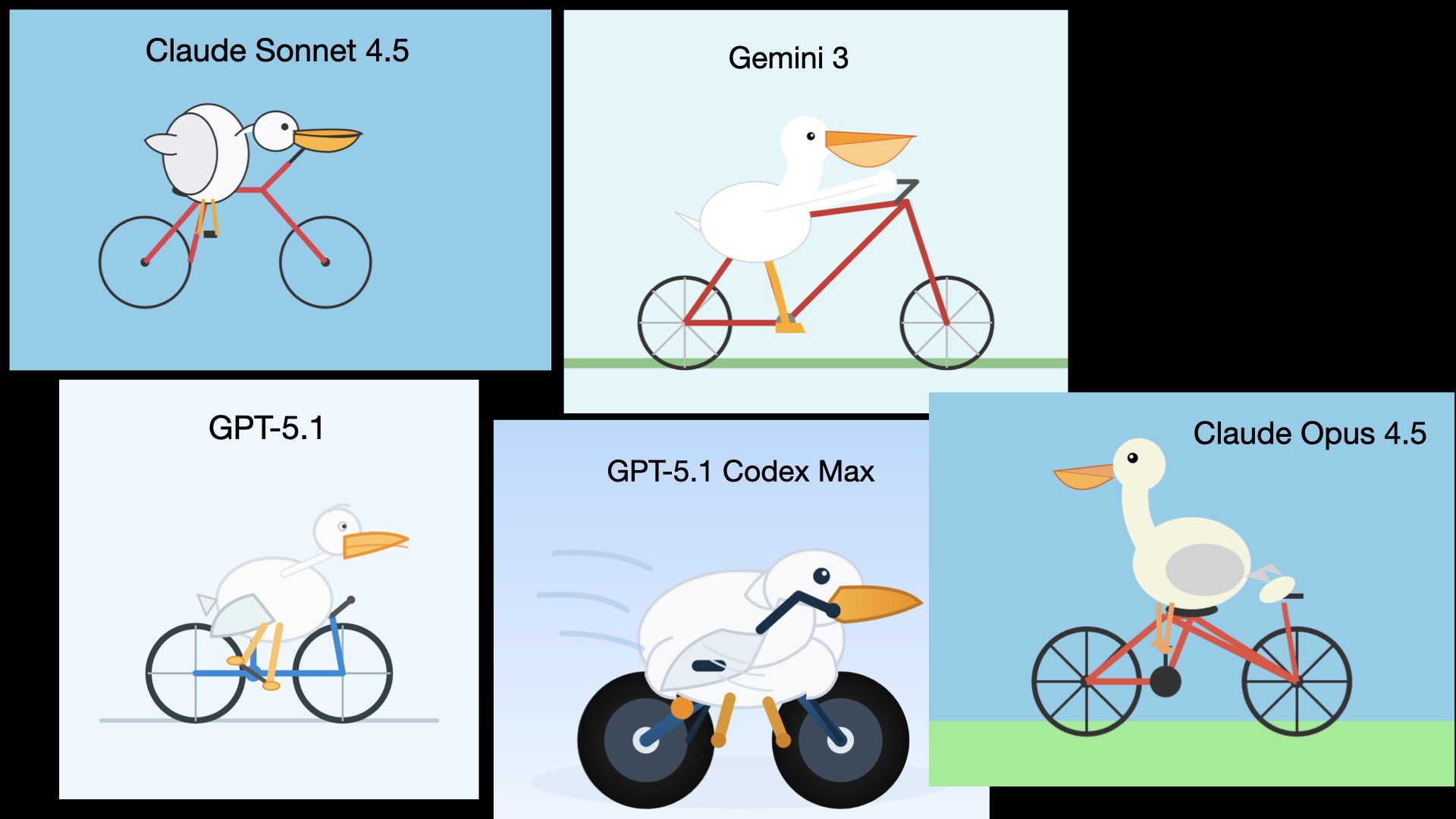

At the start of November, the widely accepted “best” model was Claude Sonnet 4.5, released on September 29. It drew this pelican for me.
By November it had been overtaken in sequence by GPT-5.1, Gemini 3, and GPT-5.1 Codex Max, before Anthropic reclaimed the crown with Claude Opus 4.5.
Of those, I think Gemini 3 drew the best pelican, but pelicans aren’t everything. Most practitioners would agree that Opus 4.5 kept the top spot for the next few months.

This took a little while to become obvious, but the real November story was that coding agents got good.
OpenAI and Anthropic had spent much of 2025 doing reinforcement learning from verifiable rewards to improve how well their models wrote code, especially when used through their Codex and Claude Code agent frameworks.
By November, the results of that work were becoming obvious. Coding agents crossed a quality threshold from “often useful” to “generally useful” — good enough that you could rely on them as day-to-day tools for real work, instead of spending most of your time cleaning up their stupid mistakes.


Over the holidays, from December into January, many of us used the break to try out these new models and coding agents and see what they could do.
They could do a lot! Some of us got a little too excited. As I started kicking off ambitious projects to see how far I could push them, I briefly experienced a bit of LLM mania myself.