
Racing has Zhang Xue; intelligent driving has WeRide.
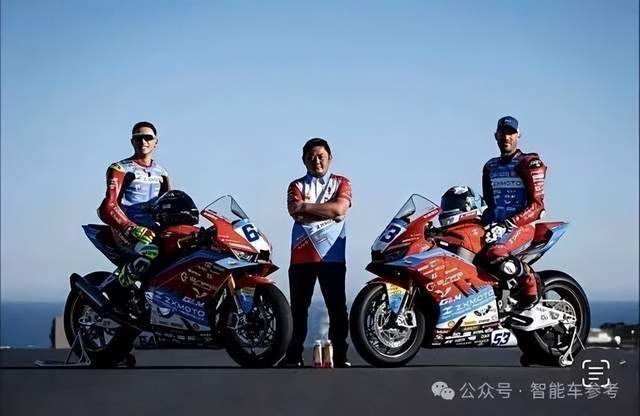
On May 17, Zhang Xue Moto won its fifth championship of the season at the WSBK round in the Czech Republic:
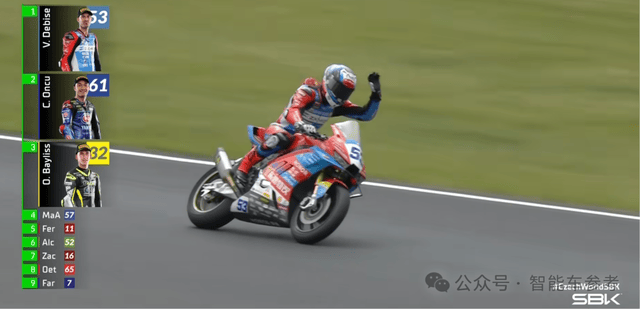
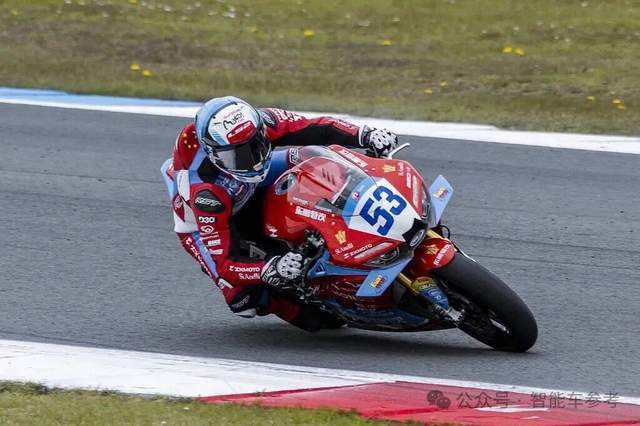
**△**Zhang Xue Racing’s No. 53 bike, five-time straight champion at the WSBK Czech round
For the first time, the title of “five-time champion” belonged to a Chinese motorcycle. It was unprecedented.
On the same day in Hefei, at the finals of the second China Intelligent Driving Competition · Hefei Station, the Chery Exeed Exlantix ES equipped with WeRide’s WRD 3.0 solution scored 102.81 points to take the championship again. This was WeRide’s fifth consecutive championship in the event.
Of course, a five-time champion is not invincible either… WeRide ran into a formidable rival in the preliminaries:
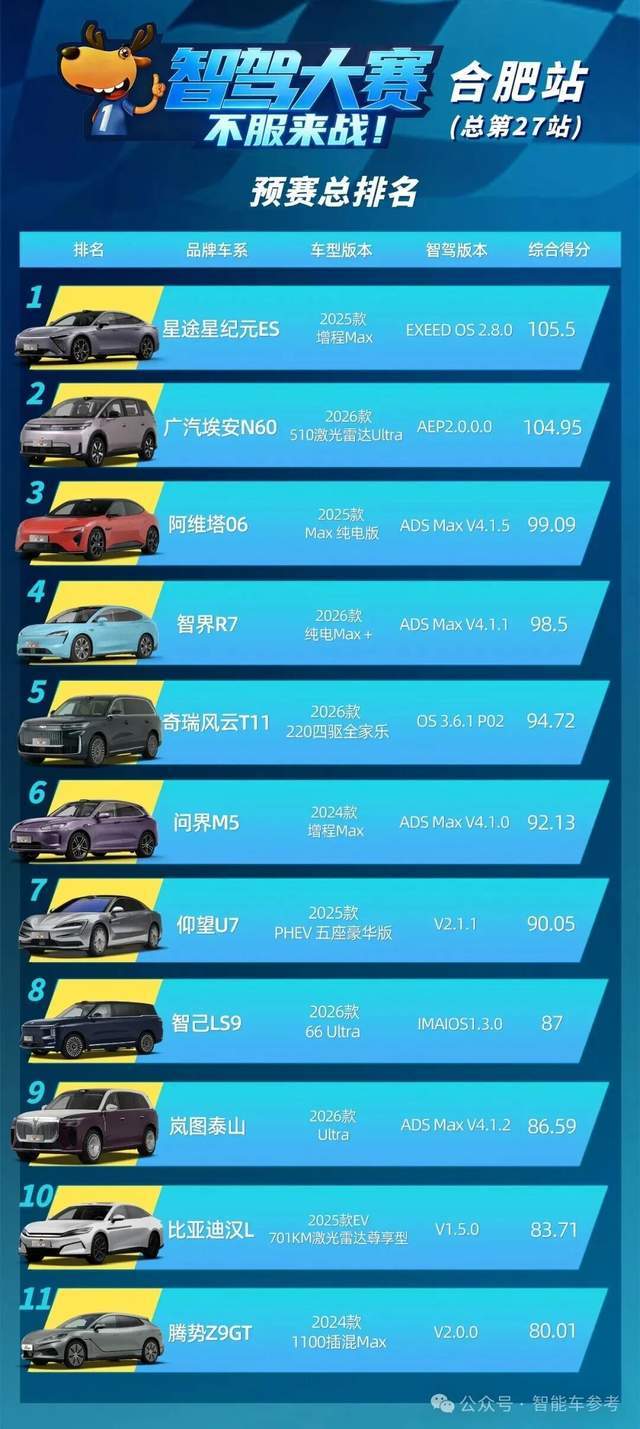
**△**The top two in the Hefei preliminaries were both WeRide solutions
But on closer inspection, that formidable rival was still WeRide’s own solution.
Two unconventional tracks, one five-time winning streak. One is reshaping the landscape of world-class two-wheel racing; the other is setting new records for China’s intelligent driving industry on a four-wheel track.
Neither became a sensation through marketing. Both won through self-developed, hard-core technology—
Zhang Xue’s MTC1000 electronic control system, balance shafts for dual counter-rotation, and variable valve technology bypassed the patent barriers of Japanese manufacturers. Behind WeRide WRD 3.0 is the battle-tested WeRide GENESIS simulation world model, as well as data feedback from a fleet of nearly 2,800 L4 vehicles, truly bringing L4 Robotaxi capabilities down to L2 production vehicles for the first time.
The two five-time champions born on the same day share a striking similarity:
Zhang Xue Moto replaced virtual simulation with real-world racing action, while WeRide used virtual simulation to pre-run every possible track.
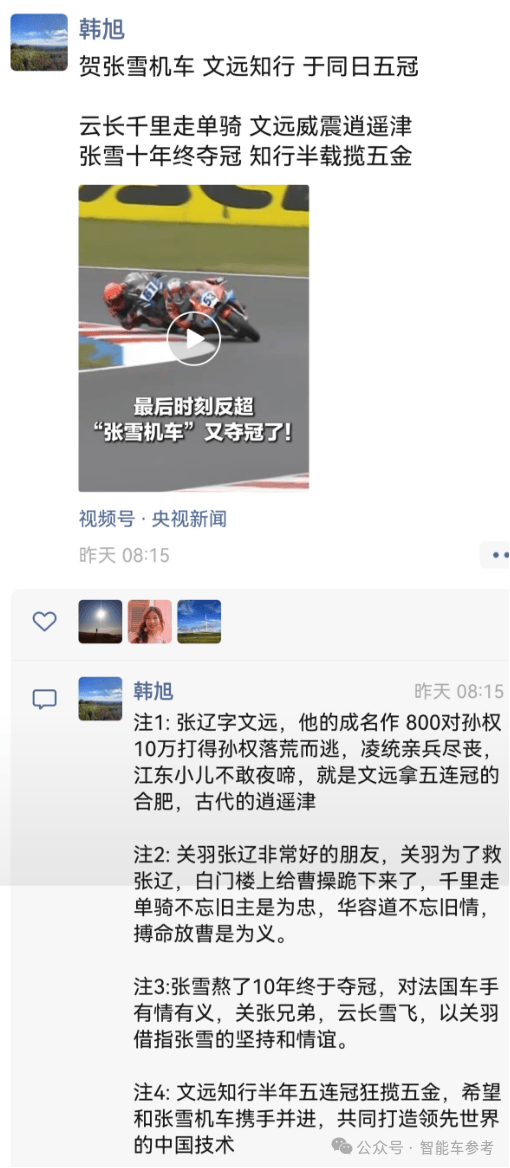
Both five-time champions used the most practical self-refinement, the shortest feedback loop, the highest testing density, and the most complete self-reliance to compress technological barriers that once took ten years to build into breakthroughs achieved within just two or three years. WeRide founder and CEO Han Xu also posted about this in his WeChat Moments, citing an episode from Romance of the Three Kingdoms to describe the difficulties both companies overcame and their feat of “the few defeating the many.”
This China Intelligent Driving Competition is hosted by Diyidian and features a lineup that includes nearly every leading autonomous driving player you can name today:
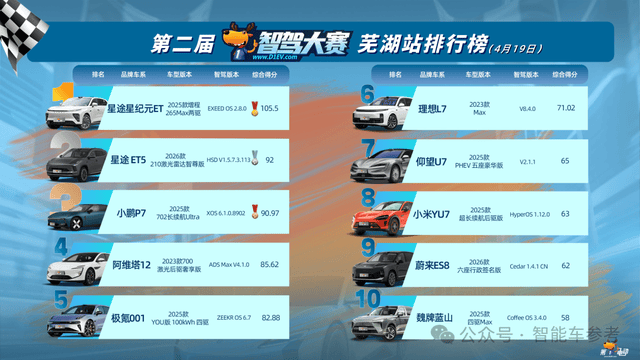
**△**Among the self-developed camp, Nio, Xpeng, and Li Auto; among the solution-provider camp, Momenta, Horizon Robotics, Deeproute.ai, and Pony.ai all took part
The routes covered expressways, complex intersections, unprotected left turns, and mixed traffic with pedestrians and vehicles—basically the driving conditions that ordinary Chinese drivers face every day.
Starting from Taizhou, Zhejiang, WeRide went on to win five consecutive stations in Wenzhou, Jinhua, Wuhu, and finally Hefei, setting a new winning streak record for the competition.
Especially in the Hefei preliminaries, the GAC Aion N60 equipped with WRD 3.0 was making its competition debut, and it used a single Qualcomm Snapdragon SA8650P—far less computing power than the industry-standard dual Orin-X setup:
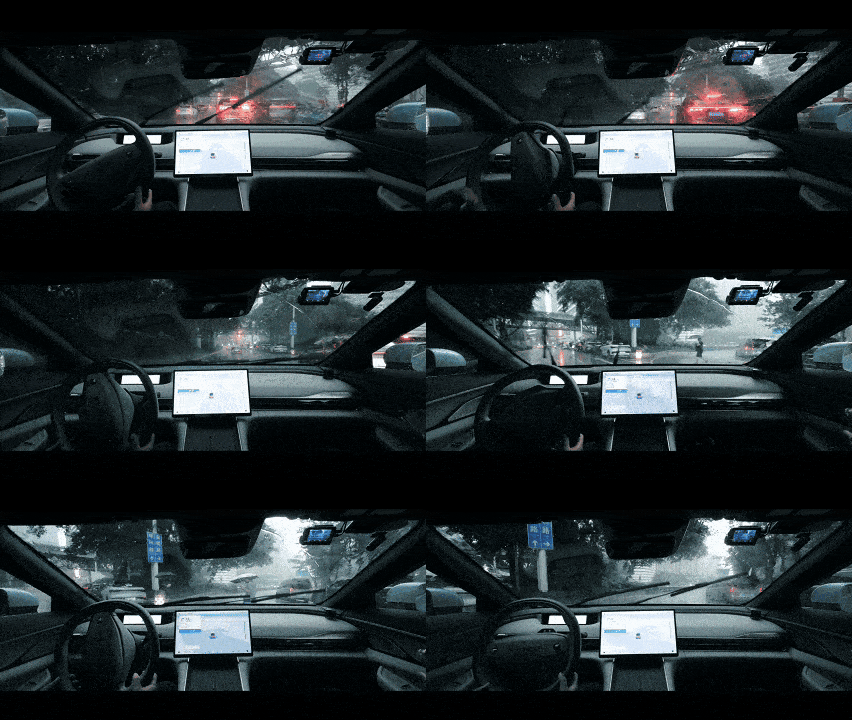
**△**WRD3.0 handling complex road conditions in the rain
The result: the Chery Exeed Exlantix ES equipped with WRD3.0 took first place in the preliminaries.
And the debuting Aion N60 took a strong second place, beating the model solutions from major industry stars by as much as 24.95 points. If the rules had not limited each participant to advancing only one vehicle, WeRide might well have swept both first and second place in the finals—almost like turning the World Table Tennis Championships into a National Games event.
The GAC Aion N60 and the Chery Exeed Exlantix ES (upgraded from OS2.8.0 to the latest one-stage end-to-end solution) were both powered by the same WeRide WRD3.0 algorithm, yet they delivered the same championship-caliber performance on two completely different computing platforms: dual Orin-X and single Qualcomm 8650P.
This is not a custom solution “tuned for a specific chip,” but a truly decoupled hardware-software intelligent driving system that can be replicated across platforms.
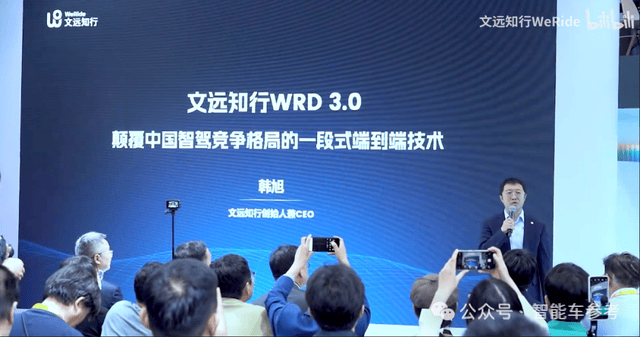
**△**WRD3.0 solution launched at the Beijing Auto Show
Coincidentally, Zhang Xue Moto’s five championships were also built on cross-platform capability: the 820RR-RS race bike and the soon-to-be-mass-produced 820RR-R share the same engine and electronic control system, so track-proven technology can be transferred seamlessly to production.
One on two wheels, one on four-wheel intelligent driving—both companies are proving the same point: truly hard-core technology does not fall apart when the platform changes.
If Zhang Xue Moto broke the long-standing dominance of European, American, and Japanese manufacturers on top-tier tracks, then WeRide WRD 3.0 has broken the assumption on China’s intelligent driving track that “the big names and star players must be stronger” by winning five in a row.
How did WeRide do it?
Five straight wins are not magic. WeRide’s technology base can be summed up as “walking on two legs”—one leg raises the floor, the other breaks the ceiling.
The first leg is data feedback from a fleet of nearly 2,800 self-owned L4 autonomous vehicles.
People in autonomous driving may already be familiar with this—the so-called “dimension reduction attack” that many L4 players have been talking about for years. Only now, after all these years, has WeRide truly made it happen.
WeRide operates nearly 1,300 Robotaxis worldwide, and when you add minibuses, sanitation vehicles, and other full-scenario L4 vehicles, the total comes to almost 2,800. These vehicles run day after day across 12 countries and more than 40 cities, accumulating real-world road conditions in the most concrete sense—especially those “long-tail scenarios” that ordinary road testing rarely encounters.
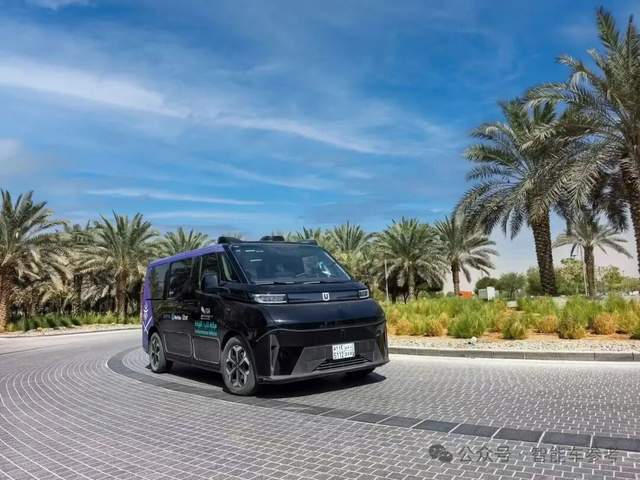
**△**WeRide Robotaxi GXR in Riyadh, Saudi Arabia
Then, this data is directly fed back into WeRide’s self-developed WeRide One general autonomous driving technology platform, and the trained algorithms are applied to the WRD 3.0 L2++ solution.
As a result, WRD 3.0 was never a blank slate when it was born. It was already a seasoned “driver” that had logged tens of millions of kilometers in L4 scenarios. This is what people mean by “high innate floor”—it starts from a position that others can only reach after years of trial and error.
The second leg is WeRide GENESIS, its self-developed simulation world model.
It can generate a wide range of extreme scenarios in the virtual world at densities tens of thousands of times higher than on real roads: sudden cut-ins from adjacent vehicles, unprotected left turns, pedestrians darting out from blind spots, riders going the wrong way, and even natural disasters.
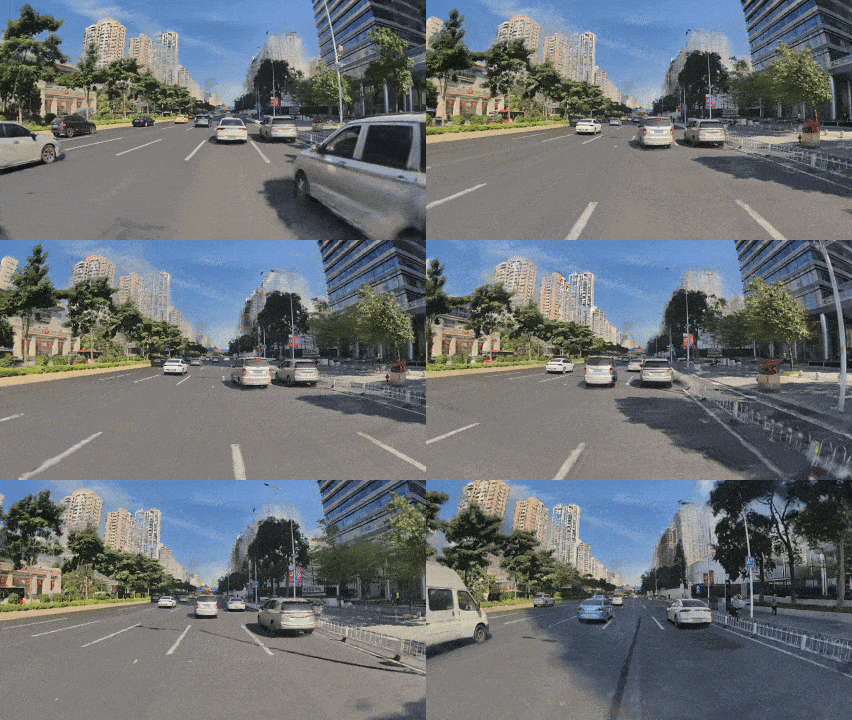
**△**WeRide GENESIS simulation scenario
GENESIS creates a complete closed loop of “scenario generation → training → evaluation → diagnosis.” Before the algorithm ever hits the road, it has already practiced these extreme cases countless times in simulation.
That is how you keep breaking through the ceiling without limit. Situations that may only happen once every few years or every tens of thousands of kilometers in the real world can be trained repeatedly in WeRide GENESIS, and even extended by changing boundary conditions for extra practice.
For vehicles equipped with WRD 3.0—something consumers can actually buy and use every day—the low floor means the AI driver won’t make basic mistakes in ordinary scenarios, especially by avoiding learning human drivers’ bad habits under end-to-end black-box solutions.
The high ceiling means that when it encounters truly “hellish” scenarios, it won’t panic; it can pass through complex sections more reasonably and more smoothly than a human driver:
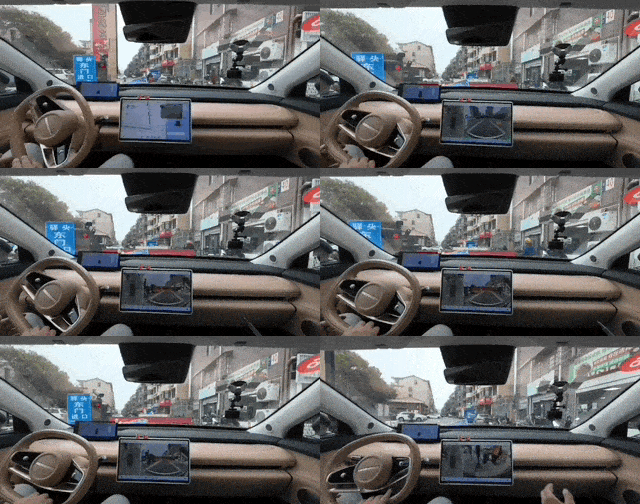
**△**After being cut off, WRD 3.0 successfully passed through the gate after two reverse maneuvers
WeRide founder and CEO Han Xu once said something interesting: “Wing Chun is powerful because Ip Man is the one fighting; it’s not that the martial art itself is powerful.”
What he meant is that the world-model paradigm is booming, and almost every L4 and L2 player is following suit. In theory, any strong player should be able to achieve “one solution for all” across Robotaxi and mass-produced L2.
But the reality is not that simple. So far, only WeRide has truly fed millions of kilometers of real L4 fleet data into its L2 solution and used its self-developed simulation system to thoroughly run through extreme scenarios.
Behind this are the effort and sweat that other players have not put in. The “leaning down” process from L4 to L2+ is like a marathon runner doing specialized explosive-power training for the 1,500-meter race—not something you can solve simply by chopping off a bit of endurance from long-distance running.
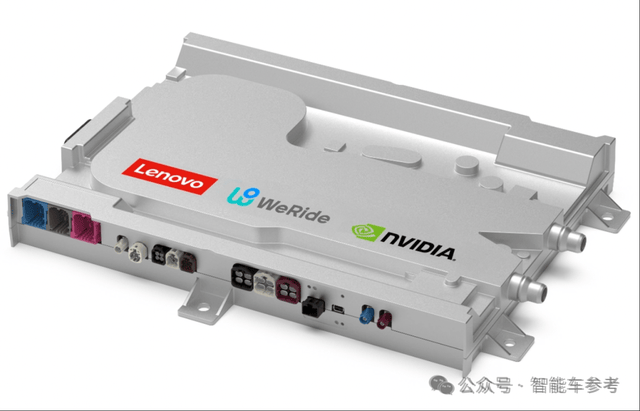
**△**WeRide’s self-developed 2000 TOPS computing domain controller HPC3.0
At the technical level, beyond basic knowledge distillation, it also involves more granular, code-level know-how, such as mixed-precision quantization before distillation, model pruning, dynamic inference optimization, MoE architecture optimization, and more…
Viewed from another angle, these technical accumulations are also exactly why the “dimension-upgrading” players that start from L2 still cannot be called true L4.
Zhang Xue Moto is saying something similar on its side. Its self-developed MTC1000 electronic control system, lightweight frame, and integrated aerodynamic design are all not “ready-made borrowed solutions,” but things they worked out themselves, lap after lap, on the track.
What both companies have in common is this: they keep the initiative in R&D firmly in their own hands and use the simplest method—the most practical method—to chip away at technological barriers, bit by bit.
How should we understand these two “five-time champions”?
If you put the core technologies behind the two five-time champions side by side, an interesting resonance emerges.
The first point is that the technical logic is the same.
Zhang Xue Moto’s X3 engine and MTC1000 electronic control system, along with WeRide’s GENESIS simulation world model and L4 data feedback, are both fundamentally building a “closed loop” — quickly feeding data generated in real operations back to the R&D side, then iterating at very high frequency.
Zhang Xue Moto runs one lap on the track, the data is sent back immediately, and a new version can be produced within 24 hours; WeRide runs tens of thousands of extreme scenarios in simulation, and the algorithm model is updated overnight.
Both are compressing the “R&D - testing - optimization” cycle from years to months, and from months to days.
The second is the shared goal of breaking monopolies. Zhang Xue Moto is going head-to-head with giants like Ducati, Yamaha, and Honda, and has taken them off the podium at the WSBK circuit.
WeRide WRD 3.0, at the China Intelligent Driving Competition, is directly defeating what many ordinary users consider to be the “ceiling” of the industry.
The significance of five consecutive wins is not the trophy itself, but the proof that China’s self-developed L2++ solutions—especially mass-production solutions from L4 players—are fully capable of outperforming first-tier manufacturers in real-world commuting scenarios.
This also leads to a more practical judgment: Tesla FSD is accelerating its entry into China, and recent job postings for intelligent driving roles in China have also surfaced.
At present, the Chinese rival most capable of truly matching FSD in both technical architecture and business model is probably only WeRide.
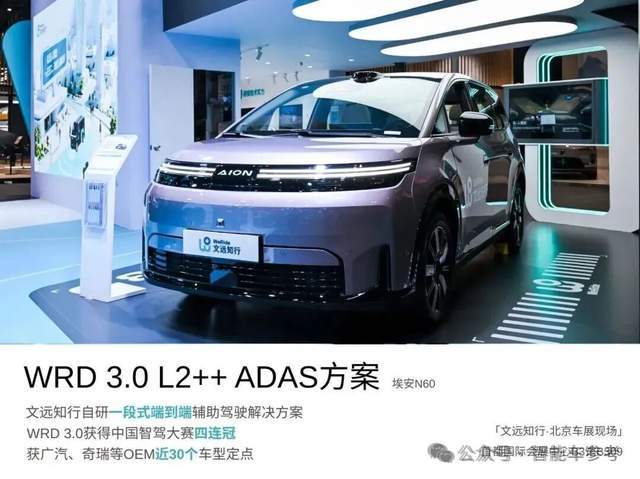
**△**GAC Aion N60 equipped with WRD3.0
Because Musk does not get involved in the shouting match between the L2 and L4 camps, nor does he care which technical route is more “orthodox.”
So the traditional L4 metrics—how many cities are open for operation, how large the operating area is—have no comparable counterpart for Tesla; and if L2 players brag about the number of solution deployment points or takeover rates per 100 kilometers… Musk simply does not care. Driven by the first principles of autonomous driving, Tesla always pushes forward with the goal of full-scenario, full-time, and full-region capability—
just like WeRide, which has always prioritized action over words.
But beyond the technology, WeRide also has an edge over FSD: it is a step ahead.
Its relative advantage is that WeRide has already accumulated a large amount of real-world data from Chinese scenarios and has completed the “necessary path” ahead of FSD.
Its absolute advantage is that WeRide has already successfully installed WRD 3.0 on the Aion N60, which starts at 106,800 yuan, as a standard feature on the car, with the cost/profit included in the vehicle price, whereas FSD’s one-time buyout price is 64,000 yuan.
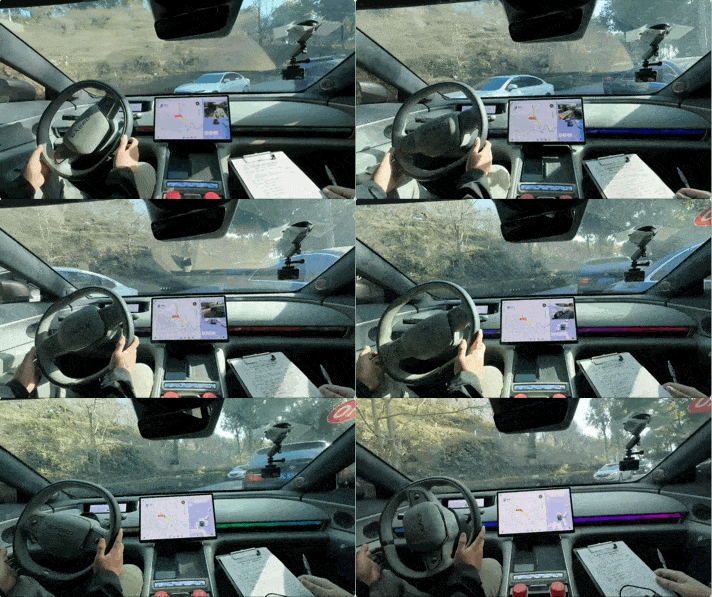
**△**WRD3.0 narrow-road passing
When high-level intelligent driving is no longer an “optional luxury” but a “standard feature across the lineup,” the rules of the competition have already been rewritten.
Even more noteworthy is that WeRide’s five-win capability is now being replicated at scale.
WeRide has already secured nearly 30 vehicle model design wins, covering the three major brands of GAC Group (Aion, Hyper, Trumpchi) and the five major brands of Chery Group (Exeed, Tiggo, Lepas, Omoda, JAECOO), with its market footprint extending from China to Europe, Southeast Asia, and the Middle East.
Among them, WeRide’s first production vehicle with GAC Group—the Aion N60—went on sale in April this year. Within two weeks of pre-sales, orders exceeded 8,300 units, and by early May that figure had surpassed 9,000. The car has shown astonishing performance in “hell scenarios” such as urban village roads in Guangzhou and evening rush hour traffic, and a Bilibili car reviewer called it the only zero-takeover vehicle in the “Nürburgring of intelligent driving” — while its competitors are intelligent-driving models in the 200,000- or even 300,000-yuan range.
So back to the original question: was it a coincidence that two five-time champions were born on the same day?
Yes and no. The coincidence is the date; the inevitability is the shared logic behind it—using the shortest feedback loop, the highest testing density, and the most complete self-reliance to compress technological barriers that once took ten years to break through into just two or three years.
Zhang Xue Moto turned real track racing into part of its R&D process; WeRide used virtual simulation to pre-run every possible track.
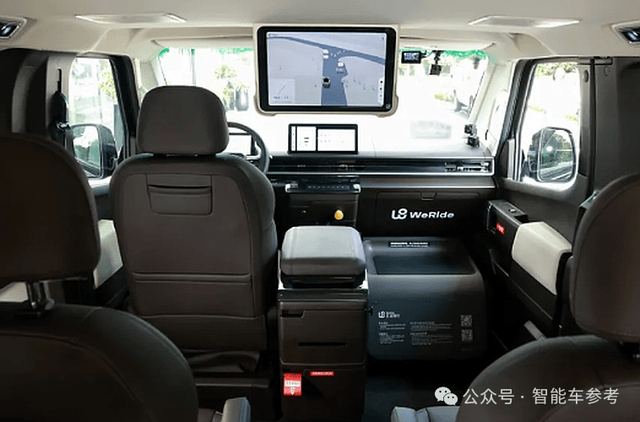
**△**Inside WeRide GXR Robotaxi
As multimodal large models + data-driven approaches become the consensus on the autonomous driving track, the so-called “L4 vs. L2 route debate” has lost its meaning.
The only truly important metric left is this: who can make the AI driver deliver the same high-level performance across different cities, different road conditions, and different vehicle models?
As Han Xu said, don’t look at the sect, look at the result—“Wing Chun is powerful because Ip Man is the one fighting.”
With five consecutive championships, WeRide has already proven it first: Ip Man has entered the ring.