The underlying paradigm has changed
Yanzhong, from Aofei Temple
QbitAI | WeChat public account QbitAI
Just now, openJiuwen, the Huawei-supported open-source AI Agent platform community, announced and open-sourced JiuwenSwarm, a swarm-intelligence agent.
From “a lobster” to “a swarm of bees,” it’s not just the name that has changed — the underlying paradigm has too.
Letting multiple AI agents collaborate efficiently and evolve autonomously like a bee swarm officially hits the accelerator on “collective intelligence” and ushers in the beginning of “beekeeping” in the AI era.
Behind this is the full landing of the next-paradigm proposition put forward by openJiuwen — Coordination Engineering.
To understand this upgrade, we need to answer one question first:
Why now, and why move from Harness to Coordination?
If we stretch out the timeline a bit, from Prompt Engineering to Context Engineering, and then to Harness Engineering at the beginning of this year, the engineering paradigm in the AI Agent field has been continuously evolving:
- Prompt Engineering: tuning prompts so the model understands the task;
- Context Engineering: organizing an agent’s context, memory, tools, and state;
- Harness Engineering: the keyword sweeping the industry since the start of the year, pushing single-agent engineering, trajectory management, error recovery, and long-horizon execution to the limit.
The next engineering question that emerges is:
How do we get multiple agents to work together like an elite team?
After all, the truly complex tasks in the real world — cross-domain deep research, large-scale software delivery, multi-role collaborative decision-making, complex business-process orchestration — are never something “one person” can handle alone; they require a team.
Software needs product, development, testing, and SRE; education needs teachers across disciplines, parents, and the student; healthcare needs triage staff and medical experts from multiple departments…
This is the next-paradigm idea proposed by openJiuwen: Coordination Engineering — an engineering paradigm centered on multi-agent collaboration.
And this time, openJiuwen has turned “coordination” from an idea into a complete runnable, installable, co-buildable, fully open-source engineering delivery:
JiuwenSwarm.
Core Design Principles of Coordination Engineering
For an agent team to truly work, a series of progressively deeper problems must be solved:
- How do multiple agents divide work autonomously and negotiate dynamically? This is the starting point of “coordination”;
- How do the best practices and role combinations that make coordination work get distilled into reusable assets? Coordination cannot start from scratch every time;
- How do the capabilities that have been distilled circulate among developers, get reused, and become the basis for further creation? Experience only creates amplified value when it is shared;
- How does the entire system get stronger the more it is used, instead of becoming rigid? Otherwise, it’s just a static framework that can’t support “collective intelligence.”
These four questions are tightly connected, each one a necessary extension of the last.
JiuwenSwarm’s answer is a corresponding full-stack technical system:
Agent Swarm, Swarm Skills, Swarm Skills Hub, plus the ever-present Swarm Skills self-evolution.
Full-stack technical system
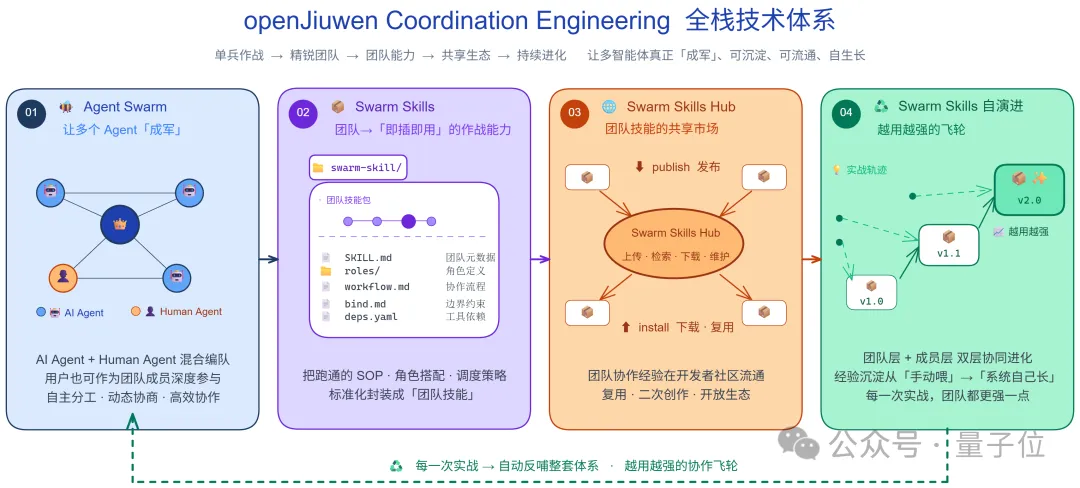
The four key components fit together like links in a chain:
Agent Swarm — turning multiple agents into a “force”
This is the core of the whole system.
Agent Swarm provides a collaboration mechanism for multi-agent teams, enabling multiple agents to divide work autonomously, negotiate dynamically, and collaborate efficiently, making the crucial leap from “solo combat” to “elite team.”
JiuwenSwarm supports routing different members to different models, assigning each role the model best suited to its needs, reducing load pressure, tailoring capabilities to the task, and improving overall performance.
Swarm Skills — turning “one team” into “one set of combat capabilities”
Agent Swarm solves “how to collaborate,” while Swarm Skills solves “how to distill and retain it.”
It standardizes the best practices, SOPs, role combinations, and scheduling strategies that emerge from team collaboration into reusable team-level skills —
turning “an excellent agent team” into “a ready-to-use capability that works in any scenario.”
Swarm Skills Hub — the shared marketplace for team skills
Once capabilities are distilled, the next step is naturally circulation.
Swarm Skills Hub opens up a shared ecosystem where team-level collaboration experience can circulate, be reused, and be remixed within the developer community.
Address: https://swarmskills.openjiuwen.com/
Swarm Skills self-evolution — a flywheel that gets stronger the more it is used
The most imaginative part is the final link in this loop.
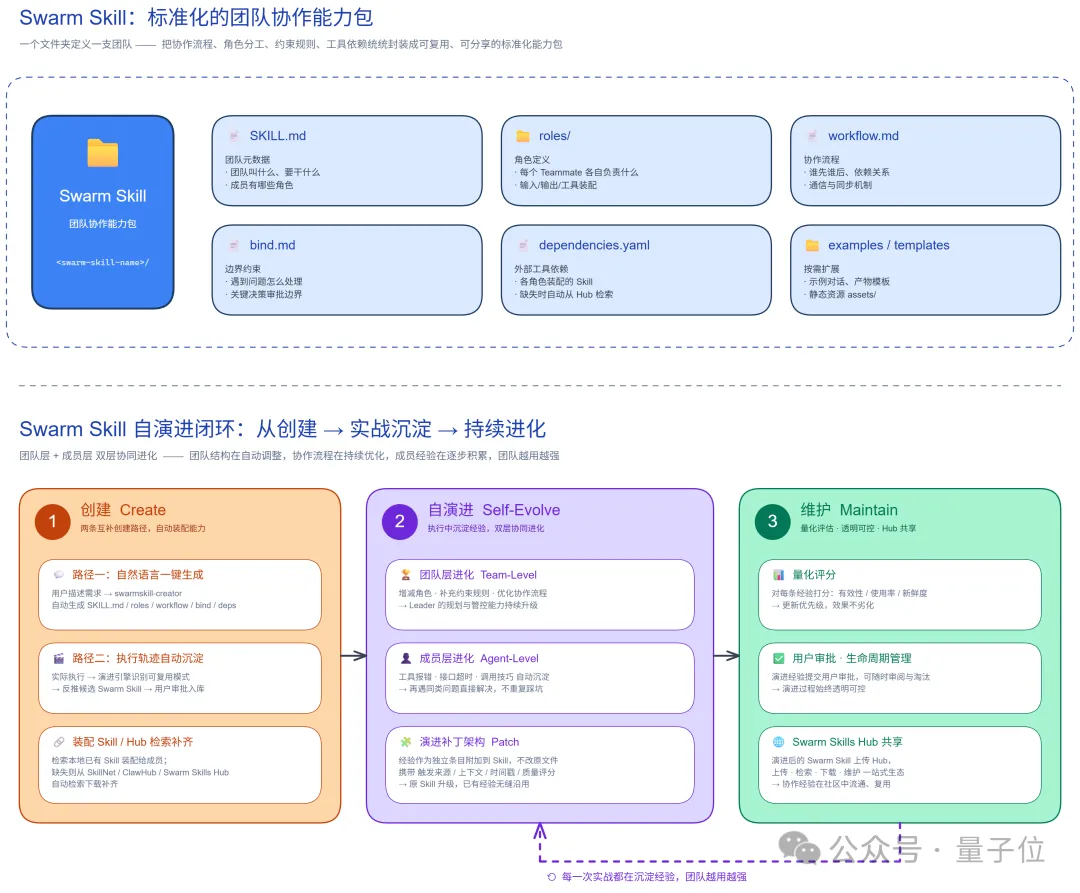
As the team executes real tasks, JiuwenSwarm’s evolution engine continuously observes the full trajectory — task decomposition, role scheduling, message exchanges, and more — automatically inferring reusable Swarm Skills from the trajectory and submitting them for user approval before adding them to the library.
Self-evolution happens on two levels at once:
- Team level: automatically add or remove roles, supplement constraint rules, and optimize collaboration workflows based on task execution trajectories, continuously improving the Leader’s planning and governance capabilities;
- Member level: distill each Teammate’s practical experience with tool errors, API timeouts, invocation tricks, and more, so similar problems can be solved directly next time without repeating the same mistakes. The team improves, and every member grows too.
How humans participate in coordination: HOTS & HITS
From team collaboration to experience distillation, from skill sharing to continuous evolution, the four core capabilities form a complete loop.
But on top of this collaboration framework, there is a more fundamental and more practical question — how do humans collaborate with this agent team?
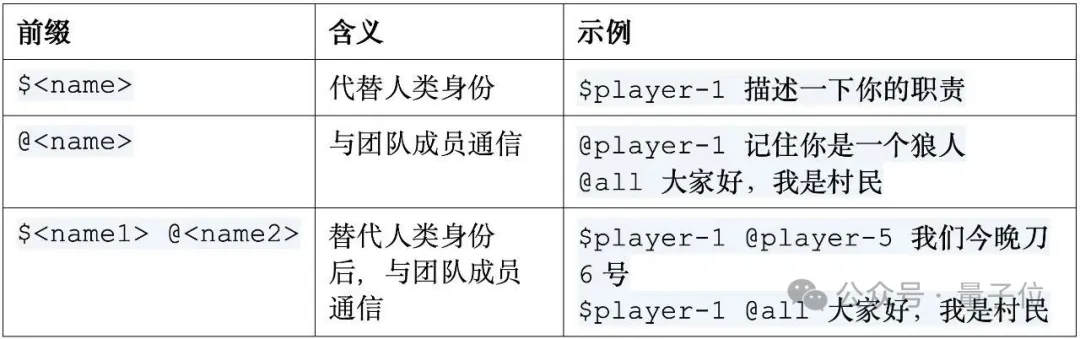
JiuwenSwarm offers two modes: HOTS (Human on the Swarm) and HITS (Human in the Swarm).
1. HOTS (Human on the Swarm): humans are the commander of the agent team
Humans stand at a higher level, observing the entire agent team’s operating state in real time: task progress, role load, collaboration bottlenecks…
When intervention is needed, they can step in at any time — adjust task priorities, switch agent roles, or change the plan midstream. The control granularity can be as fine as a single instruction, or as broad as “let’s change direction.”
2. HITS (Human in the Swarm): humans are also a member of the team
Humans are no longer outside commanders, but instead on the same team, in the same scenario, following the same workflow, collaborating in real time, and reasoning together with the agents —
humans become one of the “bees” in the swarm, working alongside the other agents.
Just like a player in Werewolf, that’s the posture.

HITS is immersive participation, while HOTS is global orchestration. These two modes are the two most important ways humans can collaborate with an agent team.
JiuwenSwarm in Practice
Next, let’s look at how JiuwenSwarm performs in real-world scenarios across healthcare, education, content creation, games, and more, and experience firsthand the astonishing results brought by Coordination Engineering.
JiuwenSwarm enables multi-agent collaboration to boost intelligence
Case 1: Multi-agent collaborative operator development improves Ascend operator generation quality
JiuwenSwarm provides a TUI mode for coding scenarios. In Ascend operator generation, different experts can take on roles such as algorithm design, Kernel implementation, and performance optimization, enabling the operator to move from paper to engineering through collaboration.
The entire collaboration process is visible in real time. Each expert does their own job and optimizes together. Compared with single-agent generation, this effectively improves both the development efficiency and the quality of complex operators.
“Ascend Operator Development & Optimization Team” skill download: [Swarm Skills Hub]
https://swarmskills.openjiuwen.com/skills/1202fde89266474dbcdf0218b33ba422
Case 2: Joint consultation by a multidisciplinary medical expert team improves diagnostic outcomes
In this case, a medical team composed of 23 AI medical experts from different specialties can dynamically create multiple expert members as needed based on the user’s condition for joint consultation.
Each “expert” analyzes the cause of the condition from their own specialty and communicates diagnostic results in real time, seeking common ground while preserving differences, ultimately producing an accurate diagnosis and recommendations.
The entire collaboration process is visible in real time. Each expert does their own job and seeks common ground while preserving differences. Compared with single-expert diagnosis, this effectively improves consultation quality.
“Ascend Operator Development & Optimization Team” skill download: Swarm Skills Hub
https://swarmskills.openjiuwen.com/skills/1202fde89266474dbcdf0218b33ba422
Swarm Skills distills team experience, enabling collective evolution and improvement over time
Case: Short-video production and creation, with experience distilled through collective evolution
When a user initiates a short-video creation task for the first time, the Leader assembles a temporary team to complete the work. JiuwenSwarm’s evolution engine identifies reusable collaboration patterns and automatically generates a Swarm Skill for short-video creation, submitting it for user approval.
When the creation task is run again based on this skill, the evolution engine detects signals such as inconsistent character design and art style, as well as the user’s intent to publish on video platforms. Based on this, it generates evolved content, adds a role for high-click-through-rate title copywriting, and optimizes the skill.
Running again with the optimized Swarm Skill further improves the video results, while also producing high-click-through-rate title copy suitable for multiple mainstream short-video platforms —
the more it is used, the richer the experience, and the stronger the team becomes.
“Short-video production team” skill download: [Swarm Skills Hub]
https://swarmskills.openjiuwen.com/skills/8b6ef486bdc14c8784cc06a64da20927
JiuwenSwarm supports routing different models and configuring human roles (HOTS/HITS)
Case 1: Multiple models participate in Werewolf gameplay
In this case, different members in the Werewolf game are routed to different models.
At the same time, humans can use a “god’s-eye view” to control the game globally, i.e., HOTS (Human on the Swarm) mode.
Case 2: A human experiences the Werewolf mini-game in an immersive way
Want to participate immersively in multi-agent collaboration?
JiuwenSwarm provides HITS (Human in the Swarm) mode:
Humans, as one of the players, can be a werewolf, a seer, or a regular villager.
You can discuss, vote, speak, bluff, and steer the tempo together with several AI teammate players; the other agents will read your speech, infer your identity, and decide whether to “carry” you or vote you out.
“Werewolf game” team skill download: [Swarm Skills Hub]
https://swarmskills.openjiuwen.com/skills/3877dbc05fba498b8ae6e50f24a0dd7b
Tips: To switch freely between HOTS and HITS, you can refer to the following command:
Case 3: Immersive multidisciplinary course tutoring
Children and parents can “step into the game” and engage in deep interaction with intelligent agents for teachers of other subjects, enabling professional tutoring for students’ schoolwork.
When the human switches to the student role, they interact with the teachers, who can assess the student’s mastery of the subject based on their questions and answers and provide study advice;
When the human switches to the parent role, they can learn about the child’s progress from the teachers and discuss supervision and motivation mechanisms.
“Academic Growth Coach Team” skill download: [Swarm Skills Hub]
https://swarmskills.openjiuwen.com/skills/ff43cba292574a2dadc5f2b0ee9d80ad
Behind the Collaboration: openJiuwen Harness Provides the Core Strength
JiuwenSwarm’s swarm collaboration capabilities are impressive, but the underlying foundation for each bee — openJiuwen Harness — is equally a source of real strength.
Without strong execution at the single-agent level, even the most elegant coordination mechanism is hard to put into practice.
This has been directly validated on the authoritative benchmark PinchBench.
PinchBench is a comprehensive agent capability benchmark released by the Kilo.ai team, covering tasks in multiple domains including code development, creative writing, document processing, meeting management, content transformation, and file operations.
Because its tasks are designed to closely match real business scenarios and its evaluation dimensions are comprehensive, it has become an important reference for measuring agent execution capabilities.
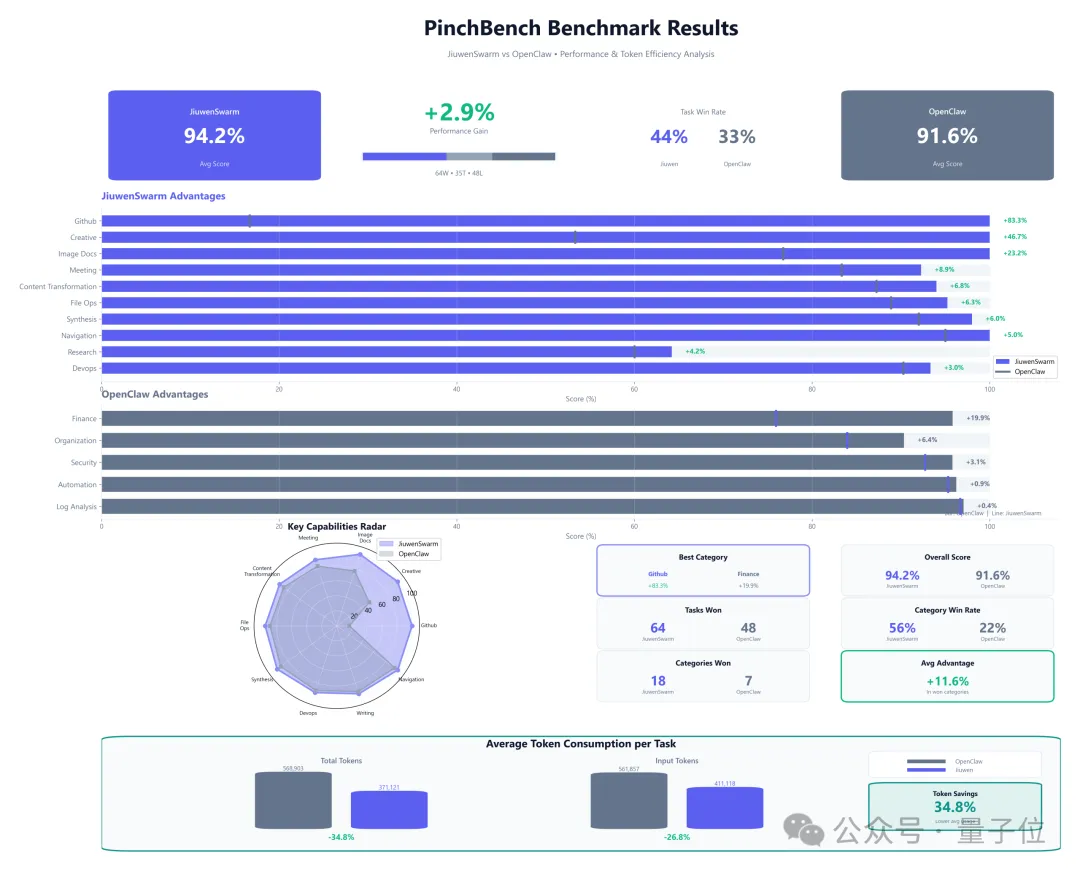
In the PinchBench results, JiuwenSwarm achieved state-of-the-art performance in the industry with a 94.2% overall score, nearly 3 percentage points higher than OpenClaw (91.6%). It also shows a clear advantage in token consumption, with average token usage reduced by 34.8% —
higher accuracy, lower cost.
At the same time, openJiuwen also delivers impressive results in memory mechanisms. On the authoritative long-context benchmark LOCOMO, its memory accuracy reaches 85% (using an 8B large model for memory processing, QA, and result judgment), outperforming major mainstream memory systems in the industry.
These results are no accident, but the product of openJiuwen Harness’s continuous refinement in areas such as the DeepAgent architecture, context engineering, and long-term memory mechanisms, giving each “team member” in JiuwenSwarm solid task execution ability.
Conclusion: Fully open-source — let’s become “beekeepers” in the AI era together
Looking back, from Harness Engineering to Coordination Engineering, and now to JiuwenSwarm, the openJiuwen community has done something truly ahead of its time.
Just as the industry is beginning to shift its focus from “a stronger single agent” to “a stronger agent team,” openJiuwen has already paved the entire path ahead:
A guiding philosophy (Coordination Engineering)
A full-stack technical system (Agent Swarm / Swarm Skills / Swarm Skills Hub / Swarm Skills self-evolution)
A flagship agent (JiuwenSwarm)
And, the entire stack is open source.
Multi-agent collaboration is already a consensus, but among the few who can turn that consensus into a complete runnable, installable, co-buildable, fully open-source engineering delivery from day one, there are not many.
The vast ocean of AI Agents will never belong to a single all-powerful “super individual,” but to collective intelligence — a group of entities, each with their own strengths, collaborating and evolving together.
And JiuwenSwarm marks the first flag on that road, making it easy for every user to “raise” their own swarm of intelligent agents.
About openJiuwen
openJiuwen is a Huawei-supported open-source AI Agent platform community, jointly built by Huawei’s 2012 Laboratory and the Huawei Cloud AgentArts team. Its flagship agent, JiuwenSwarm, embodies the full capabilities of the openJiuwen platform in key areas such as Harness engineering, multi-agent collaboration, and self-evolution.
JiuwenSwarm, fully open source — welcome to co-build
JiuwenSwarm (AtomGit): https://atomgit.com/openJiuwen/jiuwenswarm
JiuwenSwarm (GitHub): https://github.com/openJiuwen-ai/jiuwenswarm
Swarm Skills Hub: https://swarmskills.openjiuwen.com/
You are welcome to upload your own team skills to Swarm Skills Hub and let swarm experience flow through the community.