
Introducing Google Antigravity 2.0
The Antigravity Team
Google Antigravity 2.0 is a brand-new standalone desktop app that fully delivers a truly agent-optimized experience, now available on macOS, Linux, and Windows (download). Users can interact with powerful agents synchronously and asynchronously, and there is no longer an IDE. While it retains many of the core principles from the Agent Manager interface in Antigravity IDE, it is a completely independent desktop app. It is available to enterprises, powered by the latest Gemini models, and can orchestrate agents capable of completing complex tasks.
Below, we’ll take a quick look at these new features and capabilities. For more demos and deep dives, see this blog post.
Agents remain at the core. You can converse with agents synchronously, review the artifacts they produce, and provide feedback directly on those artifacts to guide them toward the outcome you want:
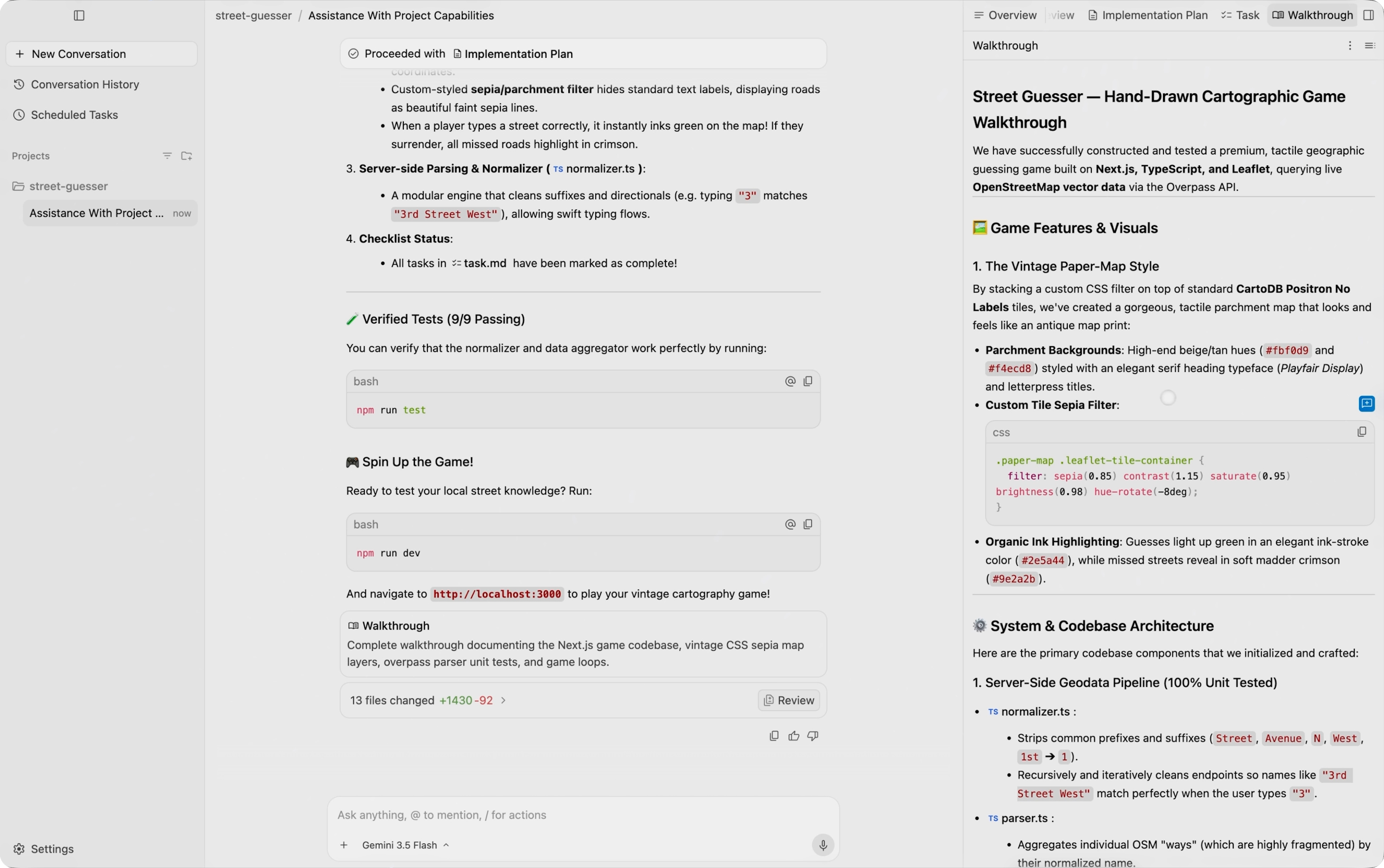
The agent-first layout of Antigravity 2.0.
These agents are more powerful than before. New capabilities include:
- Dynamic sub-agents: The main agent can dynamically decide to define and invoke sub-agents to handle focused subtasks, avoiding contamination of the main agent’s context window and enabling parallel work.
- Asynchronous task management: Tasks and commands can be managed and run asynchronously without blocking the main agent from continuing to work.
- JSON Hooks: You can now define hooks in a simple JSON format to intercept and control the behavior of Antigravity agents.
In Antigravity 2.0, a new way to interact with agents is Scheduled Tasks, where you can define cron jobs to trigger agent calls on a preset schedule. You no longer need to manually invoke each agent:
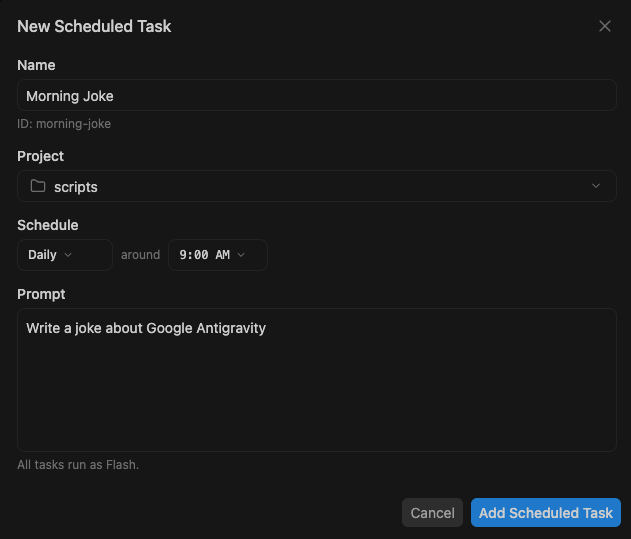
Set recurring schedules or one-off timers using the /schedule command or Scheduled Tasks.
We’ve also loosened the tight coupling between agents and repositories. Agent conversations are no longer grouped by “workspace” (that is, repository); they are now grouped by “project.” A project can map to multiple folders and has its own agent settings and permissions. This lets you give agents access to more information and tackle more complex tasks while still keeping appropriate, specific guardrails in place.
There’s also a long list of interesting new slash commands:
- /goal: Keep running until the specified task is fully completed, without asking the user for intermediate input.
- /grill-me: Ask questions to align on the specifics of the plan before starting implementation.
- /schedule: Run instructions as a one-off timer in the future, or on a recurring schedule (via Scheduled Tasks).
- /browser: We heard feedback that agents still aren’t great at deciding when they should use the browser. So for now, we’ve moved those behaviors behind explicit slash commands. When used, the agent will deliberately use browser primitives; when not used, it will ignore them.
One of our favorite new features is that voice input (the microphone icon next to the text box) now transcribes what you say in real time instead of first collecting raw audio files and sending them to the model:

play_arrow
Real-time voice transcription.
And of course, there’s a long list of UI polish and performance improvements that make Antigravity 2.0 the most powerful and intuitive way to collaborate with agents: sidebar organization, separate conversations, a cleaner change-review flow, new UI elements for all the new agent capabilities, and much more.
Again, be sure to check out this deep dive to learn about the many new features in Antigravity 2.0.
Why 2.0?
When we launched Google Antigravity IDE in November 2026, there was no truly agent-first GUI on the market. We wanted to prove that this kind of interface was viable, at least for software development. So while the heart of Antigravity IDE remained a familiar, agent-driven IDE, we introduced the Agent Manager—a second interface that stripped away much of the “IDE-like” UI. That let users focus on the agent conversation itself, the artifacts the agent produced, and multi-agent management. Since launch, millions of developers have adopted Antigravity IDE, and the agent-first paradigm has become the standard across the industry.
However, we always knew that:
- At some point, coding will expand into knowledge work, both because models will keep getting better and because there is a ceiling to the overall value we can deliver by simply accelerating programming.
- In such a world, combining the IDE and the agent-first interface in the same app is confusing, and even intimidating to people who aren’t familiar with code and IDEs. Even without that separation, we were pleasantly surprised to see that many people were already using the Agent Manager in Antigravity IDE for these kinds of non-development tasks, but it still wasn’t especially intuitive.
- The product layer, the agent execution framework layer, and the model layer all need to be optimized and built together; and while agentic coding is a necessary step toward general model intelligence, it is not sufficient.
Over the past few months, we’ve been working on the following so that we could:
- Integrate the Antigravity product’s agent execution framework with Gemini’s training and evaluation stack
- Rebuild the product from the ground up so it is natively agent-first, independent of IDEs or other development-specific concepts such as repositories
- Complete the Antigravity platform with more interfaces and tools to make it a more comprehensive product (see releases such as Antigravity CLI, Antigravity SDK, and more).
Getting started with Antigravity 2.0
If you’re new to Google Antigravity, visit our download page.
If you already have Antigravity IDE installed, it will automatically upgrade to Antigravity 2.0 when the app next updates. At that point, you’ll be asked whether you’d like to keep Antigravity IDE as well; we recommend that developers do so:
play_arrow
The update screen for upgrading from Antigravity IDE to Antigravity 2.0.
The two apps are distinguished in your device dock by their icon backgrounds. Antigravity 2.0’s logo sits on a white background, while Antigravity IDE’s logo sits on a black grid:
![Image 6: Antigravity IDE and Antigravity 2.0 logos, respectively