
Building Blocks for Foundation Model Training and Inference on AWS
Enterprise Article Published on May 11, 2026
For foundation models, for a long time, “scaling” basically meant one thing: invest more compute in pretraining, and capability will improve. This intuition has been supported by empirical studies such as Kaplan et al. (2020), which reported that as model parameters, dataset size, and training compute scale up, the loss function follows a predictable power-law trend. In practice, these trends have justified continued investment in large-scale accelerator compute and the distributed infrastructure required to use it efficiently. But the frontier has evolved—scaling no longer follows a single curve. NVIDIA’s framing of the “three scaling laws from one” captures this well: beyond pretraining, performance is increasingly scaled through post-training—such as supervised fine-tuning (SFT) and reinforcement-learning (RL)-based methods—and test-time compute (“long thinking,” search/verification, multi-sample strategies).
Figure 1: Adapted from NVIDIA’s blog post “The 3 Scaling Laws of AI, Explained”.
Taken together, these scaling paradigms are pushing the foundation-model lifecycle—pretraining, post-training, and inference—toward converging infrastructure needs: tightly coupled accelerator compute, high-bandwidth low-latency networking, and distributed storage backends. They also raise the importance of resource-management orchestration and underscore the critical role of observability at both the application and hardware layers for maintaining cluster health and diagnosing performance anomalies at scale.
Another key trend is that the foundation-model lifecycle is increasingly relying on an open-source software (OSS) ecosystem spanning model development frameworks, cluster resource management, and operations tooling. At the cluster layer, resource management is commonly provided by systems such as Slurm and Kubernetes. Model development and distributed training are typically implemented with frameworks such as PyTorch and JAX. Monitoring and visualization—observability—are commonly handled with Prometheus for metrics collection and Grafana for visualization and alerting, serving as an operations layer on top of infrastructure and resource management. Figure 1 illustrates this layered architecture, showing how hardware infrastructure supports resource orchestration, which in turn enables ML frameworks, while observability spans all layers.
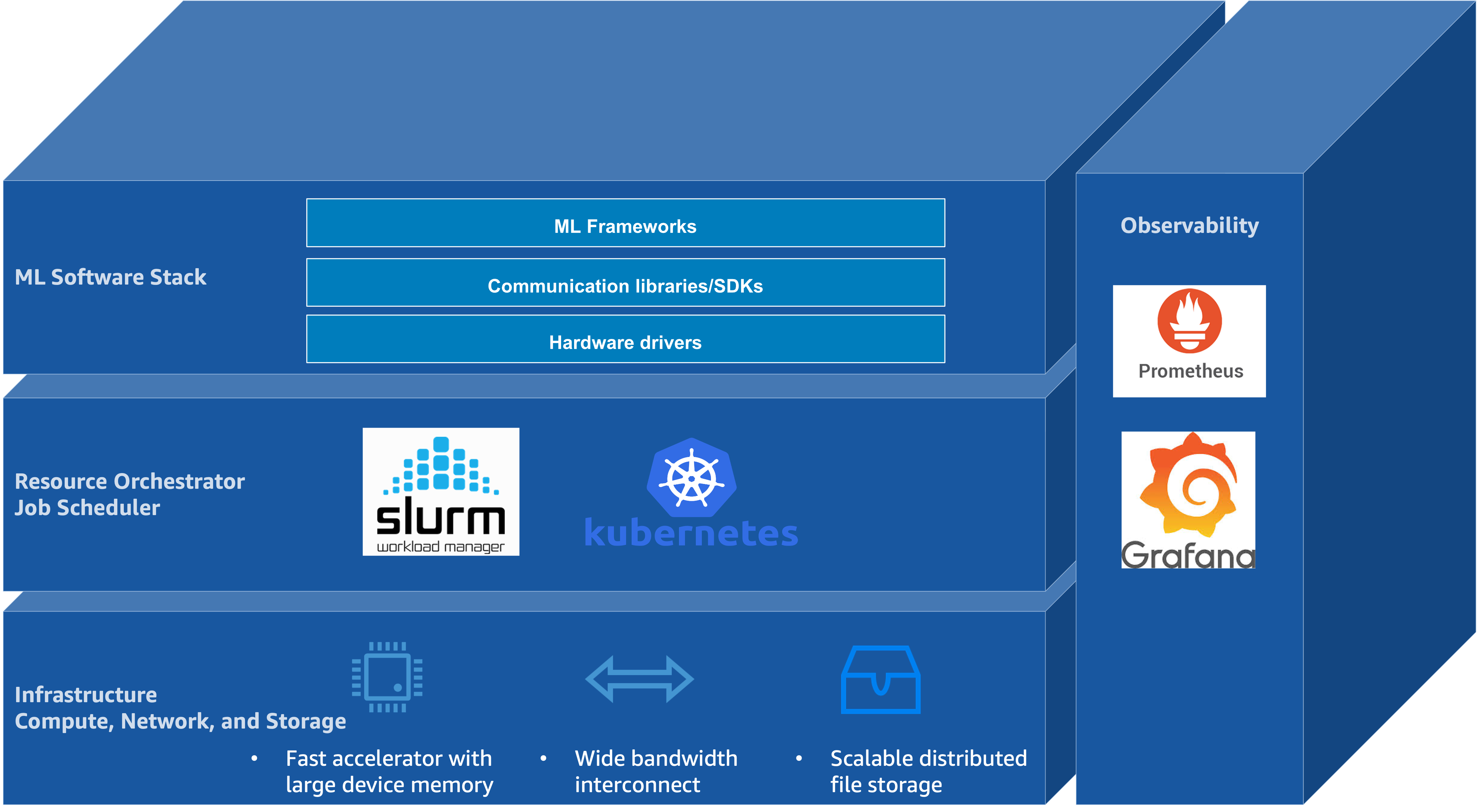
Figure 1: Layered architecture of the open-source software stack for foundation model training and inference
This article is intended for machine learning engineers and researchers involved in foundation model training and inference, with a focus on…