I run a YouTube channel where I analyze the development of AI from an ordinary technical perspective. This article is based on a recent video in which I take an in-depth look at Moravec’s paradox. Moravec’s paradox is a repeatedly quoted maxim: what is difficult for humans is easy for AI, and vice versa.
Here are my findings:
- Moravec’s paradox has never been empirically tested. (Many AI researchers I know and respect, including some pioneers, frequently cite it as fact. But that doesn’t mean I’ll accept their claims uncritically!)
- It actually reflects which things the AI community considers worth investing research effort in. It does not predict which problems will be easy or difficult for AI.
- Its accompanying evolutionary explanation is highly questionable. (AI researchers frequently speculate about the human brain without any background in neuroscience or evolutionary biology.)
- Moravec-paradox-style thinking has led both to alarmism about “superintelligent reasoning arriving soon” and to a false sense of security (in robotics, for example).
- To adapt to AI’s progress, we don’t need to predict when capability breakthroughs will occur. Because new capabilities take a long time to diffuse, we have plenty of time to respond—we just routinely waste that time and then panic!
Watch the full video, or continue reading below.
Every week brings new claims about AI progress. How can we know what comes next? Can AI predict crime? Write an award-winning novel? Hack critical infrastructure? Will we eventually have robots that can help us fold laundry and load the dishwasher at home?
What will AI’s progress mean for your job? And what will it mean for the structure of society? Facing all this uncertainty is genuinely difficult. If only we could predict which new AI capabilities will be developed soon and which will remain difficult to achieve for the foreseeable future.
Historically, AI researchers have been pretty bad at predicting the progress of AI capabilities. We don’t really have any principles that tell us which types of tasks are easy or difficult for AI.
However, we do have one—the Moravec paradox. It refers to the observation that training computers to do things humans consider difficult, such as mathematics and logic, is easy, while training computers to do things humans consider easy, such as perceiving the world or walking, is difficult.
The concept originated in Mind Children, a 1988 book by robotics researcher Hans Moravec. He was a robotics researcher then, and still is today. He wrote:
It is comparatively easy to make computers exhibit adult-level performance on intelligence tests or at playing checkers, but difficult or impossible to give them the skills of a one-year-old when it comes to perception and mobility.
In the early days of AI, researchers focused on chess and other reasoning tasks because these were thought to be the most difficult tasks—and to represent uniquely human abilities. But interestingly, if you want to build a robot capable of defeating a human grandmaster, determining which move to make is actually the easy part. The truly difficult part is carrying out the physical actions on the chessboard. This is now widely understood, which is why Moravec’s paradox seems so intuitively plausible.
If Moravec’s paradox holds, its implications would be remarkable. To find out which AI capabilities are likely to emerge first, we would only need to look at how difficult those tasks are for humans. Science would therefore be automated before folding laundry, and so on.
But there’s a problem: Moravec’s paradox has never been fact-checked, despite being repeatedly presented as fact in videos with hundreds of thousands of views and in TED Talks. When I looked closely at the evidence behind this so-called paradox, I discovered something surprising.
In this article, I’ll discuss why both the theory and the evidence behind this paradox are unreliable. Then I’ll explain why simplistic predictions about what is easy or difficult for AI have misled AI researchers and technology leaders. This way of thinking has led to alarmism on the one hand and a false sense of security on the other. (Now there’s a real paradox.) Finally, I’ll answer the following question: If we can’t rely on Moravec’s paradox, how should we prepare for AI’s progress and its consequences?
The Evidence Behind the Paradox Is Unreliable
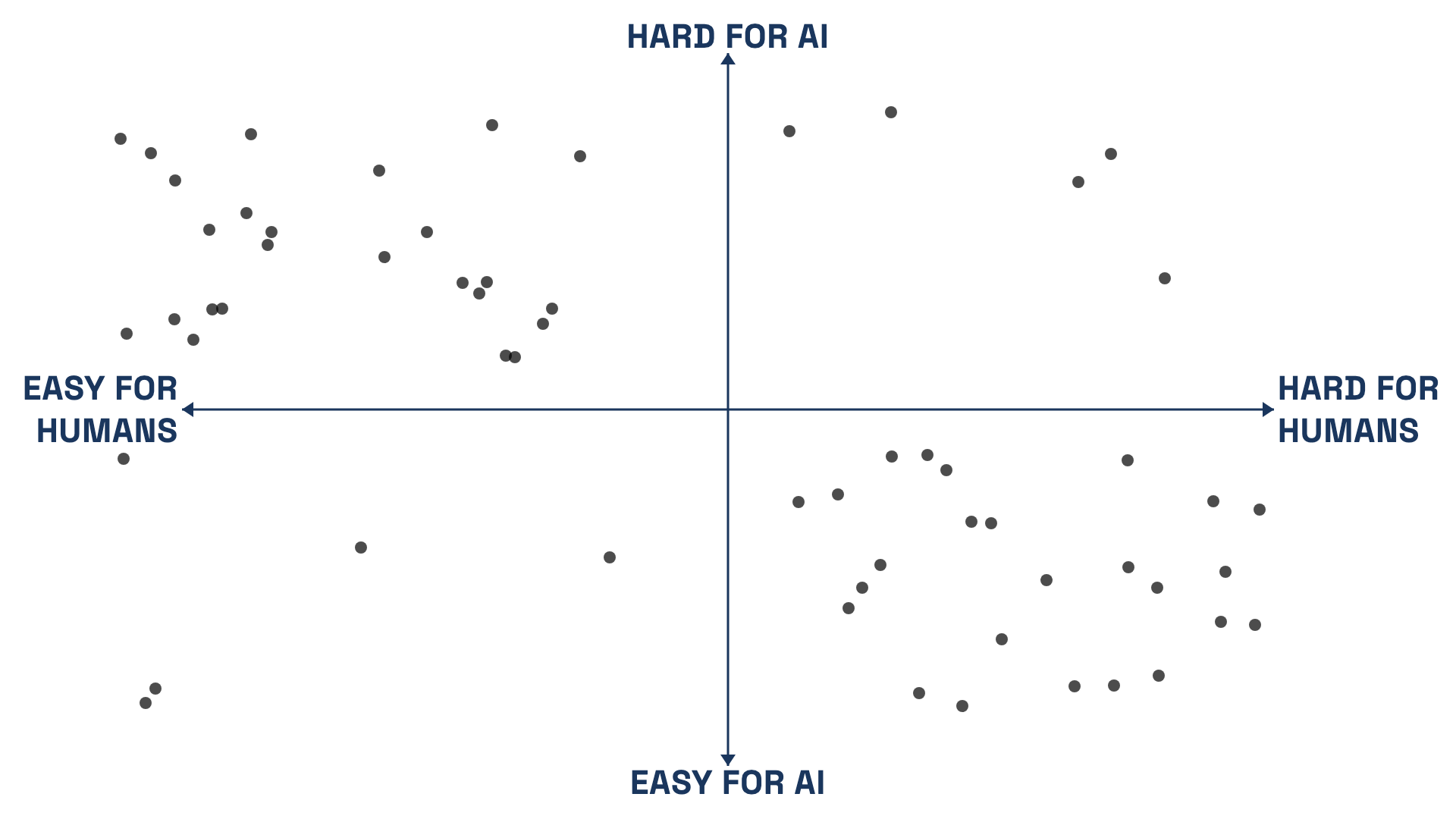
How should we test Moravec’s paradox? We could take a sample of existing tasks, determine how difficult each task is for humans and how difficult it is for AI, and then plot the results on a chart. If we saw something like the result below, we could consider the paradox confirmed.