
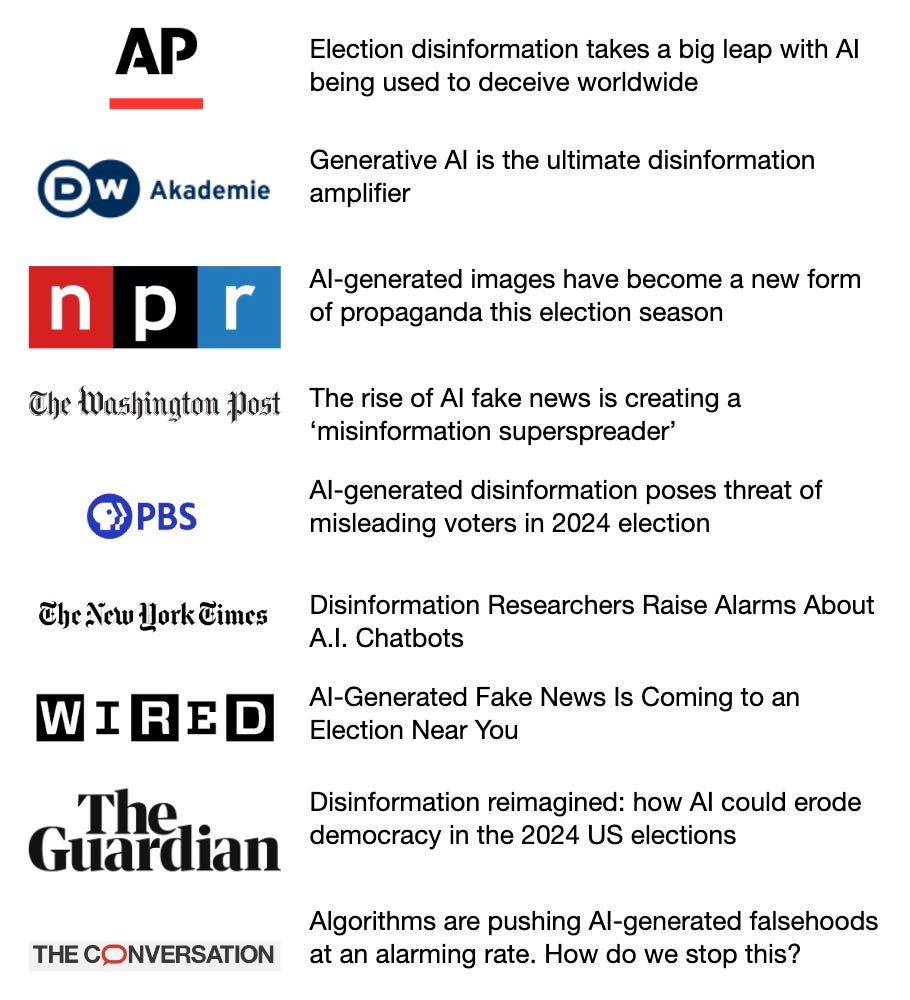
AI-generated false information was one of the most closely watched issues during the 2024 U.S. presidential election. In January 2024, the World Economic Forum claimed that “mis- and disinformation are the world’s most severe short-term risks,” and that “AI is amplifying manipulated and distorted information that could undermine societal stability.” News headlines about the 2024 election told a similar story:
By contrast, in our earlier writing we predicted that AI would not trigger a misinformation “apocalypse.” When Meta released its open-weight large language model, called LLaMA, we argued that it would not unleash a flood of misinformation. In a follow-up article, we pointed out that the spread of misinformation is the key bottleneck for action; generative AI lowers the cost of producing misinformation, but not the cost of spreading it. Other researchers have also made similar arguments.
Which of these two views is closer to reality?
Fortunately, we can answer that question using evidence from how AI was used in elections around the world in 2024. Many news organizations and research projects have cataloged known instances of AI-generated text and media, along with their impact. Rather than guessing at AI’s potential effects, we can look at what it has actually done in the real world so far.
We analyzed all of the election-related AI uses collected by the WIRED AI Elections Project. This project tracks known uses of AI to create political content during elections around the world in 2024. For each case, we identified what AI was used for and estimated how much it would have cost to produce similar content without AI.
Our findings are: (1) half of AI use was not deceptive; (2) even deceptive content generated with AI was just as cheap and easy to replicate without AI; and (3) rather than focusing on the supply of misinformation, focusing on demand does a better job of diagnosing the problem and identifying interventions.
To be clear, AI-generated synthetic content does pose many real risks: including the creation of non-consensual sexual images and child sexual abuse material targeting individuals, as well as fueling the “liar’s dividend,” which lets those in power dismiss real but embarrassing or controversial media about them as AI-generated. These are important challenges. This article focuses on a different issue: political misinformation.